Gerda Begins Searching for Kay
The Snow QueenGerda Begins Searching for Kay is the turning point at which grief becomes a journey. Unable to learn where Kay has gone, Gerda rejects the assumption that he is dead and acts on the possibility that he can still be found. Her search begins not with a map or a guide but with her most treasured possession: the Red Shoes, which she offers to the river in the hope that it will return her playmate. The river does not bring Kay back, but its current carries Gerda away from home and into the wider world.
Loss and the decision to search
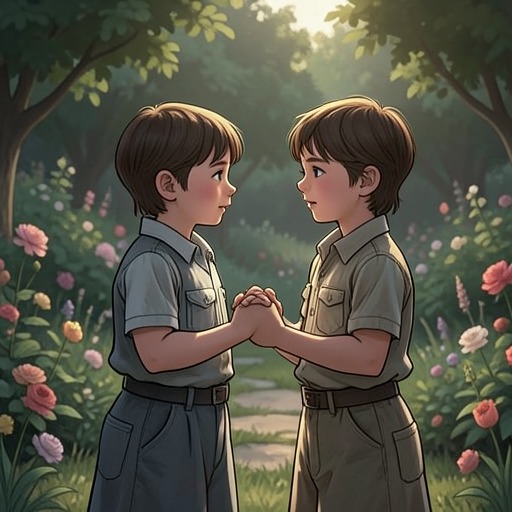
After Kay vanishes, no one can say where he went. The boys offer only that he tied his sledge to a much larger one, which drove through the streets and out of the town gate. His unexplained departure leaves his fate uncertain; many people weep, and Gerda mourns him for a long time. She believes he has drowned in the river near the school, a fear that makes the water both the imagined place of his death and the first place she seeks him.
The arrival of spring changes the atmosphere but does not settle the question. Gerda tells the sunshine that Kay is dead, and it contradicts her; she tells the sparrows, and they also refuse to believe it. Their responses do not provide proof that Kay is alive, but they unsettle the certainty of her despair. Gerda begins to doubt her own conclusion. Rather than wait for news, she decides to go to the river and ask for Kay herself.
The opening account of the Demon’s looking-glass gives this search a larger story-world context. The mirror magnifies what is bad and diminishes what is good; even a tiny fragment can distort sight, while a fragment in the heart can make it cold. Against that premise, Gerda’s response to uncertainty is significant: she does not treat her fearful guess as the whole truth. Her search proceeds through trust and attachment, not through certainty about what happened.
The offering and the drifting boat
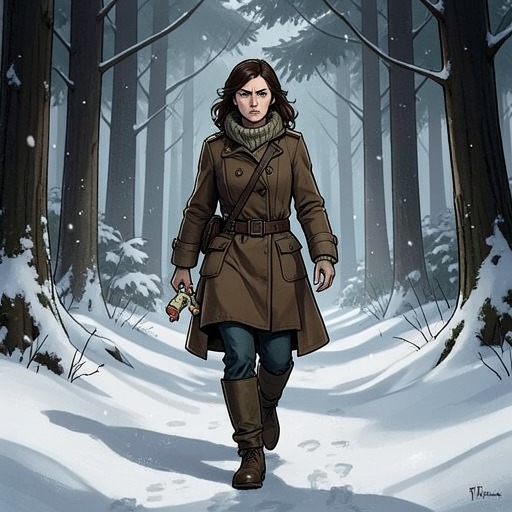
Gerda leaves early, after kissing her sleeping Grandmother, and goes alone beyond the town gates. She asks the river whether it has taken Kay and offers it her Red Shoes—shoes she loves dearly—in exchange for his return. The small waves seem to nod, but the bargain fails. When Gerda throws the shoes in, they fall near the bank and are carried back to shore. The river’s apparent answer is both tender and powerless: it will not keep what she loves, yet it cannot give Kay back.
Gerda assumes she has not thrown the shoes far enough. She climbs into a boat lying among the reeds and tries again from its farther end. The boat is not fastened. Her movement sends it gliding away, and by the time she reaches the end, it has pulled more than a yard from the bank and is drifting faster. The attempt to control the search has instead carried her beyond her control. Frightened, Gerda cries for help, but no one hears except the sparrows. They fly along the shore, singing to comfort her, while the current bears her onward.
The Red Shoes float behind the boat, still visible but unreachable because the boat moves ahead of them. Gerda sits quietly with only her stockings on her feet. This reversal gives the shoes a double place in the episode: they are the price she offers for Kay, and the marker of the home she has left behind. Her journey begins through an act of love, but not by a route she intended.
From river to wider world
The banks are green and pastoral, with flowers, old trees, sloping fields, and grazing cows and sheep, but no people are in sight. Gerda takes heart from the possibility that the river may carry her to Kay. She lifts her head to look at the landscape, and the boat continues for hours. Her hope does not rest on evidence that Kay is nearby; it is what allows her to endure the uncertainty of being carried onward.
At last the boat reaches a cherry orchard and a small red house with red and blue windows, a thatched roof, and wooden soldiers outside. Gerda calls to the soldiers, mistaking them for living people, before seeing that they are figures made of wood. The Conjuring woman comes out, catches the boat with her crutch, draws it to shore, and lifts Gerda onto dry land. Gerda is relieved to stand on solid ground, though she is wary of the stranger. She explains what has happened and asks whether Kay has passed that way. The Conjuring woman says he has not, but might come, and invites Gerda to eat cherries and look at the flowers. The river has not delivered her to Kay; it has delivered her to a new encounter, one that temporarily diverts her from her search.
Confirmation and continuation of the search
Later, the Wood Pigeons provide the first concrete account of Kay’s direction after his disappearance. They say that a white fowl carried his sledge and that he rode in the Snow Queen’s carriage as it passed through the wood. They also say the Snow Queen blew on them, killing all the young pigeons except the two survivors. When Gerda asks where the carriage was going, they can offer only a likely destination: Lapland, where snow and ice are always present. This report transforms the search from a journey toward an unknown possibility into a pursuit with a named destination, though the pigeons’ qualification leaves uncertainty intact.
In Finland, Gerda faces the Snow Queen’s living snowflake guards without shoes or gloves. The flakes gather around her on the ground despite a clear sky lit by the northern lights. Remembering how large snowflakes looked through a burning-glass, she recognizes that these are larger and more frightening still: living creatures in shapes like porcupines, twisted serpents, and bristling bears. Gerda recites the Lord’s Prayer. Her breath takes the form of angels, whose numbers grow until they form a legion; they drive the snowflakes apart, ease the cold in her hands and feet, and clear her way toward the Snow Queen’s castle. The river’s accidental departure from home has thus opened into a deliberate, perilous pursuit. The event’s decisive change is not that Gerda finds Kay at once, but that loss no longer leaves her waiting: she keeps going, from uncertain hope to usable clues and onward into danger.