Gerda Escapes the Conjuring Woman's Garden
The Snow QueenGerda’s escape from the Conjuring Woman’s garden is the turning point that breaks an enchanted delay in her search for Kay. A garden designed to keep her content has made time seem to stand still; a rose, brought back to life by Gerda’s tears, restores the memory that the Conjuring Woman had tried to erase. Once Gerda recognizes how long she has been detained, the safe, perpetual summer becomes a trap she must leave, even though the world beyond it is cold and bleak.
A refuge designed to detain
Gerda arrives at the Conjuring Woman’s house by river, carried in a boat through a landscape of flowers, old trees, fields, grazing cows and sheep, but no people. The house stands in a cherry orchard, with a thatched roof, red and blue windows, and wooden soldiers outside. The Conjuring Woman, leaning on a crutch beneath a flower-painted hat, draws the boat to shore and welcomes the tired child inside. Gerda tells her everything and asks whether she has seen Kay. The Conjuring Woman says he has not passed that way, but might come, and invites Gerda to eat cherries and stay.
The welcome is affectionate but not innocent. The Conjuring Woman is not described as a wicked witch: she uses her conjuring chiefly for amusement, but she wants Gerda for herself. As she combs Gerda’s long flaxen hair with a golden comb, the child thinks less and less about Kay. The Conjuring Woman understands that the roses at home might revive Gerda’s attachment and send her away. She touches the rose-trees in the garden with her crutch, and they sink into the earth until no one could tell where they had stood. The garden’s comfort is therefore built around an act of concealment: to keep Gerda, the Conjuring Woman removes the flowers most likely to bring her search back to mind.
Inside the garden, flowers of every season bloom together, and Gerda plays in warm sunshine for days. At night she sleeps in an elegant bed with red silk pillows embroidered with colored violets. The abundance makes the garden feel complete, yet Gerda senses that something is missing without knowing what it is. Its endless summer is not simply a pleasant setting; it suspends the ordinary signs by which she might measure time and remember the life beyond its borders.
The rose restores the search
The interruption comes through an oversight. The Conjuring Woman has removed the roses from the garden but has forgotten the rose painted on her hat. When Gerda notices it, the flower gives a name and shape to the absence she has felt. She runs through the garden looking for roses and finds none. Then she sits and weeps where one of the rose-trees had sunk beneath the ground. Her tears moisten the earth, and the tree rises again, blooming as before. The movement reverses the Conjuring Woman’s spell: the missing rose returns not through another act of conjuring, but through Gerda’s grief and remembrance.
Gerda embraces and kisses the roses. They call to mind the roses at home and, with them, Kay. She asks the flowers whether he is dead. The roses answer that he is not: they have been in the ground where the dead lie, and Kay is not there. This is a limited reassurance rather than a direction to him, but it matters. Gerda has recovered the purpose that the garden’s enchantment had blurred, and she has received confirmation that her search need not end in mourning.
Flower stories and the delay
Gerda asks the other flowers for news, but they know only their own stories. Their speech offers imaginative diversions, not information about Kay. A buttercup tells of a poor servant-maid who visits her grandmother on a bright spring morning; the kiss between them seems to gather gold from the sunlight, the flower, and the heart. The scene’s tenderness turns Gerda’s thoughts toward her own Grandmother, who, she realizes, must be longing for her and grieving as she once grieved for Kay. Gerda resolves to go home with Kay, but she also recognizes that asking the flowers has brought her no closer to finding him.
As she hurries on, a narcissus catches her by the leg. Gerda pauses to listen, but the flower describes a little dancing girl in a room with a bow window: the girl washes her bodice with water from a teapot, dries her dress on the roof, and poses before the narcissus, which admires its own perfume and appearance. The account is absorbed in the flower’s own self-regard and the girl’s small domestic scene. Gerda rejects it as irrelevant and runs toward the garden door. The episode makes the contrast plain: the flowers can produce vivid tales, but their elaborate inward worlds cannot answer the question that brought Gerda there.
The garden opens onto autumn
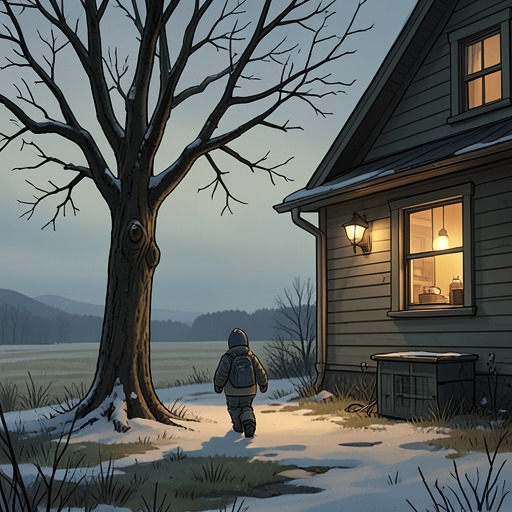
The garden’s barrier is a rusty latch. Gerda presses against it, the door springs open, and she runs out barefoot into the wider world. She looks back three times, but sees no one following her. Only after she has run until she can go no farther does she sit on a large stone and look around. The seasonal truth that the garden withheld is suddenly visible: summer has ended, and autumn is already far advanced. Gerda had known nothing of this while sunshine and flowers continued all year inside.
Her first response is regret at the time she has lost, followed by renewed urgency. She rises to continue, though her feet are wounded and sore. Outside, the willow leaves are yellow, dew falls, and leaves drop from the trees; the sloe-thorn still bears fruit, but its sloes are sour. Against the garden’s unchanging abundance, these signs make the passage of time tangible. The escape restores Gerda’s freedom, but it does not spare her the physical cost of leaving: she must resume her journey hurt, without shoes, in a landscape that appears cold and weary.
Consequences for the quest
The escape reopens the larger pursuit rather than resolving it. In the wider story, fragments of the Demon’s distorted looking-glass can make their bearers see only the worst side of things, and fragments lodged in the heart can make it cold. The garden’s enchantment works differently, through warmth, beauty, and forgetfulness, but it likewise obstructs clear attachment to what matters. Gerda’s recovery of memory is therefore a necessary return to the search, not yet a rescue of Kay.
Later, Wood Pigeons tell Gerda that they saw Kay in the Snow Queen’s carriage and identify Lapland as the likely direction of travel. Still farther along her journey, living snowflake guards confront her in Finland; she prays, and angels appear to drive them back so that she can continue toward the Snow Queen’s castle. These later dangers show what the garden’s delay has postponed her from facing. Its door marks the end of sheltered suspension and the return to a difficult, exposed journey, undertaken because Gerda has remembered whom she must find.