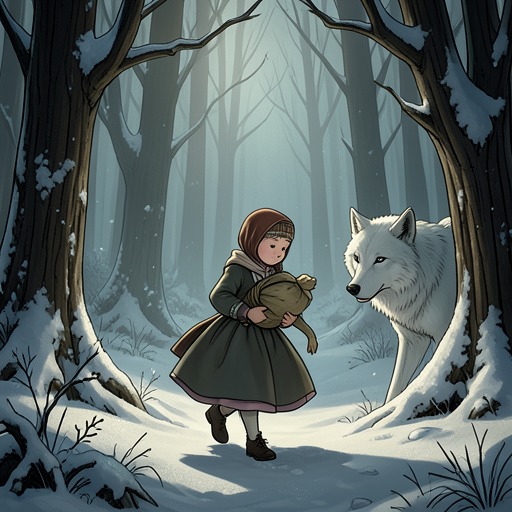
Gerda Receives Guidance from the Northern Women
The Snow QueenGerda Receives Guidance from the Northern Women is a turning point in Gerda’s journey: the women do not remove the danger or give her a new weapon, but clarify what has happened to Kay and why Gerda herself is capable of reaching him. Their help takes practical forms—a meal, a message written on dried fish, and a final ride to a landmark—while their most important guidance is that Kay’s captivity depends on fragments of the distorted looking-glass and that Gerda’s own innocence is the strength she needs.
The Route Through Lapland
After a journey that has exhausted the food carried by the Reindeer, the travelers stop at a low, poor-looking hut in Lapland. Its roof slopes almost to the ground, and its door is so low that people must crawl on hands and knees to enter. An old Lapland woman is alone inside, cooking fish by the light of a train-oil lamp. The Reindeer tells their story, beginning with his own, while Gerda is too pinched with cold to speak.
The Lapland woman explains that the journey is not nearly over: they must travel more than a hundred miles farther, to Finland, where the Snow Queen now lives and burns Bengal lights every evening. Because she has no paper, she writes a few words for the Finland woman on a dried stock-fish. The message is a small, improvised object, but it gives the travelers a way to carry information across the remaining distance. Once Gerda has warmed herself and eaten and drunk, the woman entrusts her with the fish, warns her to take care of it, and ties her back onto the Reindeer.
The Message Reaches Finland
The Reindeer carries Gerda at full speed beneath the blue northern lights. In Finland they reach the woman’s hut by knocking at its chimney; it has no door above ground. The heat inside is so intense that the Finland woman wears scarcely any clothes. She loosens Gerda’s dress and removes her fur boots and mittens so the child can bear the temperature, then places a piece of ice on the Reindeer’s head.
The Finland woman reads the writing on the dried fish three times and learns it by heart. She then puts the fish into her soup, unwilling to waste it. This practical gesture closes the message’s journey: the note has delivered its information, and even the material carrying it becomes food. The Reindeer again tells his own story before Gerda’s. He praises the woman’s command of the winds, describing how knots in a piece of twine could release fair wind, stronger wind, or a storm capable of uprooting forests. He asks her to give Gerda strength equal to that of twelve men, so she can overcome the Snow Queen.
What the Finland Woman Reveals
The Finland woman answers the Reindeer’s plea by explaining Kay’s condition. Kay is with the Snow Queen, but he finds everything there so pleasing that he believes it is the finest place in the world. The apparent contentment is not evidence that he has freely chosen his captivity: a fragment of broken glass lies in his heart and another in his eye. Until these fragments are removed, he will not become a human being again, and the Snow Queen will retain her power over him.
This diagnosis connects Kay’s present estrangement to the earlier account of the broken looking-glass. Its fragments distort whatever a person sees, and a fragment lodged in the heart makes it cold. The Finland woman’s explanation makes both effects concrete in Kay: the shard in his eye alters his perception, while the one in his heart accounts for his changed capacity to feel. His belief that the Snow Queen’s realm is ideal is therefore part of the affliction, not a reliable judgment of the place or a sign that Gerda’s search is unnecessary.
Gerda’s Strength
When the Reindeer asks again for power to help Gerda conquer the Snow Queen, the Finland woman rejects the idea that some external gift would make the child equal to her task. A power as great as that of twelve men, she says, would be of little use. She unrolls a large skin covered with wonderful characters and reads from it until perspiration runs down her forehead, but her knowledge does not produce a charm or weapon for Gerda.
Instead, she points to what Gerda has already done: people and animals have served her, and she has made her way through the world barefooted. The Finland woman names Gerda’s power as her purity and innocence of heart. No one else can supply something greater, and no aid will suffice if Gerda cannot reach the Snow Queen and remove the glass fragments from Kay. The help offered is thus deliberately limited. The women can guide and carry Gerda part of the way, but the decisive act belongs to her.
The Threshold and Its Test
The Finland woman tells the Reindeer that the Snow Queen’s garden begins two miles away and directs him to set Gerda down beside a large bush covered with red berries. She orders him not to linger in conversation and to return quickly. He carries Gerda to the place, then leaves her there and runs back. Before going, he kisses her; large, bright tears trickle over his cheeks. The farewell marks a change in the conditions of the journey: Gerda must proceed alone, without the Reindeer’s warmth or protection.
Gerda realizes that she has forgotten her boots and mittens when the cutting cold reaches her, but the Reindeer dares not stop. Left shoeless and gloveless in the ice-bound landscape, she runs forward toward the Snow Queen’s garden. A regiment of living snowflakes approaches across the ground beneath a clear sky lit by the northern lights. Their shapes are unlike ordinary flakes: some resemble porcupines, others twisted serpents, and others small, bristling bears. They are the Snow Queen’s guards, the Living Snowflake Sentries, and their dazzling whiteness does not make them harmless.
Gerda repeats the Lord’s Prayer. Her breath, visible like steam in the cold, grows until it forms Angels, who increase in number as they touch the earth. Carrying helmets, spears, and shields, they thrust their weapons into the Living Snowflake Sentries, which shiver into pieces. The Angels stroke Gerda’s hands and feet, easing the cold, and she can continue toward the Snow Queen’s castle with courage and safety. The guidance she received has brought her to the threshold; the first danger beyond it demonstrates the force of the faith and innocence the Finland woman had identified as her own power.