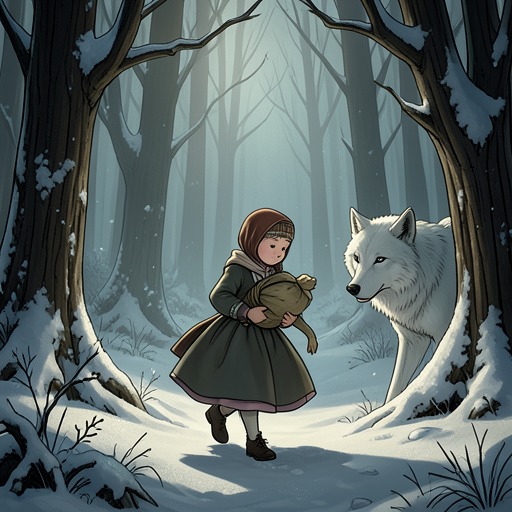
Gerda Searches the Palace at Night for Kay
The Snow QueenGerda Searches the Palace at Night for Kay is a decisive false lead in Gerda’s journey: guided by the Forest crow and the Tame crow, she enters the Palace of the Prince and Princess expecting to find Kay, only to discover that resemblance is not reunion. The search gives her shelter and renewed help, but its outcome sends her back onto the road rather than bringing her quest to an end.
The Lead and the Plan
The Forest crow believes the young man who came to court may be Kay. According to the crow’s account, the stranger spoke with unusual confidence and skill, much as the crow himself spoke; he said he had come not to woo the Princess but to hear her wisdom. The Princess was pleased with him, and he with her. The Forest crow had not witnessed the encounter directly: he had heard the story from his sweetheart, the Tame crow. Gerda recognizes in the stranger’s cleverness a quality she associates with Kay, who could do mental arithmetic and fractions, and asks to be taken to the palace.
The plan is uncertain from the start. The Forest crow warns that a little girl will have difficulty getting permission to enter, but Gerda trusts that Kay will come out as soon as he learns she is there. The crow flies away to seek the Tame crow’s advice. His return comes late in the evening, with food taken from the kitchen for Gerda and a route that avoids the official entrance: the silver-uniformed guards and gold-liveried servants would turn her away, but the Tame crow knows a back stair leading to the sleeping apartments and knows where its key can be found.
The Night Search
The Forest crow leads Gerda through the garden along a broad avenue as leaves fall and the palace lights are extinguished one by one. At the back door, which stands ajar, her anticipation mingles with anxiety. She imagines Kay’s clear eyes and long hair, his familiar smile from their days among the roses, and the happiness he will feel when he learns how far she has traveled and how much his absence has grieved those at home. Her hopes shape what she expects to see before she has reached the bedchamber.
At the top of the stairs, a lamp burns in a small closet. The Tame crow waits there, turns her head to inspect Gerda, and leads the way with the lamp. They pass a hall hung with rose-colored satin embroidered with artificial flowers. Dreams flit through the rooms so quickly that Gerda cannot make out the royal figures in them, while each hall seems more splendid than the last. The bedroom itself is lavish: its ceiling resembles a palm tree whose leaves are costly crystal, and two beds, one white and one red, hang like lilies from golden stems.
Gerda searches the red bed, which she believes must hold Kay. She pushes aside a leaf, sees a brown neck, and calls out to him. The dreams rush back into the room on horseback, waking the sleeper. The young man turns his head: he is not Kay, though his neck resembles Kay’s. The Princess also wakes and asks what has happened. Gerda weeps and explains her journey and the crows’ help. The scene turns her confident expectation into disappointment, but the discovery is unambiguous: the Prince is a lookalike, not the missing boy.
Reward Without Reunion
The Prince and Princess respond with pity rather than anger. They praise the crows for helping Gerda, while making clear that the unauthorized entry must not happen again, and offer the birds a choice between freedom and positions as court crows, with what remains from the kitchen. The Forest crow and the Tame crow choose fixed appointments, thinking of security in old age. The Prince gives up his bed so Gerda can sleep; she folds her hands, grateful that people and animals alike have shown her kindness. Her dreams return as angel-like figures, one drawing a little sledge on which Kay sits and nods to her, but the vision disappears when she wakes.
The next day, the palace offers Gerda silk and velvet, a stay of several days, and comfort. She asks instead for boots, a small carriage, and a horse so that she can continue into the wider world to seek Kay. The request brings more than she asks for: she receives boots and a muff, and the Prince and Princess send her away in a coach of pure gold bearing their coat of arms. The coachman, footman, and outriders wear golden crowns; the coach carries sweet cakes, fruit, and gingerbread nuts. The Prince and Princess help her into it and wish her success.
The Forest crow accompanies Gerda for the first three miles, unable to bear riding backwards. The Tame crow stays behind, suffering from a headache since her new appointment. At the departure, Gerda and the Forest crow weep; after a few miles he also says farewell, then watches from a tree, flapping his black wings while the coach glitters in the sunlight. The episode thus gives Gerda material assistance and a brief bond of companionship, but no reunion. Its sumptuous coach carries her onward, and the Forest crow’s farewell marks the end of this stage of help.
Place in the Wider Search
The night visit belongs to a chain of mistaken expectations and animal assistance. The Forest crow’s report makes the palace seem like a plausible destination, and the secret route lets Gerda test that hope for herself. The distinction between Kay’s recognizable abilities and the Prince’s mere physical resemblance exposes the limits of inference: a detail that looks like confirmation at a distance proves insufficient at close quarters. The night’s increasingly splendid halls heighten the anticipation, while the red bed delivers the reversal.
Gerda’s failure to find Kay does not stop her. She declines the court’s safer invitation to remain and chooses the means to travel farther. Later, the Wood Pigeons provide a more consequential account: they saw Kay riding in the Snow Queen’s carriage, which was carried by a white fowl through the forest, and believe it was bound for Lapland. The contrast clarifies what the palace search could not establish. Gerda’s belief that Kay might be at court is disproved; the birds’ report points her toward the Snow Queen and the northern regions, renewing the pursuit with a destination.