Kay
The Snow QueenKay is Gerda’s beloved childhood companion, a boy whose sharpness turns cruel after fragments of the Demon’s looking-glass lodge in his eye and heart. The glass makes him see faults where he once saw beauty; the Snow Queen’s frozen palace then gives that distorted vision a home. His restoration comes not through solving its icy puzzle alone, but through Gerda’s love and the recovery of their shared memories.
Identity and Childhood
Kay and Gerda are poor children in a large town. They are not brother and sister, but love each other almost as if they were. Their homes are garrets opposite one another, and the water-pipe between their roofs becomes the support for two wooden flower boxes planted with herbs and rose bushes. In summer, Kay can cross from his window to Gerda’s with a single jump; in winter, they must descend the long staircases and go out through the snow to meet. The arrangement makes their closeness part of everyday life, while the roses give that shared space its defining image.
The children’s bond is also shaped by stories and play. They sit together among the roses, look at a picture book of animals and birds, and hold hands as they recite a hymn about roses and the Christ-child. Kay’s Grandmother supplies stories and explanations, including the image of white bees swarming in the snow. These details establish a childhood world in which affection, imagination, and natural beauty belong together—precisely the things Kay will later dismiss or misread.
The Looking-Glass Changes Him
The story first explains the looking-glass made by the Demon: it diminishes whatever is good or beautiful and magnifies what is bad. After the mirror breaks, even its tiniest fragments retain that power. A piece in the eye distorts perception; a piece in the heart makes it cold. Kay receives both. When he first feels something strike his heart and something enter his eye, he thinks the trouble has passed, but the fragments remain. The change is not an ordinary illness: it alters what he notices and how he responds to the people closest to him.
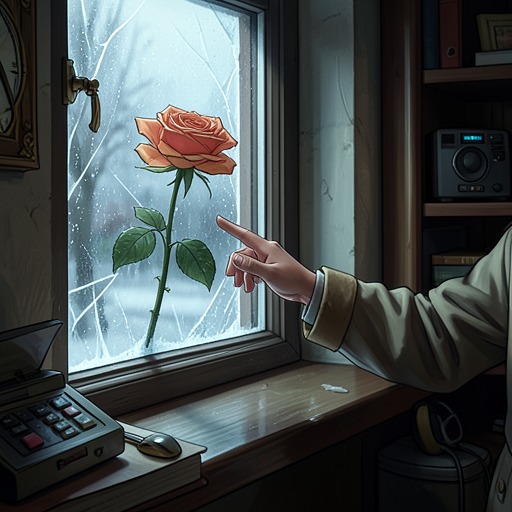
Kay begins to call Gerda’s tears ugly and to insist that nothing is wrong with him. The roses, once central to their shared garden, now appear worm-eaten, crooked, and ugly to him. He kicks the flower boxes, tears off the roses, and, seeing Gerda frightened, pulls off another before jumping through his window and leaving her. His actions give the inward corruption a visible consequence: the flowers that joined their homes become the first objects he deliberately destroys.
The change spreads beyond the garden. Kay dismisses Gerda’s picture book as fit only for babies and interrupts Grandmother’s stories. He puts on spectacles, imitates her, and makes people laugh; then he begins mimicking the speech and gait of people in the street, concentrating on whatever is peculiar or disagreeable about them. Onlookers mistake this fault-finding for unusual cleverness and call him a genius. The narration identifies the fragments—not a newly discovered talent—as the cause of his mockery. Even Gerda, who loves him wholeheartedly, becomes someone he teases.
Taken to the Snow Queen’s Palace
The Wood Pigeons later tell Gerda that they saw Kay in the Snow Queen’s carriage as it travelled through the wood. A white fowl carried his sledge, and the Snow Queen’s breath killed the young birds in the pigeons’ nest except for the two who survived. Their account places Kay’s removal within the same winter journey that takes him away from the familiar world of Gerda and the roses.
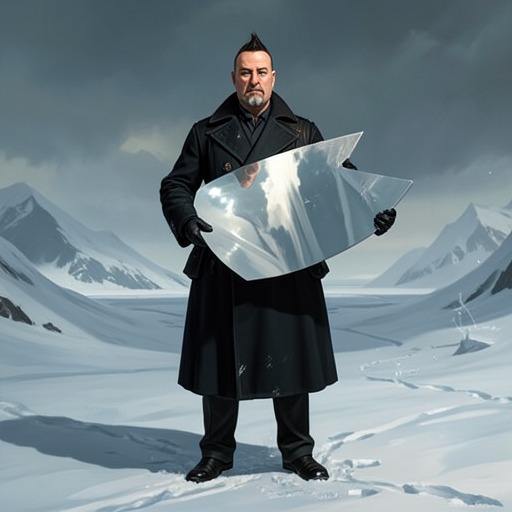
At the palace, Kay is almost black with cold, but he does not feel the chill: the Snow Queen has kissed away his shivering, and his heart is already ice. He spends his time dragging sharp, flat pieces of ice into arrangements, like pieces in a puzzle. His fingers are described as artistic, and he regards the figures he makes as important; the shard in his eye has preserved the distorted judgment that magnifies what seems hard, exact, and detached. The puzzle becomes his occupation and the measure of his attention in the vast frozen hall.
Kay can form many figures and words, but not Eternity. The Snow Queen has promised that, if he can spell it, he will be his own master and receive the whole world and a new pair of skates. When she leaves to visit Etna and Vesuvius, intending to make the volcanic peaks white, she leaves him alone with the ice pieces and the unfinished task. The promise makes the puzzle more than a pastime: it is the condition attached to his freedom, even as the looking-glass shard keeps him absorbed in a way of seeing that cannot complete it.
Gerda’s Rescue and Kay’s Restoration
Gerda reaches the palace and recognizes Kay at once. She runs to him, throws her arms around his neck, and calls to him, but he sits stiff and cold. Her arrival initially meets no recognition. The turning point begins when her hot tears fall on his breast, penetrate to his heart, and thaw the lump of ice. She sings the hymn the children had shared among the roses. Kay then bursts into tears; the fragment washes out of his eye, and he recognizes Gerda. His first response is to ask where she has been and where he has been, followed by his perception that the hall is cold, large, and empty. What once seemed absorbing now looks desolate.
Gerda’s kisses restore him bodily as well as emotionally: his cheeks bloom, his eyes shine, and his hands and feet become healthy and cheerful. The ice pieces dance, then arrange themselves into the letters of Eternity when the children lie down to rest. The word that Kay could not make while isolated is completed in the moment of reunion. It fulfills the Snow Queen’s stated condition for his mastery and freedom, but the scene places that achievement after the return of recognition and feeling, not as the product of detached calculation.
Kay and Gerda leave the palace hand in hand. They speak of Grandmother and the roses on the roof as they travel; the winds subside and the sun appears. At the bush with red berries, they meet the Reindeer, who has brought another young reindeer. The children drink the warm milk and kiss her, then travel to the Finland woman to warm themselves and receive directions, and to the Lapland woman, who has made them new clothes and prepared their sleighs. Both reindeer accompany them to the country’s boundary, where the first green leaves are budding. Kay’s return to warmth and companionship thus moves outward from the frozen hall toward the home and seasonal world from which he was taken.
Narrative Role and Significance
Kay’s arc makes the looking-glass’s abstract distortion personal. Its fragment does not merely change his opinions: it redirects his attention from the roses’ beauty to their imperfections, turns stories into occasions for interruption, and makes other people’s peculiarities material for ridicule. The visible shard in his eye and the ice in his heart give separate forms to corrupted perception and diminished feeling, while the Snow Queen’s kisses reinforce the condition created by the mirror.
His recovery reverses those effects through details established in childhood. Gerda’s tears thaw the heart; the familiar hymn and her presence restore recognition; the roses return in their remembered place in his thoughts. The ice puzzle’s completion matters, but it follows this restoration: Eternity appears only after Kay can again respond to Gerda and share a memory with her. The contrast makes his freedom more than a prize won by cleverness. It is joined to the recovered capacity to feel, recognize, and return with another person.