Palace of the Snow Queen
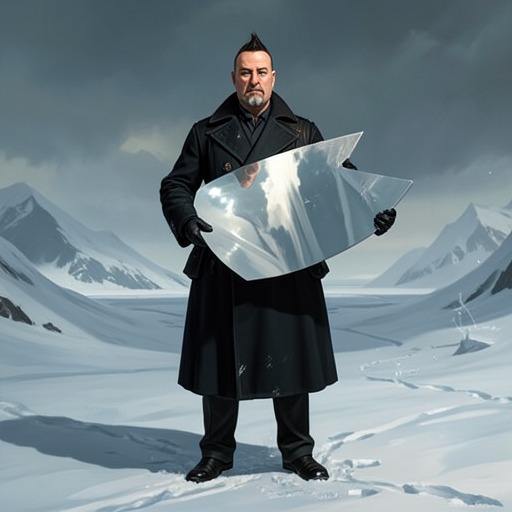
The Snow QueenThe Palace of the Snow Queen is an immense, ice-bound stronghold at the North Pole, on the island of Spitzbergen. Its rooms make a landscape of cold and apparent reason: drifted snow forms the walls, cutting winds form the windows and doors, and an empty frozen lake lies at its center. Kay is held there under the Snow Queen’s influence, but the palace also becomes the setting of his rescue. Gerda’s arrival and tears reverse the emotional and perceptual changes that have governed him, and the ice itself completes the word that makes him free.
Setting and Architecture
The palace stands apart from the Snow Queen’s summer tent in Lapland. The reindeer explains that Lapland is a place of snow and ice where the Snow Queen has her tent, while her strong castle is farther north, at the North Pole on Spitzbergen. This distinction makes the palace the remote seat of her power, not simply another stop in the children’s journey. Kay has been carried away in the Snow Queen’s carriage; the wood-pigeons report seeing him in it as it travelled through the forest, and the reindeer identifies the likely northern destination.
The palace’s architecture is made from the elements that define its surroundings. Its walls are formed from drifted snow, and its windows and doors from cutting winds. It contains more than a hundred rooms; the largest extend for several miles. Vivid northern lights illuminate these enormous interiors, but their brightness does not make them welcoming. They remain empty, cold, and glittering, with no games or social pleasures to soften their scale. The contrast between brilliant light and vacant space makes the palace seem less like a home than a domain organized around isolation.
The Lake and the Palace’s Order
At the center of the endless hall is a frozen lake whose surface is broken into a thousand forms. Each piece resembles the others, and each is described as perfect in itself, like a work of art. The Snow Queen sits there when she is at home and calls the lake the Mirror of Reason, claiming it is the best—and the only—one in the world. The name joins the palace’s physical cold to its governing idea: separate pieces can be arranged with precision, but the world they compose has no warmth or human companionship.
Kay’s work on the lake repeats this pattern on a smaller scale. He drags sharp, flat pieces of ice together and arranges them into figures and words, absorbed in what he considers an important exercise of reason. A shard of the demon’s looking-glass remains in his eye, distorting his judgment; the glass’s fragments can make their bearers see only the worst side of what they look at, while a fragment in the heart makes it cold. The palace therefore does not create Kay’s altered vision, but gives it an environment in which his cold concentration appears entirely at home.
Kay’s Captivity
The Snow Queen has kissed away Kay’s shivering, and his heart has become a lump of ice. Though his body is blue, almost black, from the cold, he does not feel it. Alone in the vast hall, he devotes himself to fitting the ice pieces together. He can form many complete figures and words, but cannot make the one word he most wants: Eternity. The Snow Queen has promised that if he succeeds, he will be his own master and receive the whole world and a new pair of skates. The promise makes his puzzle both an occupation and a condition of release, although the shard in his eye and the frozen state of his heart leave him unable to finish it.
The Snow Queen eventually leaves the palace to visit the craters of Etna and Vesuvius, intending to make them white. Her departure leaves Kay alone in the miles-long hall, still bent over the ice. The palace’s emptiness is thus not merely architectural: it is the circumstance of his captivity. He does not think of Gerda or imagine that she could be standing outside the palace, a sign of how completely his altered state has severed him from their former bond.
Gerda’s Arrival and the Rescue
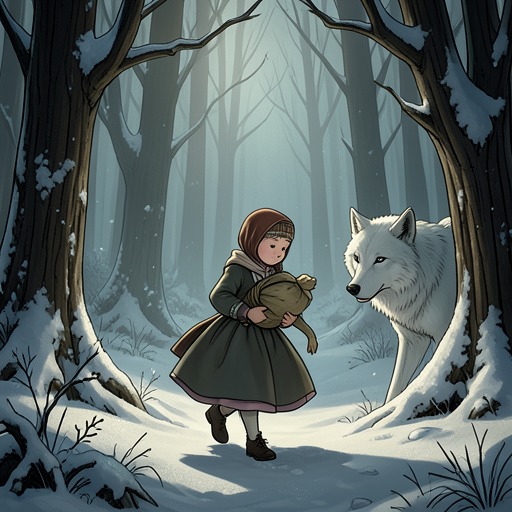
Gerda reaches the palace after crossing the frozen country without shoes or gloves. A regiment of living snowflakes, the Snow Queen’s guards, rushes at her over the ground. She repeats the Lord’s Prayer; the breath from her mouth takes the shape of angels, who gather into a legion and drive the guards apart. At the palace entrance, another prayer stills the cutting winds. Her passage into the great hall is therefore marked by a contrast with its cold order: the forces that obstruct her yield to the faith and feeling she carries with her.
Gerda recognizes Kay at once, runs to him, and throws her arms around his neck. He remains stiff and cold. Her hot tears fall on his breast, thaw the ice in his heart, and wash away the fragment there. She sings the remembered verse about roses blooming and ceasing to be, and the Christ-child whom they will see. Kay then bursts into tears; the shard swims out of his eye, and he recognizes Gerda. The place that had enclosed him in isolation becomes the scene in which recognition returns. As he looks around, he now perceives the hall as cold, large, and empty.
Release and Narrative Significance
After Kay and Gerda weep together, the pieces of ice dance. When the children tire and lie down, the pieces arrange themselves into the letters of Eternity, the word Kay could not form. The Snow Queen had attached freedom and the promised reward to his completing it; now the completed letters stand as a visible sign of his release. Gerda’s kisses restore Kay’s health and cheerfulness, and the palace no longer has the power to keep him in the state that made its frozen puzzle seem supremely important.
The children leave hand in hand. As they go, the winds rest and the sun appears; at the red-berried bush, the reindeer are waiting. Their departure carries them away from the palace’s enclosed winter and back toward other people and the signs of returning life. The stronghold’s decisive function is not simply to imprison Kay, but to concentrate the story’s opposition between cold, isolating judgment and the bonds of memory, faith, and affection. Its ice can be arranged into beautiful forms, yet only Gerda’s arrival allows the final word to be made—and the children to leave.