Robber Castle
The Snow QueenRobber Castle is a cracked, crowded stronghold in the forest where Gerda is held among robbers, their animals, and the volatile Robber-girl. Its importance lies in a reversal: the castle first seems to promise danger and confinement, but within its walls Gerda hears reliable news of Kay’s journey and finds the help that carries her farther north.
Setting and Architecture
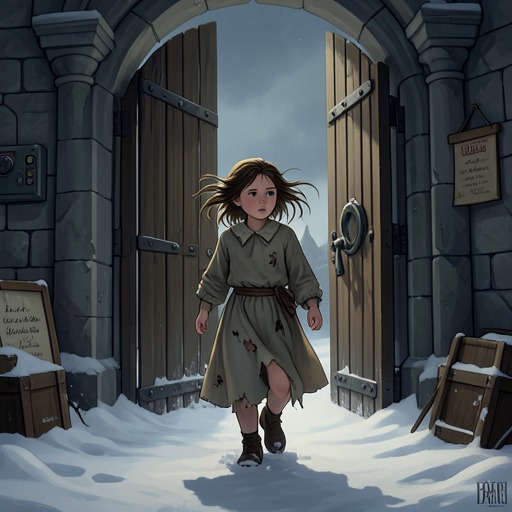
The castle stands in a forest reached by coach over stumps and stones. Its walls are cracked from top to bottom, and Ravens and Crows pass through holes and crevices in the masonry. The courtyard is guarded by great bulldogs, each described as seemingly large enough to swallow a man. They jump about but are not allowed to bark, giving the entrance an unnerving quiet even amid the movement of birds and animals.
Inside, a large, smoky hall is organized around a bright fire burning directly on the stone floor. There is no chimney: smoke rises to the ceiling and finds its own way out. A large cauldron holds boiling soup, while hares and rabbits roast on a spit. The room is at once a working domestic space and an intimidating one, with food, fire, and noisy company set against the disorder of smoke and the threat of the armed household.
A corner of the hall serves as the girls’ sleeping place, with straw and carpets on the floor. Above it, more than a hundred pigeons occupy laths and perches. Near an opening in the wall, Wood Pigeons are kept in a cage. The Robber-girl also keeps a Reindeer tied up nearby, with a bright copper ring around its neck. The castle’s architecture thus holds its inhabitants and animals in close proximity: the same rooms that shelter Gerda also display the means by which other creatures are confined.
The Robber-girl’s Household
The Robber-girl brings Gerda to the castle after taking her into the coach. Though about Gerda’s size, she is stronger, with broader shoulders, darker skin, black eyes, and a mournful look. Her authority is immediate and unsettling. She decides that Gerda will sleep beside her, claims Gerda’s muff and dress for play, and treats the captive girl as a possession; yet, after Gerda tells her how fond she is of Kay and why she has travelled, the Robber-girl wipes her tears and promises that the robbers will not kill her.
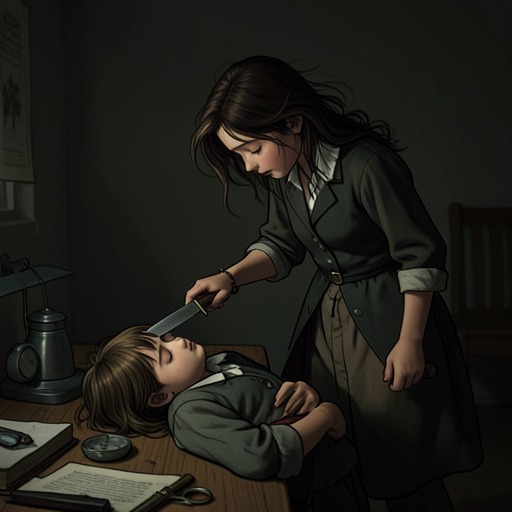
That promise does not make the castle safe. The Robber-girl keeps a long, sharp knife and says she sleeps with it beside her because no one can know what may happen. She demonstrates its threat by drawing it over the Reindeer’s neck, which makes the animal kick, and laughs at the fear she causes. Gerda is pulled into bed with her, while the knife remains in the Robber-girl’s hand. The mixture of tenderness and menace is characteristic of the place: care is offered, but it remains subject to the Robber-girl’s unpredictable will.
Gerda cannot sleep. As the Robbers sit around the fire singing and drinking and the old woman stumbles about, Gerda lies uncertain whether she will live or die. The castle’s warmth and food therefore provide no immediate comfort. For her, the crowded hall is a scene of danger; for the people who inhabit it, it is an ordinary night of eating and drinking. That difference makes the castle feel less like a simple refuge than a temporary enclosure whose safety depends on the Robber-girl.
News of Kay
During the night, the Wood Pigeons tell Gerda that they have seen Kay. A white fowl carried his sledge, and he sat in the Snow Queen’s carriage as it travelled through the forest. The Snow Queen blew upon the pigeons; all their young ones died except the two who recount what they witnessed. Their account turns the castle’s captive-animal corner into a source of news: the birds’ confinement has not prevented them from seeing the event that explains where Gerda must go.
The pigeons suggest that the Snow Queen was probably travelling to Lapland, where snow and ice are always present, and direct Gerda to ask the Reindeer. In the morning, Gerda passes on what she has heard. The Robber-girl initially dismisses it as talk, but the Reindeer confirms that he knows Lapland well because he was born and raised there and once ran across its snow-covered plains. The castle brings together three separate witnesses and perspectives: the Wood Pigeons’ sighting, Gerda’s urgent questions, and the Reindeer’s firsthand knowledge of the northern country.
Release and Departure
The next step begins with the Robber-girl’s knowledge of the household’s routine. The men have gone away, while her mother remains at the castle; after drinking from a large bottle at noon, the mother sleeps for a little while. The Robber-girl uses that interval to arrange Gerda’s departure. Her decision marks a change in her treatment of the captive: the girl who had claimed Gerda’s clothes and kept a knife beside her now chooses to help her pursue Kay.
She unties the Reindeer and instructs him to carry Gerda toward the Snow Queen’s castle. The Reindeer jumps for joy. The Robber-girl lifts Gerda onto his back, ties her on, and provides a cushion. She keeps Gerda’s soft muff but gives her fur boots and her mother’s large warm mittens, which reach to the elbows. She also fastens two loaves and a ham to the Reindeer so that the travellers will have food. These practical preparations make the departure more than a sudden act of release: the Robber-girl equips Gerda and the Reindeer for the journey ahead.
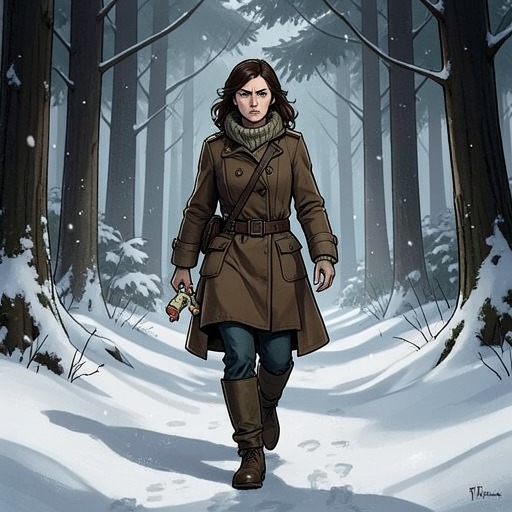
Before opening the door, the Robber-girl coaxes the great dogs inside and cuts the cord binding the Reindeer with her sharp knife. Gerda stretches out her mittened hand in farewell, and the Reindeer carries her away over stumps and stones, through the forest, across marshes and plains. Wolves howl and Ravens scream as the travellers move on beneath the red, flickering northern lights. By the time they reach Lapland, the loaves and ham have been eaten. Robber Castle is left behind, but its central contribution to Gerda’s quest travels with her: the direction provided by the pigeons, the Reindeer’s assistance, and the supplies that sustain the first part of the northward journey.
Narrative Significance
Robber Castle changes the shape of Gerda’s search without resolving it. The household is neither a straightforward sanctuary nor an unbroken threat: its locked birds and tied Reindeer expose its coercive order, while the same inhabitants provide knowledge and aid. Gerda’s vulnerable night there gives way to a deliberate escape, arranged by someone who has the power to endanger her and chooses instead to help.
The castle also functions as a threshold between the forest journey and the northern pursuit of the Snow Queen. News of Kay arrives through animals who witnessed his passage; confirmation and transport come from the Reindeer; and the Robber-girl’s intervention sets them on their way. The movement from the smoky, crowded hall to the open route toward Lapland is therefore both geographical and practical: a place of captivity becomes the launching point for Gerda’s next stage.