Snow Queen
The Snow QueenThe Snow Queen turns Kay’s susceptibility to cold into captivity, carrying him from the familiar world into a palace where reason is rendered as ice and freedom depends on solving a puzzle. Beautiful and formidable, she rules through winter, a transforming kiss, and a promise of mastery; yet her departure leaves Kay alone, and Gerda reaches him by a power the queen has not supplied or controlled.
Identity and Appearance
The Snow Queen first appears to Kay at a window, when a single large snowflake settles on the edge of a flower box and grows into the figure of a woman. Her garments seem to be made of countless linked, starry flakes. She is fair and beautiful, but also made of shining ice; her bright eyes resemble stars, though their gaze offers neither peace nor rest. She nods and waves toward the window. Kay is frightened and leaps down from his chair, while the moment ends with the suggestion of a large bird passing by.
Her later arrival makes the image concrete. Kay has fastened his little sledge to a large white one and is drawn beyond the town as the snow thickens. When he cannot free himself, he is carried on through the storm. The snowflakes swell until they look like great white chickens; then the sledge stops, and the driver rises. The disguise falls away: the fur and cap prove to be snow, and the driver is the Snow Queen. Her entrance joins transformation to concealment: the winter landscape that seemed to surround the carriage becomes the means by which its rider is hidden.
Taking Kay and the Power of the Kiss
She tells the frightened Kay that they have travelled well and draws him under her warm fur. Its apparent warmth is part of the encounter’s reversal: as she wraps him in it, he feels as if he is sinking into a snowdrift. Her first kiss on his forehead is colder than ice and passes through him to his heart, which is already almost a lump of ice. Kay briefly feels as if he is going to die, but soon feels well again and no longer notices the cold around him.
The effect is not only physical. After the first kiss, Kay’s immediate concern is his little sledge, still fastened behind the queen’s carriage to a white creature flying after them. The second kiss makes him forget Gerda, his Grandmother, and everyone at home. The queen then forbids further kisses, warning that she would kiss him to death. The exchange establishes both the reach and a stated limit of her power: intimacy can erase Kay’s attachments, but she recognizes that repeating the kiss would end his life.
The larger story has already introduced the fragments of the Demon’s distorted looking-glass, which make their bearers see the worst in what they look at and can leave a heart cold as ice. Kay’s condition belongs to this wider disturbance, but the queen’s kisses deepen his cold and separation. The account does not say that she made the mirror or its fragments; her role is to take Kay into her keeping and sustain the altered condition in which he no longer remembers home.
The Frozen Palace and Its Bargain
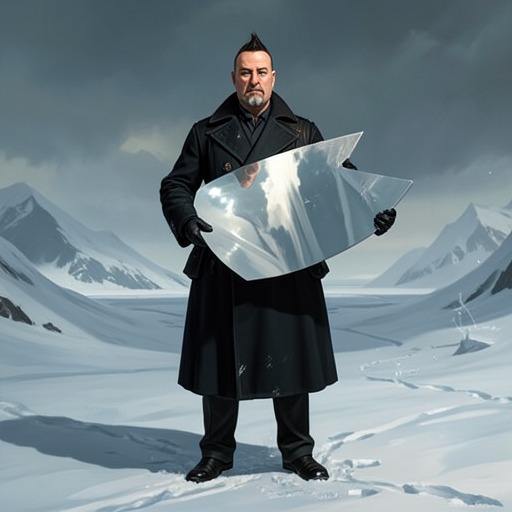
The Snow Queen’s palace gives her rule an architectural form. Its walls are drifted snow and its windows and doors are cutting winds. More than a hundred rooms stretch through the vast, empty building, with the aurora lighting its glittering halls. At the center is a frozen lake broken into carefully formed pieces. The queen calls it the Mirror of Reason and regards it as the best, indeed the only, mirror in the world. In a story where distorted sight has already made beauty and goodness appear diminished, this claim makes her icy court a rival system of perception: an ordered world that treats cold precision as the highest standard.
Kay sits in the great hall arranging sharp, flat pieces of ice into patterns, like pieces in a puzzle. The queen’s kiss has left him so cold that he is blue, almost black, though he does not feel it. A fragment of glass remains in his eye, and the figures he makes seem to him exceptionally important. He can form many designs and words, but not Eternity, the word he most wants to arrange. The queen has promised that if he succeeds he will be his own master and receive the whole world and a new pair of skates. Her offer makes release conditional on a task that Kay cannot complete: the promise of freedom is held within the very game that keeps him absorbed and captive.
Rule, Departure, and Limits
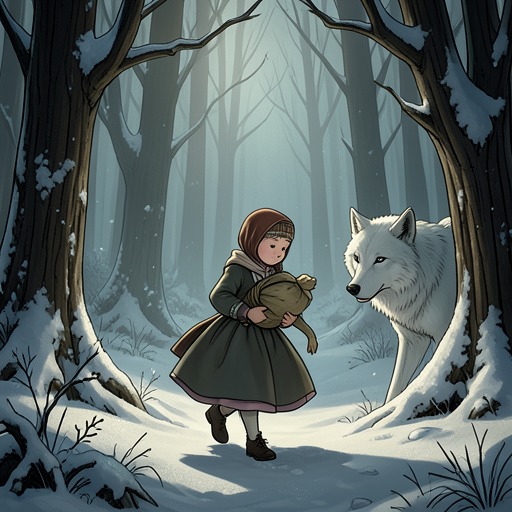
The Snow Queen’s authority extends beyond the palace itself. On the approach through Finland, Gerda encounters living snowflakes in frightening forms: some resemble porcupines, others twisted serpents, and others bristling bears. They are identified as the Snow Queen’s Snowflake Guard. Gerda recites the Lord’s Prayer; the breath rising from her mouth takes the shape of Angels, whose spears shatter the snow creatures and open a safe path forward. The queen’s guards can obstruct the approach to her castle, but they do not make the journey impossible.
The queen also leaves her domain. She announces that she must hurry to warmer countries and intends to look into the black craters of Etna and Vesuvius, making them white, a change she says will benefit the mountains as well as their lemons and grapes. She flies away, leaving Kay alone in the enormous hall, still intent on his pieces of ice. Her absence is consequential: she is not present when Gerda enters, and the rescue begins without a direct confrontation between the two.
Relationship to Gerda and Narrative Significance
The Snow Queen’s hold over Kay is measured against Gerda’s determination to find him. The Wood Pigeons report seeing Kay in the queen’s carriage and suggest that she was travelling to Lapland, where snow and ice are always present. Their account also recalls that she blew upon them and killed all their young except the two who survived. The queen’s passage therefore leaves harm beyond the boy she carries, while the birds’ testimony gives Gerda a direction for her search.
At the palace, Gerda reaches Kay after the Snowflake Guard has been dispersed. She prays as cutting winds rage, and they sink down; inside the hall, she recognizes Kay, runs to him, and throws her arms around his neck. He remains stiff and cold. The scene sets her freely given attachment against the queen’s transforming kisses and the solitary, abstract task that has occupied him. The Snow Queen has carried Kay away and shaped the conditions of his captivity, but she has not secured his isolation from Gerda. Her decisive narrative role lies in that contrast: she makes coldness a landscape, a court, and a bond, while the search for Kay tests whether those forms can overcome the ties he has forgotten.