Tame crow
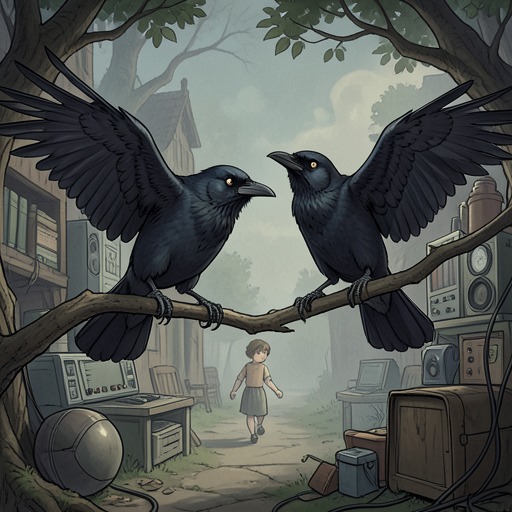
The Snow QueenTame crow is Forest crow’s sweetheart and a bird who moves freely about the palace. Her knowledge of its domestic spaces makes her more than a source of court gossip: when Gerda reaches the kingdom seeking Kay, Tame crow helps convert the crows’ sympathy into a way for Gerda to enter the palace and continue her search. Her contribution is practical and specific, from obtaining food to identifying a back staircase and its key.
Identity and Palace Position
Tame crow is introduced through Forest crow’s account of his sweetheart, who can go freely about the palace. The arrangement gives her access to information and places unavailable to Gerda at the guarded front entrance. The Princess’s search for a husband is one piece of news she passes to Forest crow: the Princess wants a suitor who can answer when spoken to, rather than someone who merely looks grand. Forest crow relays the account to Gerda, presenting Tame crow as his source and grounding the tale in her presence at court.
The court’s response to the Princess’s decision is public and elaborate. Notices invite handsome young men to visit the castle, while a crowd of would-be suitors struggles to speak once it reaches the throne room. Their failure contrasts with the Tame crow’s quiet competence around the palace: she does not compete for the Princess’s attention, but knows how the household operates. Her position is defined less by rank than by movement through spaces and relationships that allow her to help someone from outside the court.
Helping Gerda Reach the Palace
When Gerda says that Kay will come to fetch her if he learns she is there, Forest crow goes to consult his sweetheart. Tame crow responds by arranging assistance rather than leaving Gerda to face the guards at the main entrance. She sends a small roll of bread taken from the kitchen, recognizing that Gerda may be hungry, and explains that the silver-uniformed guards and gold-liveried servants will not let her enter by the front. Instead, Tame crow knows of a back staircase leading to the sleeping apartments and knows where its key can be found.
The plan places Tame crow’s local knowledge at the center of Gerda’s nighttime approach. At the top of the stairs, in a small closet with a lamp, she is waiting and turns her head to look at the girl. Gerda curtseys as her grandmother taught her; Tame crow answers warmly, saying that Forest crow has spoken highly of her and that her life story is touching. She offers to walk ahead if Gerda carries the lamp, then guides her along a route intended to avoid meeting anyone. The help is discreet because discovery would end the attempt before Gerda can find out whether Kay is in the palace.
Partnership and Reward
Tame crow’s assistance grows out of her relationship with Forest crow. He calls her his sweetheart and relies on what she tells him; when he later guides Gerda to the palace, the two birds cooperate in carrying out the plan. The narrative makes their partnership consequential without making Tame crow a substitute for Gerda’s purpose: she can open a way inside, but Gerda must still confront the uncertainty of whom she will find there.
After Gerda tells the Prince and Princess what has happened and how the crows helped her, the Princess offers the birds a choice between freedom and becoming court crows, with access to what remains in the kitchen. Tame crow and Forest crow bow and ask instead for a fixed appointment, explaining that provision for their old age would be comfortable. The reward therefore answers a practical concern the pair express themselves. Their request turns an episode of risky assistance into a more settled place within the court household.
Departure and Later Fate
When Gerda leaves the palace in a golden carriage to continue looking for Kay, Forest crow accompanies her for the first three miles. Tame crow stays behind. The account explains her absence by noting that she has been suffering from a headache since the new appointment, perhaps from eating too much. The detail gives the court reward an ordinary, comic consequence: the kitchen provision she and Forest crow sought is associated with excess, and it prevents her from joining the journey.
At the departure, Tame crow stands in the doorway flapping her wings while Gerda and Forest crow weep. The parting is especially painful for Forest crow, who later flies to a tree and watches the glittering coach as long as he can see it. Tame crow’s place in this scene is the one who remains at home while her partner briefly accompanies Gerda; their separation follows from the different roles each plays in the journey, not from any stated quarrel or change in affection.
Narrative Role and Ending
Tame crow’s actions connect the palace episode to Gerda’s larger search: she supplies information about the Princess’s household, food for the traveler, and the means of entering unseen. The sequence moves from reported knowledge to direct assistance, then to a negotiated reward and a parting. In that pattern, her usefulness depends on ordinary access and cooperation rather than extraordinary power. She helps because she knows the palace and because she and Forest crow act together on Gerda’s behalf.
Later, the Robber-girl tells Gerda that Forest crow has died and that Tame crow is now a widow, wearing a bit of black worsted around her leg and mourning him. The news closes the account of the crows’ partnership with a loss, but gives no cause or circumstances for Forest crow’s death. Tame crow’s earlier help remains part of Gerda’s route toward Kay, while the brief report of mourning records what became of the bird who had stayed behind.