The Magic Mirror's Law of Distortion
The Snow QueenThe Magic Mirror's Law of Distortion is the governing power of the mirror made by the Demon: it reverses ordinary judgment by diminishing what is good or beautiful and enlarging what is bad or worthless. Its force survives the mirror's destruction, turning tiny fragments into agents that distort perception and, when they lodge in the heart, change feeling as well as sight.
The Mirror's Distorting Operation
The mirror makes everything good or beautiful that it reflects seem almost to shrink to nothing, while everything worthless and bad appears larger and worse than before. A lovely landscape becomes like boiled spinach; a person's features are so distorted that the person may be unrecognizable, and a single freckle seems to spread across the nose and mouth. The mirror does not merely make flaws easier to notice: it alters proportion until the beautiful is negligible and the blemish seems to define the whole.
Its distortion also reaches inward. When a good or pious thought passes through someone's mind, the mirror misrepresents it. The rule therefore applies both to what is seen and to moral judgment: an impression of corruption is made to look like clear sight, while goodness is diminished or falsified.
The Claim to Truth and Its Reach
The Demon treats the mirror's effects as a source of amusement, and those at his school spread it widely. They present what they see through it as what the world and humanity are really like. That claim turns distortion into a purported method of seeing clearly: the mirror's users mistake its systematic bias for disclosure. As it is carried from place to place, every land and people are subjected to its view.
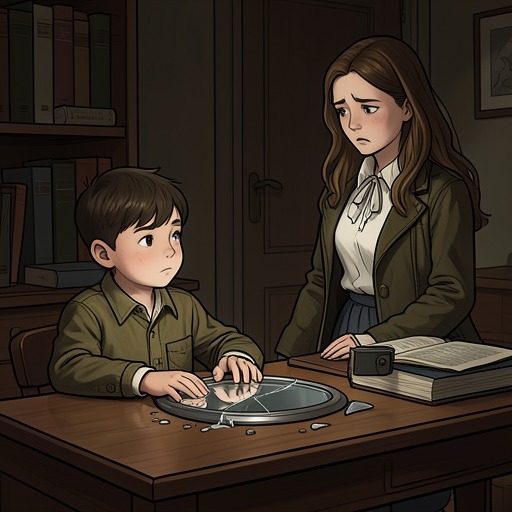
The attempted ascent toward heaven exposes a physical limit in the mirror's reach. The higher its bearers fly, the more slippery it becomes, until it slips from their hands and falls to earth. The fall does not end the distortion; it multiplies its means of transmission. The mirror breaks into millions of pieces, and fragments small as grains of sand scatter through every country.
Fragments and Their Effects
The shards retain the whole mirror's power, however small they are. A fragment entering an eye may remain unnoticed, yet from then on its bearer sees through a distorted medium, or sees only the worst side of what is viewed. Larger fragments can be made into window-panes, putting the same distortion between people and the friends they look at; other pieces become spectacles that prevent their wearers from seeing rightly or justly. The rule thus survives not as an intact, distant object but as an unnoticed obstruction embedded in ordinary acts of looking.
A shard in the heart produces a different, more severe consequence: the heart becomes cold like a lump of ice. Kay experiences both forms of corruption. When he says that something has struck his heart and that there is something in his eye, Gerda looks but sees nothing; although Kay thinks the eye-shard is gone, it remains. He soon judges the roses by their worm-eaten and crooked parts, calls them ugly, kicks their boxes, and tears off the flowers. The shard in his heart leaves him feeling no pain, while the one in his eye makes the roses' defects eclipse their beauty.
Narrative Consequences
The law links a fantastical object to a visible change in conduct. After the fragments affect Kay, he dismisses a picture book as fit only for babies, interrupts Grandmother's stories, and mocks her with spectacles before imitating people in the street. Others interpret his performances as signs of unusual cleverness, but the story identifies the glass in his eye and the coldness in his heart as their cause. The rule therefore explains how distorted perception becomes cruelty and estrangement, rather than remaining a private visual anomaly.
The mirror's destruction intensifies rather than resolves its danger: one whole object becomes millions of scattered fragments, each capable of carrying the original power into an eye or a heart. Its defining irony is that it encourages its users to believe they are seeing the world's true condition while making sound judgment impossible. Through Kay's altered response to the roses, the story shows the law at its most intimate: the distortion does not erase the beautiful object, but makes its faults appear to be all that is there.