The Robber-Girl Unties the Reindeer and Frees Gerda
The Snow QueenThe Robber-girl’s decision to free Gerda turns a forest robbery into an unlikely rescue: the girl who had held Gerda under her control equips her for the cold, unties the Reindeer, and sends them toward the Snow Queen’s castle. The departure is not a simple act of kindness. It grows out of a night in which Gerda’s account of Kay meets the animals’ knowledge of the north, and it marks a decisive change in the purpose of the Reindeer’s captivity.
Capture and Confinement
The episode begins when a gold-lit coach carrying Gerda passes through a forest. Robbers stop it, kill its attendants, and pull Gerda out. The old robber-woman considers keeping her, but the Robber-girl intervenes and claims Gerda as a companion. That intervention prevents the old woman from acting on her intention and transfers Gerda from one danger into another kind of confinement: she is to stay with the Robber-girl, surrender her warm muff and fine dress, and sleep in her bed.
The Robber-girl does not present herself as harmless. She makes clear that Gerda’s safety will depend on her own decision, and initially speaks as though she alone may determine Gerda’s fate. Yet her first gestures also complicate the threat: she wipes Gerda’s tears and puts on the soft muff herself. The scene establishes an uneven relationship in which protection and possession coexist. Gerda is not free to leave, but the person holding her is not simply aligned with the older robbers’ intentions.
The coach carries the girls to Robber Castle, a damaged building with cracked walls and openings used by ravens and crows. Inside, the smoky hall contains a fire on the stone floor, a cooking cauldron, and roasting food. After they eat, the Robber-girl takes Gerda to the sleeping corner that she shares with her animals. More than a hundred pigeons roost above them; the Wood Pigeons are kept in a cage, and a Reindeer is tied nearby with a bright copper ring around its neck. The Robber-girl handles the animals roughly and uses her knife to frighten the Reindeer, making the setting’s mixture of care, captivity, and threat visible before the rescue begins.
The Animals’ News and the Northern Route
Gerda cannot sleep. While the Robber-girl sleeps beside her with a knife close at hand, the Wood Pigeons tell Gerda that they saw Kay in the Snow Queen’s carriage. A white fowl carried his sledge, and the Snow Queen’s passage through the forest killed the pigeons’ young, leaving only the two who speak to Gerda. They believe the carriage was probably travelling toward Lapland. Their account gives Gerda the first direct news of Kay’s direction during this episode, turning her search from a general pursuit into a journey with a possible destination.
The Wood Pigeons direct Gerda to ask the Reindeer. The animal says that Lapland is his birthplace and the country where he grew up running over snow-covered plains. He describes it as a place of snow and ice, says the Snow Queen has a summer tent there, and identifies her stronger castle as being at the North Pole, on the island of Spitzbergen. The information extends the route beyond the forest and gives Gerda a northern guide who knows the terrain from experience. The Reindeer’s account also distinguishes the Snow Queen’s temporary northern dwelling from her more formidable stronghold.
In the morning, Gerda tells the Robber-girl what the Wood Pigeons have said. The Robber-girl questions whether their talk is reliable and asks the Reindeer whether he truly knows Lapland. His answer—that he was born and raised there—confirms his knowledge. The exchange changes what Gerda’s captors can do with the information: the Reindeer is not merely a chained animal who has overheard her story, but a possible carrier capable of taking her north.
The Decision to Release Them
The Robber-girl explains that the other robbers have gone away, while her mother remains at the castle. At noon, her mother drinks from a large bottle and then sleeps for a short time. The Robber-girl says she will act during that interval. Her account makes the opportunity practical and specific: the release depends on the temporary absence of the other men and on knowing when the remaining adult will be asleep.
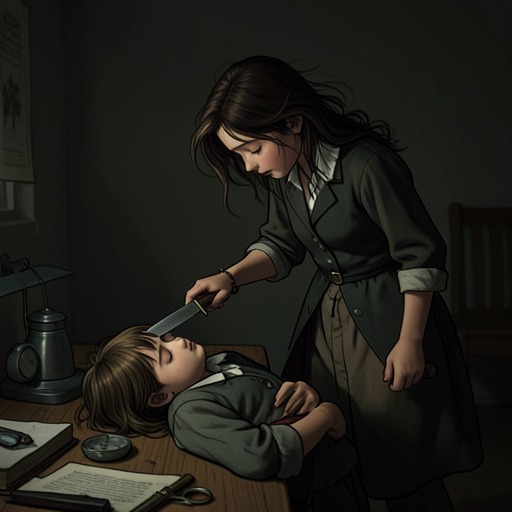
Before carrying out the plan, the Robber-girl interacts with her mother in a boisterous, familiar manner. The mother responds by flicking her nose, an action the narration describes as affectionate. This brief exchange shows that the Robber-girl can move freely around her mother, even though the mother has authority in the castle. When the mother has fallen asleep, the Robber-girl goes to the Reindeer. She admits that she has enjoyed frightening him with the knife, but chooses instead to untie him. She gives him a clear task: carry Gerda to the Snow Queen’s castle, where Gerda’s playfellow is.
That decision reverses the Reindeer’s situation and the Robber-girl’s role in Gerda’s journey. Until then, she has kept him tied up and made his confinement a source of amusement. Now she releases him and entrusts Gerda to his care. She lifts Gerda onto his back, ties her securely in place, and provides a cushion. The practical care matters: the Reindeer is being sent on a difficult journey with a passenger, not simply turned loose to flee.
Departure and Consequences
The Robber-girl prepares Gerda for the cold with the fur boots Gerda had worn and large warm mittens belonging to the Robber-girl’s mother. She keeps Gerda’s muff, but gives her the alternative clothing so that she will not lack protection. She also ties two loaves and a ham to the Reindeer, ensuring that the travellers have food for the road. These provisions give the farewell its concrete form: Gerda leaves without the warm muff she had first been made to surrender, but with boots, mittens, a cushion, and supplies chosen for the journey ahead.
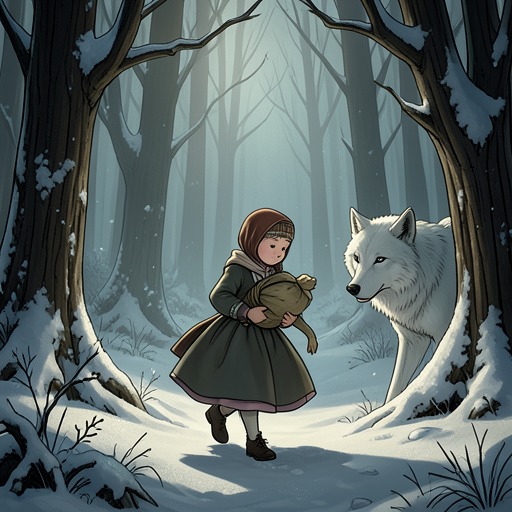
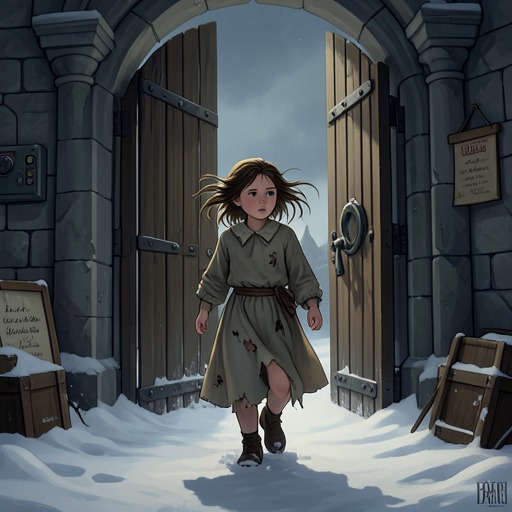
The Robber-girl opens the door, coaxes the large dogs inside, and cuts the cord binding the Reindeer. She charges him to take care of Gerda. Gerda reaches back to say farewell, and the Reindeer carries her away over rough ground, through forest, marshes, and plains. Wolves howl and ravens cry as they travel; above them, the northern lights flicker. The narrative follows their movement out of the castle’s enclosed world and into a landscape that is both a route forward and a new danger.
The food does not last the whole journey. By the time Gerda and the Reindeer reach Lapland, the loaves and ham are gone. The episode therefore ends not at the Snow Queen’s castle but at the next stage of the search: the Reindeer has brought Gerda into the northern region indicated by the Wood Pigeons, and their arrival makes further help necessary. The Robber-girl’s release does not complete Gerda’s rescue of Kay; it makes that rescue possible by replacing confinement with movement, and by joining Gerda’s determination to the Reindeer’s knowledge of the north.