The Rose and Christ Child Hymn
The Snow QueenThe Rose and Christ Child Hymn is a two-line song that links the fragile beauty of roses with the promise of seeing the Christ-child. First learned and sung by Gerda in the shared rooftop garden, it returns at the decisive moment when she finds Kay in the Snow Queen’s palace. The refrain joins childhood memory to religious faith: roses bloom and fade, but the song’s promised vision reaches beyond their season and, in the story’s ending, helps frame the children’s return home.
Origin in the Rooftop Garden
Gerda has learned the hymn before the summer in which the children sit together among the roses. Seeing their own blossoms in the song’s words, she sings it to Kay, and he joins her:
“Roses bloom and cease to be, But we shall the Christ-child see.”
The children then hold hands, kiss the roses, look toward the sunshine, and speak to it as if the Christ-child were present. The scene connects the hymn not only with an expectation of the future but with a way of seeing the present: ordinary sunlight and the flowers in their small garden become occasions for shared devotion. The song is introduced through their friendship and through a concrete place they have made together above the surrounding houses.
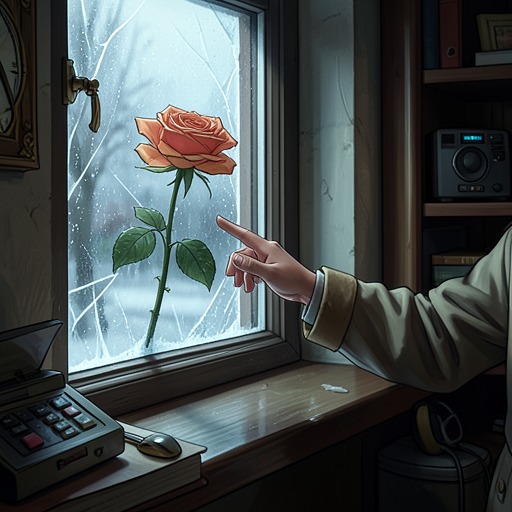
The garden’s roses give the first line a visible, seasonal counterpart. Their blossoms are beautiful, but the words acknowledge that they will not last. That recognition does not make the children’s happiness false or insignificant; rather, the hymn places passing beauty beside a promise that exceeds it. At this early point, the two sing together in a world of summer, flowers, and companionship. The refrain’s later return will preserve that moment after the garden and their shared life there have been broken apart.
Memory Through Separation
The song becomes important through recurrence, not through frequent repetition. After a fragment of the magic mirror enters Kay’s eye and heart, he begins to see fault and ugliness where he had once shared Gerda’s pleasure in the roses. He calls the flowers ugly, kicks their boxes, and pulls off the blossoms. The episode makes the garden’s flowers a measure of what has changed in him: the roses remain before him, but the corrupted way he sees them has altered their meaning. Against that change, the hymn’s pairing of temporary bloom with enduring hope retains the memory of their earlier, shared response to the flowers.
Later, Gerda escapes the Conjuring woman’s garden and discovers that the apparently endless summer there concealed the passing of time. She finds herself in late autumn, with yellow willow leaves, falling dew, and trees losing their leaves. This sharp contrast between an enchanted garden’s unchanging flowers and the world’s actual seasons recalls the hymn’s acknowledgment that roses bloom and cease to be. The story gives that recognition a cost: Gerda has lost time, her feet are sore, and the landscape appears cold and bleak. Yet the song’s second line offers a promise that is not limited to any one season or flower.
On the approach to the Snow Queen’s castle, Gerda has no shoes or gloves in the cold of Finland. Living snowflake guards gather around her, but she repeats the Lord’s Prayer; the steam of her breath takes the shape of Angels, who drive the guards back and let her continue. This is not another performance of the hymn, but it places Gerda’s remembered song within a larger pattern in which religious words accompany endurance and rescue. The hymn’s hope is carried not as an abstract explanation of every danger, but as part of the story’s sustained association between faith, persistence, and the possibility of deliverance.
The Refrain at Kay’s Rescue
Gerda finds Kay in the palace’s great empty hall and throws her arms around him. He remains stiff and cold. Her hot tears fall on his breast, thaw the ice in his heart, and wash away the piece of glass lodged there. Then Gerda sings the same two lines she and Kay had sung together in the garden. The refrain thus returns at a changed and decisive moment: what began as a shared song beside living roses becomes an act of remembrance addressed to the friend who no longer recognizes her.
Kay begins to weep, and the splinter in his eye comes out. He recognizes Gerda and asks where they have both been. The hymn does not work as a mechanical charm; the account places it after Gerda’s tears have begun to thaw him, and before Kay’s own tears complete the removal of the glass from his eye. Its force lies in the sequence of recovery it accompanies: bodily contact, the thawing of the heart, the remembered song, recognition, and renewed feeling. The words reintroduce the shared world Kay had lost access to under the influence of the mirror fragments.
Afterward, the pieces of ice move into the letters of the word the Snow Queen had set Kay to find before he could be his own master. Gerda’s song is therefore heard at the threshold between the breaking of the mirror’s hold and Kay’s freedom. The refrain does not state the puzzle’s answer or replace the ice letters; instead, its return marks the restoration of a relationship and a capacity for feeling at the moment the condition of the palace is overturned.
Homecoming and Meaning
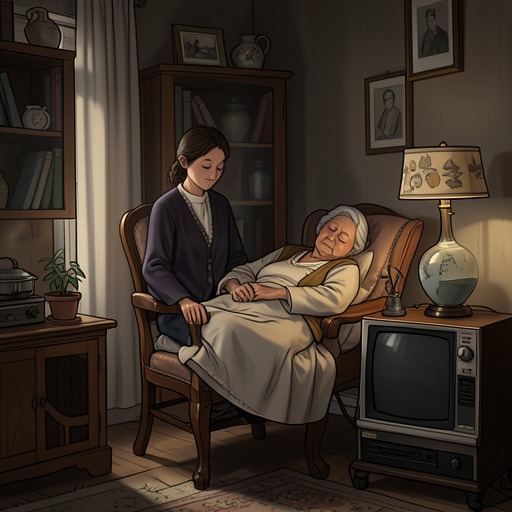
When Gerda and Kay return to their town, spring grows more lovely around them. They recognize the church steeples, hear the bells, and enter their grandmother’s room. The roses on the roof are again in full bloom, and the little chairs from their childhood remain. Sitting in those chairs and holding hands, they encounter the familiar setting of the song’s first performance, though they have both grown into a man and a woman during their adventures.
Their grandmother reads from the Bible that people must become like little children to enter the kingdom of God. The two look into each other’s eyes and understand the old song. At this final return, the hymn is no longer only something Gerda learned and sang to Kay; it has become a phrase whose significance they recognize together, in the light of their journey and reunion. The story closes by holding maturity and childhood together: they are grown, yet remain children at heart, while summer has returned and the roses bloom again.
The hymn’s structure gives the story a compact account of loss and restoration. Its first line names a truth the plot repeatedly makes visible in flowers, seasons, and the passing of time. Its second line sets beside that transience a religious promise, and the story returns to the refrain precisely when memory and affection begin to overcome the coldness imposed on Kay. At home, the roses, the old room, the Bible reading, and the recovered song converge. The refrain does not abolish change; it makes return possible without pretending that the children have not passed through separation.