The Snow Queen Takes Kay Away
The Snow QueenThe Snow Queen Takes Kay Away turns a boy’s ordinary winter game into a forced departure, carrying Kay out of his familiar world and breaking his ties, for a time, with Gerda and home. The scene’s change is both physical and inward: a sledge that Kay expects to control becomes the means of his capture, while the Snow Queen’s kisses alter what he feels and remembers. The episode brings the earlier danger of the Demon’s distorted looking-glass into Kay’s life and establishes the separation that sends Gerda in search of him.
Background and the First Departure
The abduction follows the arrival of a glass fragment in Kay’s eye and heart. The Demon’s distorted looking-glass makes what is good seem diminished and what is bad appear enlarged; even a tiny fragment retains that power. A splinter in the eye distorts perception, while one lodged in the heart makes it cold. The story has already connected that change to Kay’s altered manner: he mocks a picture book as fit only for babies, interrupts Grandmother’s stories, imitates people’s peculiarities for laughs, and teases Gerda, who loves him. The event therefore makes concrete an earlier inward change: Kay is already less responsive to the forms of affection and wonder that had mattered at home.
On a snowy day, Kay puts on thick gloves, takes his sledge, and calls upstairs to Gerda that he is going to the great square, where the boys play and ride. There, the boys sometimes tie their sledges to country carts and are pulled along; Kay joins in this familiar game. When a large white sledge circles the square, he fastens his own little sledge to it. Its passenger is wrapped in rough white fur and wears a white cap. The apparently simple act of hitching on becomes the decisive mistake: once the larger sledge leaves the square, Kay follows it out through the next street and beyond the town gate.
The Carriage and the Revelation
The driver nods pleasantly when Kay looks back, as if they are acquainted. Whenever Kay tries to loosen his sledge, the driver nods again, and Kay remains attached. The gestures make the capture unnerving without initially explaining it: the driver gives no answer, but the repeated nod coincides with Kay’s failed attempts to free himself. The sledge goes faster, the snow grows so thick that Kay cannot see a hand’s breadth ahead, and his own call for help goes unheard. When he finally loosens the cord, the little sledge still holds fast. It jumps as if crossing hedges and ditches, while the wind and snowfall carry him farther from the town.
Afraid, Kay tries to say a prayer but can remember only the multiplication table. The snowflakes grow until they look like great white chickens, then spring aside as the large sledge stops. Its passenger rises, and the white fur and cap fall away: they are made entirely of snow. The driver is the Snow Queen, the identity concealed by the carriage’s white disguise. What had seemed a strange but familiar-looking traveler is revealed as the power directing Kay’s journey.
Kisses and the Change in Kay
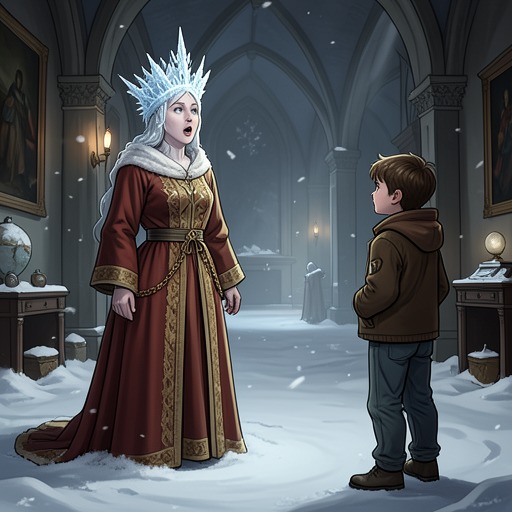
The Snow Queen tells Kay that they have driven well, asks why he trembles, and draws him beneath her warm fur. When she kisses his forehead, the kiss is colder than ice and goes through to his heart, which is already almost a lump of ice. Kay feels as if he is going to die, but only for a moment; soon he seems well again and no longer notices the cold around him. The immediate consequence is paradoxical: the cold that should make him suffer instead becomes something he no longer feels.
His first thought afterward is for his sledge. He sees it fastened to one of the white chickens flying behind the Snow Queen’s carriage, so the object that carried him into danger remains in tow. She kisses him a second time, and Kay forgets Gerda, Grandmother, and everyone at home. She then says there must be no more kisses, or she would kiss him to death. The warning places a limit on the intimacy even as the second kiss has already accomplished a devastating separation: Kay is alive beside her, but his remembered attachments have been erased.
Kay looks at the Snow Queen and finds her beautiful, with a face he considers impossible to surpass in loveliness and intelligence. She no longer seems to him to be made of ice, and he feels no fear of her. He boasts that he can do mental arithmetic through fractions and knows the country’s square mileage and population. Her smile makes him think he does not yet know enough. The scene thus sets his confident, calculating knowledge against the lost capacity to remember the people who love him; his account of numbers does not restore the personal bonds the kiss has removed.
Flight and the Consequences of Separation
The Snow Queen flies higher with Kay on a black cloud as a storm blows and howls. They pass over woods and lakes, sea and land; wolves howl below, snow crackles, and black crows fly overhead beneath a clear, bright moon. Kay passes through the long winter night and sleeps by day at the Snow Queen’s feet. The movement extends the abduction beyond a single departure from town: Kay is carried across a vast landscape, while the account gives no indication that he is trying to return or even thinking of Gerda.
The separation’s consequences become visible in the household Kay has left behind. During his absence, nobody knows where he has gone. The boys can only report that he tied his sledge to a very large one that drove through the street and out of the town gate. Gerda weeps for a long time and fears that Kay has died in the river near the school; with spring’s arrival, she says he is dead and gone. Later, two Wood Pigeons report having seen Kay in the Snow Queen’s carriage, with a white fowl carrying his sledge. They say the Snow Queen blew upon them as she passed through the wood and that all their young died except the two survivors. They suppose she was travelling to Lapland, a destination they infer from the snow and ice there. Their account supplies witnesses to the flight and points Gerda toward the next stage of her search, without undoing the uncertainty and grief created by Kay’s disappearance.