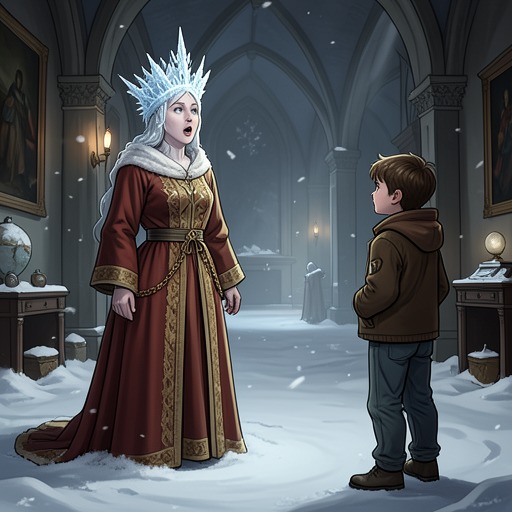
The Snow Queen and Kay's Relationship
The Snow QueenThe Snow Queen and Kay’s relationship begins as an abduction and takes on the appearance of intimacy without becoming reciprocal. She carries him away in her sledge, changes his bodily and emotional responses with kisses, and sets the condition for his freedom. Kay, meanwhile, regards her as beautiful and intelligent, but his perception has been altered by the looking-glass shard in his eye. Their bond is therefore shaped by an unequal power: she determines where he goes, what he remembers, and what he must accomplish, while he mistakes the cold order of her world for perfection.
Capture and Departure
Kay’s connection to the Snow Queen begins in the town square, where he fastens his little sledge to a large white one driven by a fur-wrapped stranger. When the sledge speeds out of town, he tries to loosen the cord, but his vehicle remains fastened. Snow and distance separate him from help; frightened, he calls out, but nobody hears. The scene establishes the essential imbalance of their relationship before he even knows who has taken him: Kay is carried along, unable to choose the direction or stop the journey.
The driver then reveals herself as the Snow Queen. She invites Kay into her warm fur, an offer that seems to answer his immediate fear and cold. But the comfort is also part of his removal from ordinary life. Her sledge continues into the wintry distance, and after her second kiss Kay has forgotten Gerda, Grandmother, and everyone at home. The loss is not merely physical separation. The Snow Queen’s presence has displaced the attachments by which Kay might have understood what has happened to him.
Kisses, Perception, and Control
The Snow Queen’s kisses operate as instruments of control. Her first kiss is colder than ice and reaches Kay’s heart, already nearly frozen by the looking-glass shard lodged there. For a moment he feels as though he will die; then he seems well and no longer notices the cold around him. The change makes him less able to recognize his condition. What would otherwise alarm him becomes, under her influence, something he does not feel.
A second kiss erases his memory of home and of the people closest to him. The Snow Queen then says there must be no more, because another kiss would kill him. The warning acknowledges the danger of her power but does not reverse what the earlier kisses have done. Kay is left alive, compliant, and cut off from his former attachments. The account presents affection and coercion in the same gesture: a kiss offers closeness while also altering the person receiving it.
Kay’s altered perception helps explain why he accepts this connection. He sees the Snow Queen as so beautiful that he cannot imagine a lovelier or more intelligent face, and she appears perfect to him rather than icy. This judgment belongs to a world in which a glass fragment has already distorted his sight and another has chilled his heart. His admiration is real as an experience, but it cannot be treated as an unclouded assessment of the person who has taken him. The contrast between his sense of her perfection and the effects of her kisses makes the relationship’s apparent tenderness deeply unreliable.
The Palace and the Terms of Freedom
At the Snow Queen’s palace, Kay is physically blue with cold, almost black, but does not feel it because her kiss has removed his shivering and his heart has become ice. He spends his time arranging sharp, flat pieces of ice into patterns. The game seems to him an exercise in reason, and the figures appear exceptionally important; the shard in his eye helps shape that conviction. His absorption in the task replaces the relationships and concerns he has lost.
The Snow Queen gives this work a direct connection to Kay’s freedom. If he can form the word Eternity from the ice pieces, she promises that he will be his own master, along with the whole world and a new pair of skates. Yet the condition keeps him inside her system: she sets both the puzzle and the reward, while he struggles to complete a word he cannot manage. Her offer makes release imaginable, but only on terms she controls. When she leaves for warmer countries to look at Etna and Vesuvius, Kay remains alone in the immense hall, still occupied by the task.
Gerda’s Return and the End of the Bond
The Snow Queen is absent when Gerda reaches the palace and finds Kay. He sits stiff and cold and does not respond when she embraces him. Gerda’s tears fall on his breast, thaw the ice in his heart, and wash away the fragment lodged there. When she sings the familiar lines about roses and the Christ-child, Kay begins to weep; the tearful change releases the shard from his eye as well. He recognizes Gerda and sees the palace again as cold, large, and empty.
The ice pieces then form Eternity, the word Kay had been unable to arrange. Its appearance marks a reversal of the Snow Queen’s terms: Kay’s freedom is realized, but through his reunion with Gerda rather than through continued submission to the palace and its challenge. The Snow Queen is not present to contest that change. Kay and Gerda leave together, speaking of Grandmother and the roses at home. Their departure ends the Snow Queen’s hold over Kay in the story, while the restoration of his memory and perception makes clear how thoroughly that hold had reshaped his experience.
Narrative Significance
The relationship links the story’s magical effects to a question of perception: Kay does not simply travel to the Snow Queen’s world but comes to experience its coldness as comfort and its order as perfection. The shards in his eye and heart make that transformation legible, while the Snow Queen’s kisses intensify it by changing his memory and sensation. Her promised reward gives the captivity a deceptively rational structure, but the condition of solving the puzzle keeps freedom within her authority.
The relationship’s ending contrasts imposed attachment with remembered bonds. The Snow Queen can carry Kay away and make him forget those at home, but Gerda’s arrival restores recognition through tears, song, and physical closeness. Kay’s return to her is not a negotiated reconciliation with the Snow Queen; it is the termination of a coercive connection. The contrast between the Snow Queen’s cold kisses and Gerda’s tears gives the change its force: Kay becomes able to feel, remember, and leave.