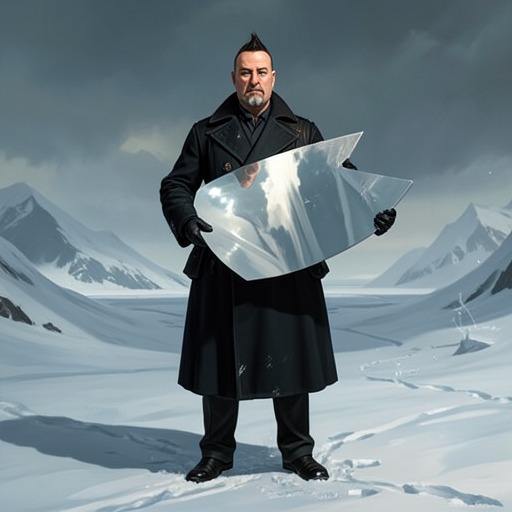
The demon’s distorted looking-glass
The Snow QueenThe demon’s distorted looking-glass is a magical instrument made by Demon whose central power is to reverse the apparent scale of moral and aesthetic value: good things shrink, while faults and ugliness loom larger. When the glass breaks, its fragments carry that distortion into the world and into human bodies. Kay’s eye and heart show the consequences most clearly: what begins as a piece of glass becomes a change in perception, conduct, and attachment that helps the Snow Queen retain power over him.
Making and Power
Demon creates the mirror in a merry mood and regards its effects as an amusement. In its reflection, beautiful landscapes look like boiled spinach, people appear hideous and physically distorted, and a single freckle can seem to spread across the nose and mouth. The glass also misrepresents good or pious thoughts. Its operation is therefore more than a reversal of beauty: it makes goodness difficult to recognize and makes faults disproportionately conspicuous. Because faces become unrecognizable and even virtuous thought is altered, the mirror attacks both the appearance of the world and the possibility of judging it fairly.
Demon’s School helps turn the device into a widely shared way of seeing. Its pupils talk about the wonders they have witnessed and claim that, through the mirror, people can at last see what the world and humankind are really like. They carry it from place to place until every land and people has been viewed through it. Their confidence in the instrument’s supposedly truthful vision contrasts with the distortions the story has already described: the mirror does not reveal reality, but makes its own warped judgment seem like knowledge. The attempt to fly with it up to heaven to see the Angels extends that confidence to the highest possible vantage. The glass grows slippery as they rise, however, and falls from their hands.
Shattering and Circulation
The mirror breaks into millions of pieces, but its destruction multiplies rather than cancels its danger. Some fragments are smaller than a grain of sand and fly into countries throughout the world; a few remain in the air. Even the tiniest shard retains the power of the whole mirror. A fragment entering an eye sticks there without the person knowing it, after which the person sees through a distorted medium or notices only the worst side of what is before them. The danger lies partly in its invisibility: the affected person may experience the altered view as ordinary sight rather than recognize it as an imposed distortion.
Other pieces act on bodies in different ways. Fragments lodged in hearts make them cold like lumps of ice, while larger pieces can be used as windowpanes or made into spectacles. Those forms carry the same moral consequence into everyday acts of looking: friends seen through a fragmentary pane, or through the spectacles, cannot be seen rightly or justly. The mirror thus survives as several kinds of object, from an unseen particle inside a person to a manufactured lens. Its breakage exposes the material persistence of the danger: a single instrument becomes a dispersed influence, difficult to detect and present in multiple settings.
Kay’s Corruption
Kay experiences both forms of the mirror’s power. After he and Gerda have been looking at a picture book, he says that something has struck his heart and that there is something in his eye. Although he soon thinks the trouble has gone, the fragment remains. The shard in his eye makes him pick out defects in the roses and call them ugly; he kicks their boxes and tears off the flowers. The shard in his heart turns it to ice, so that he feels no more pain. The episode gives the mirror’s abstract rule an intimate consequence: Kay’s altered vision and diminished feeling appear together, and his treatment of the roses immediately wounds Gerda.
The change continues beyond that first outburst. Kay dismisses the picture book as fit only for babies, interrupts Grandmother’s stories, imitates her, and mocks peculiar or disagreeable features in people he sees. Others mistake this conduct for evidence that he will be clever and unusually gifted. The narrative instead identifies the glass in his eye and the coldness in his heart as its cause. His apparent sharpness is thus inseparable from a failure to see people justly; the mirror’s distortion is mistaken by those around him for ability.
Removal and Narrative Significance
The Finland woman later explains that Kay is with the Snow Queen and finds everything there so much to his taste that he believes it is the finest place in the world. She attributes this belief to the pieces of glass in his heart and eye, and says that they must be taken out or he will never be a human being again and the Snow Queen will retain her power over him. Her account connects the mirror’s original distortion to Kay’s present captivity: the shards do not merely cause isolated moments of cruelty but shape what he values and how he understands his surroundings.
The looking-glass gives the story a concrete model for corrupted judgment. Its effects move from reflection to fragment, from fragment to eye or heart, and from altered perception to conduct and vulnerability. The contrast between its claim to disclose what the world is really like and its systematic exaggeration of evil makes its false authority central to its meaning. Its continued presence after shattering also makes the threat harder to oppose than a single visible object: even an almost imperceptible piece can change the world a person sees, while a piece in the heart changes what that person can feel.