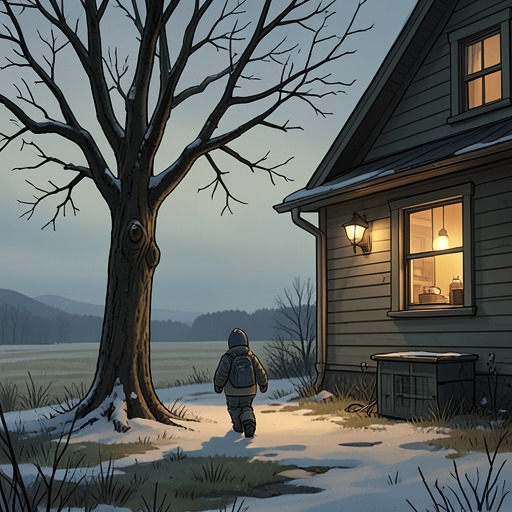
Winter
The Snow QueenWinter governs more than the weather: it closes familiar routes, alters what characters can see, and turns separation into a physical trial. Its hard surfaces and falling snow accompany Kay’s departure with the Snow Queen, while Gerda’s pursuit moves through changing seasons toward a landscape of ice. The story’s cold is therefore both a setting and a pressure on the relationships and perceptions at its center.
Seasonal Time and the Home
Winter first marks a boundary in the children’s ordinary life together. Kay and Gerda’s flower boxes, rose branches, and shared stools make a small garden above the street, but when the windows freeze, they cannot simply step across as they do in summer. Instead, they warm copper pennies on the stove and press them to the panes, opening little round holes through the frost so they can look at one another. The season changes a simple meeting into an act of ingenuity: their connection persists, but winter makes its barrier visible.
That domestic frost also gives the Snow Queen’s arrival an early, almost familiar form. When snow falls, Grandmother describes white bees swarming and says their queen flies through town at midnight, looking in at windows; the ice then forms patterns resembling flowers and castles. What begins as a story told indoors binds winter’s ordinary effects to the possibility of an uncanny visitor. Frost is at once decoration on the glass and a threshold through which the children imagine a power beyond their home.
Snow, Perception, and Kay’s Departure
After fragments of the Demon’s distorted mirror enter Kay’s eye and heart, winter supplies images that suit his altered attention. He teases Gerda and dismisses a picture book as fit only for babies. On a snowy day, he uses a burning-glass to magnify flakes resting on his blue coat, preferring their apparent perfection to real flowers. The flakes seem flawless only until they melt; his pleasure in magnification and faultlessness echoes a way of seeing that prizes the cold, isolated detail over living things. Winter does not cause the mirror’s corruption, but its crystalline appearances give that changed vision a compelling spectacle.
The snowfall then becomes the route by which Kay leaves. Wearing thick gloves and carrying his sledge, he goes to the great square to join the other boys. He ties his sledge to a much larger white one, whose driver nods whenever he tries to loosen the cord. The vehicle speeds out through the town gate as the snow grows so heavy that he cannot see a hand’s breadth ahead. When he tries to pray, he can remember only the multiplication table. The familiar winter play of sledges has turned into a journey he cannot control.
Kay’s winter continues beyond the town. He travels through the night with the Snow Queen, over woods and lakes, sea and land, amid howling wind, wolves, crackling snow, and crows overhead. By day he sleeps at her feet. The movement from the children’s small frozen window to this immense winter passage measures the scale of the separation: the season that once delayed a meeting now surrounds Kay in a world far beyond Gerda’s reach.
Gerda’s Search Through Changing Seasons
Kay’s disappearance is first experienced as a winter of uncertainty. Nobody can tell Gerda where he has gone; the boys know only that he followed a large sledge out of town. She weeps and believes he has drowned in the nearby river. After the long winter days, spring arrives, but the change in weather does not resolve the uncertainty. Gerda continues to insist that Kay is dead and gone, while the sunshine does not accept her conclusion. Seasonal renewal and emotional assurance do not arrive together.
Gerda’s search also exposes how sheltered time can distort a traveler’s sense of its passage. In the Conjuring Woman’s garden, sun shines and flowers grow throughout the year. When Gerda escapes, she looks back, then rests on a stone and discovers that summer has passed and autumn is far advanced. Her bare feet are sore; willow leaves have yellowed, dew falls, and the world appears cold and bleak. She recognizes that she has wasted time and sets out again. The garden’s unchanging summer has not merely offered comfort: it has concealed the season through which her search must proceed.
Cold as an Ordeal and a Contrast
By the time Gerda reaches Finland, winter is no longer a distant condition glimpsed through a pane. The reindeer carries her to a bush bearing red berries and leaves her there without shoes or gloves, in the cold, ice-bound country. She runs forward beneath a clear sky lit by the northern lights as living snowflakes approach across the ground. Their shapes are strange and threatening, and their whiteness recalls the flakes Kay once admired through the burning-glass, now magnified into a real danger. The contrast turns his earlier fascination into an image of the peril Gerda must face.
Gerda meets that peril with prayer. The steam of her breath takes the shape of angels, who multiply, drive back the snowflake guards, and stroke her hands and feet so that she feels the cold less. She can then continue toward the Snow Queen’s castle. Winter’s force remains severe, but it does not have the final authority over her movement. Across the story, the season alternately obstructs a meeting, carries Kay away, hides time in a false summer, and tests Gerda in the open; its recurring cold makes her steadfast care legible against a world that can seem frozen, misleading, or impassable.