Charlotte's father
The Sorrows of Young WertherCharlotte's father is a district judge, a widower, and the head of a large household. His life is first associated with family and a secluded home; later, when a murder in Walheim brings Werther to him for help, he becomes the voice of legal procedure and public responsibility against Werther's urgent appeal for mercy.
Identity and Household
He is described as frank and open-hearted, and has nine children. His eldest daughter, Charlotte, is especially well spoken of. The narrator hears of the judge before meeting him and learns that he lives apart from town and court, in a royal hunting lodge where he was permitted to reside after his wife's death. Remaining in either town or at court had become painful to him following that loss; the lodge offers him a separate domestic sphere, described as his retirement and, by Werther, as his little kingdom.
The household is presented through the children and the care Charlotte gives them. When Werther arrives at the lodge on the way to a country ball, he sees six children, aged between eleven and two, gathered around Charlotte as she cuts and distributes bread. The scene makes the judge's family life tangible before he himself enters the narrative directly: Charlotte's attentiveness to her siblings is the first impression of the home Werther is about to visit.
Residence and Community Ties
The judge's home is within walking distance of Werther's surroundings: the royal hunting lodge can be reached in about an hour and a half. Though withdrawn from town and court, he remains connected to the surrounding community. In Werther's account, Charlotte carries messages from her father to an elderly vicar during a visit to the vicarage. Her presence there, and her attention to the old man and his family, show the household's continuing social ties without placing the judge himself at the visit.
The lodge also frames the difference between private retreat and public duty. The judge has chosen a residence away from places associated with his grief, but he has not abandoned his judicial role. When news of a killing reaches the household, his infirmity does not keep him from insisting on going to the scene to investigate.
The Murder in Walheim
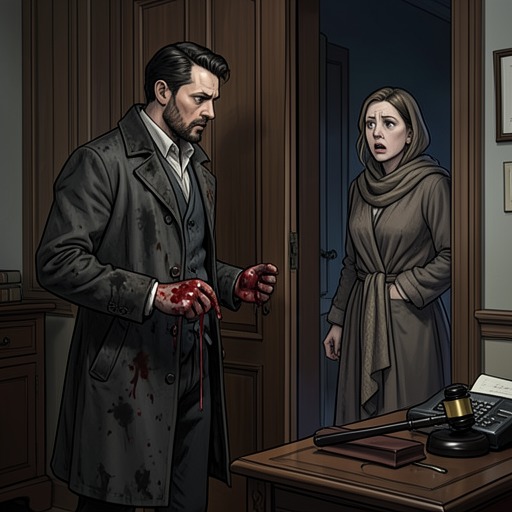
The judge's clearest direct action follows the murder of a man in Walheim. At the lodge, the eldest boy tells Werther that a peasant has been killed. The judge is already in unusual commotion with the household, and is reasoning with Charlotte: despite his infirmity, he insists on going to the scene and instituting an inquiry. The victim has been found dead at his own door, and suspicion falls on a former servant of the widow for whom the murdered man had worked.
Werther recognizes the arrested suspect as the former servant he had previously known and feels convinced of the man's guilt. He also sees the case through the servant's attachment to the widow and responds with pity, believing the crime excusable and his own condition nearly akin to the prisoner's. This personal identification drives him to seek the judge's intervention, first arguing passionately for the prisoner and then asking that the judge connive at his escape.
Law and Werther's Appeal
The judge hears Werther's argument but rejects its premise. He reasons that excusing the crime would establish a precedent by which any law might be violated and public security destroyed. He also explains that he cannot act without incurring serious responsibility: the case must proceed through the ordinary channel. His refusal is therefore not presented simply as a personal rebuff; it rests on the institutional limits of his office and the consequences he believes an exception would carry.
Albert, who has arrived before Werther, agrees with the judge. Werther presses his plea with zeal and determination, but the judge interrupts, argues seriously, and rebukes him for becoming the advocate of a murderer. He will neither bend the legal process nor assist the prisoner's flight. His decision makes the conflict concrete: Werther places individual suffering and compassion above procedure, while the judge insists that the law's general application and public safety cannot be set aside for a sympathetic case.
Character and Narrative Role
The judge's firmness contrasts with Werther's emotional urgency, but the narrative also records Werther's recognition that the opposing view is reasonable. Werther suspects that Albert's remarks contain personal bitterness toward him, yet admits in reflection that the judge and Albert are correct; he is simply reluctant to concede it. The judge thus helps expose the divide between Werther's judgment in the abstract and his conduct when feeling takes hold.
His role remains defined by a small number of consequential appearances: the widowed father living with his children, the man who insists on investigating a local killing despite infirmity, and the magistrate who refuses to convert pity into interference with the law. The case ends without the judge granting Werther's request, and Werther leaves in anger. The contrast between domestic sympathy and judicial obligation gives the character his significance: he is both part of the family world that first draws Werther toward the lodge and the official boundary that Werther's compassion cannot overcome.