Walheim
The Sorrows of Young WertherWalheim is the rural village where Werther settles for a time, drawn by its quiet landscape and the modest daily pleasures it affords. To him, it becomes both a refuge from unsettled thoughts and a place of close observation: under its linden trees and among its cottages, ordinary family tenderness and rural hardship stand side by side.
Setting and Landscape
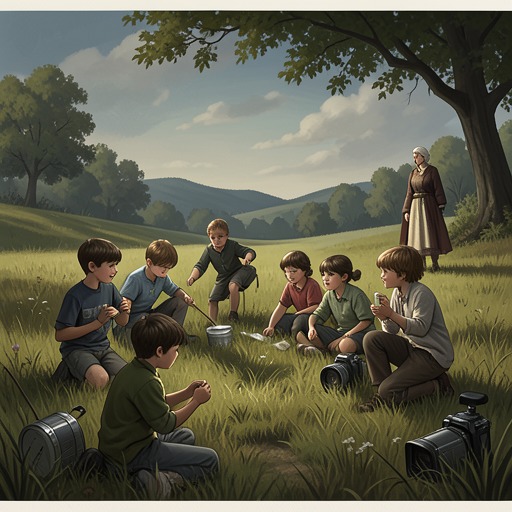
Walheim lies about a league from town on the side of a hill. Footpaths leading out of the village open onto a view across the valley, and the place’s quiet green, shaded by two enormous linden trees near the church, is bordered by peasants’ cottages, barns, and homesteads. An old woman keeps a small inn there, selling wine, beer, and coffee. Werther often has his table and chair brought outside, where he drinks coffee and reads Homer.
The village’s appeal belongs to a wider contrast in Werther’s account: he finds the town disagreeable but the surrounding countryside beautiful. Walheim gives that beauty a particular, lived-in form. It is not an empty wilderness but a settled community whose paths, church green, and farm buildings provide the setting for the human encounters that hold his attention.
Werther’s Retreat and Daily Life
Werther first comes upon Walheim by chance during a walk. He is taken by the sight of a four-year-old boy carefully holding a baby between his knees while the rest of the village is out working in the fields. Sitting on a plough, Werther sketches the children together with a hedge, a barn door, and broken cart wheels. The unarranged details confirm his preference for observing nature directly rather than imposing an artistic design upon it.
After meeting the children’s mother, Werther learns that she had left the baby in the older boy’s care while she went to town with her eldest son to buy wheaten bread, sugar, and an earthen pot. Her husband is away in Switzerland seeking money left by a relative. Werther gives the children kreutzers, including an extra one for the youngest, and later returns often. They grow familiar with him; he shares milk and bread and butter with them, gives them lumps of sugar, and arranges for them to receive their Sunday kreutzer even when he does not visit after evening service.
Walheim also becomes the setting for a deliberately simple routine. Werther gathers peas in the garden for his dinner, shells them while reading Homer, then prepares and cooks the meal himself with butter from the kitchen. He connects these small tasks to the self-sufficient life he associates with Homer’s world and with the peasant who enjoys food raised through his own labor. The routine gives him pleasure not through novelty or grandeur, but through work, recollection, and attention to the seasons of ordinary life.
Villagers and the Limits of the Pastoral Ideal
The people Werther encounters make Walheim more than a picturesque retreat. The mother’s care for her children and the older boy’s tenderness first appear to him as an image of innocent, uncomplicated affection. He finds that watching her and the children can quiet his own disturbed thoughts. Yet the family’s circumstances are not carefree: the mother worries that the children might inconvenience a gentleman, while her husband’s journey ends without the money he sought and with him returning ill.
When Werther later visits the old woman beneath the linden trees, the eldest child runs out to greet him, but the mother tells him that the youngest has died. Her husband has also returned from Switzerland without money and was taken ill with fever on the journey; he would have had to beg his way home without help from others. Werther is unable to answer her news and leaves sorrowful after giving the child a present and accepting some fruit. The place that had offered him a picture of calm domestic life thus also discloses bereavement, illness, and financial insecurity.
A separate encounter in Walheim’s rural setting concerns a peasant lad who works for a young widow and is deeply attached to her. The lad’s devotion, and the obstacles surrounding the possibility of marriage, become part of Werther’s attention to village life and to the passions he believes can be found among people society calls uneducated. Walheim’s green and farm surroundings frame not only affection and repose but also unequal expectations and personal misfortune.
Narrative Significance
Walheim’s meaning shifts without losing its physical features. Its hillside paths, linden trees, church green, and small inn remain associated with quiet and natural beauty; the children and Werther’s daily cooking give that setting the texture of repeated, modest pleasures. At the same time, the death of the youngest child and the family’s material troubles resist the notion that rural simplicity guarantees happiness.
For Werther, the village is a place where observation becomes both artistic principle and emotional practice. He studies children, villagers, work, and landscape as things that should be encountered without embellishment, yet his response to them is intensely personal: the children soothe him, their loss grieves him, and the peasant lad’s story draws his sympathy. Walheim therefore holds together the comfort Werther seeks in nature and the human suffering that prevents that comfort from becoming a complete escape.