
The Road from Grief to Care
The StaircaseLizzy’s daily acts of responsibility transform bereavement from private suffering into a capacity to protect others.
increasing Bearing strength in each event
 decreasing
Bearing strength in each eventdecreasingA Child Refuses to Cry
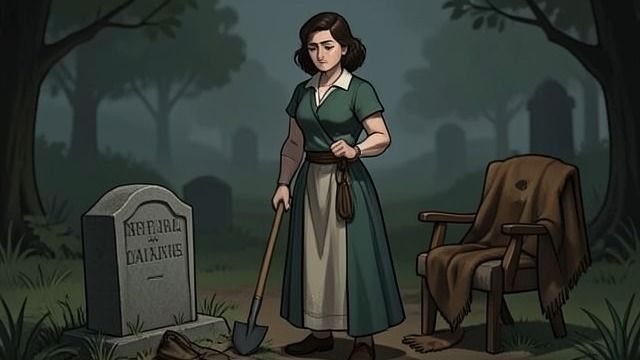
A Child Refuses to Cry
Grief Delayed
Lizzy watches Mama lowered into the grave without tears. She tells herself that the place is not holy and that Mama is already gone from the buffalo robe.
Her refusal to grieve is not indifference. She has not yet learned how grief feels and uses anger and bluntness to keep the loss at a distance.
The Body Remembers
At night, Lizzy’s body shakes with sobs she calls hatred for Elinora. Her emotional defense cannot stop grief from emerging when she is alone.
The burial initiates a long process rather than a completed farewell. Lizzy will repeatedly discover that feelings she has disowned remain present in her body.
Meals Beside the Grave

Meals Beside the Grave
An Appetite Lost
Lizzy cannot eat while Mama lies nearby. Mrs. French explains that eating on the trail is necessary for survival, even when desire has disappeared.
Lizzy looks at Mr. Enders and decides to stay alive for him. The decision is tentative and made in the middle of a meal she can barely touch.
Care Begins as Duty
Lizzy later helps with chores and feeds the children, even while she feels hollow. Practical care enters her life before emotional recovery does.
The novel shows survival as an action repeated in ordinary moments. Lizzy’s ability to serve others will eventually grow into genuine chosen responsibility.
A Friend’s Worries

A Friend’s Worries
Violate Shares Her Fear
Violate tells Lizzy about her failing strength and fear that the convent will baptize her Catholic if she loses consciousness. She asks Lizzy to promise to undo it with an asafoetida bag.
Lizzy doubts the remedy but agrees, recognizing that Violate needs someone to take her fear seriously. Their friendship gives each woman a listener for what she cannot comfortably tell others.
Mutual Care
Violate also asks about Lizzy’s worries and insists that friends share both trouble and good news. Lizzy admits her concern about her father and the future of the carpenter.
The relationship is reciprocal rather than merely charitable. Lizzy learns that being cared for does not prevent her from caring for someone else.
The Baby in the Garden

The Baby in the Garden
Testing an Attachment
Lizzy takes Elena into the garden after Delvina’s death and tells herself that the baby’s importance is only temporary. She tries to determine whether her earlier promise to take Elena was sincere.
The attempt to deny her feelings reveals how much she fears becoming attached to someone she may have to leave. Elena’s helplessness draws out the tenderness Lizzy is trying to suppress.
Love Becomes a Choice
Lizzy later asks Jean Baptiste Lamy to consider placing Elena with her and Mr. Enders. She accepts that the decision requires more than affection and must be safe for the child.
The bond moves from fantasy to commitment. Lizzy chooses care not because it will repair her own losses, but because Elena needs a future.
Going Forward Together

Going Forward Together
A Family in Motion
Lizzy leaves Santa Fe with Elena, Ben, Cleo, and companions who will help the journey succeed. The group carries both affection and practical support into the uncertain road ahead.
Lizzy’s family is no longer limited to the household she lost in Missouri. It includes relationships built through shared care and the choice to remain responsible.
Grief Still Present
The departure passes the hills near Fort Marcy and the graves of Robert and Violate. Lizzy remembers those who are gone even as she moves toward a new home.
Her growth does not require forgetting. She can carry grief and still make plans for the living.
At Mama’s burial
The first supper after Mama’s burial
After Lizzy begins visiting the cemetery
The week José waits at the Bishop’s farm
The final departure in April
