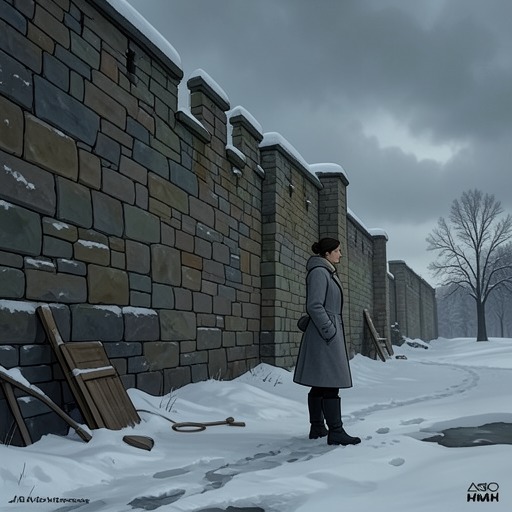
A land of fancy and a land of stark truth
The StaircaseA land of fancy and a land of stark truth is Violate Lacey’s compact description of Santa Fe and the interpretive principle that shapes the novel’s staircase mystery. The phrase holds enchantment and painful reality together: in a city alive with marvels, stories may be more than stories, but belief never cancels the need to judge what is true. Lizzy Enders encounters both possibilities in the beggar carpenter she brings to the convent, and the novel leaves the decisive question open.
The Phrase and Its Speaker
Violate Lacey tells Lizzy that Santa Fe can feel “prickly and sharp” when its stark truth is pressing close, yet can also enchant with magic. Her warning is not simply to accept the city’s marvels: the trick, she says, is recognizing which kind of experience one is facing. Fancy and truth are not cleanly separated into safe categories; their coexistence makes discernment necessary.
Violate Lacey’s own account of Jesse James immediately puts that uncertainty into play. She claims that he came to hide at the fort the previous night, says that he visits from time to time, and describes him as a nice young man about the age her son Robert would have been. Lizzy, who comes from Missouri, feels possessive of the outlaw as a figure from her own state and resents Violate Lacey’s claim on him. The exchange makes the phrase more than local color: Santa Fe’s enchantment is something people assert and contest, while Lizzy’s attachment to Missouri supplies her with a skeptical counterclaim.
The Carpenter and the Staircase
The chapel staircase turns the distinction between fancy and stark truth into a concrete problem. Jean Baptiste Lamy explains that the nuns have prayed a novena to Saint Joseph and that he, too, has prayed, but that the bishop cannot perform the miracles people expect of him. Faced with the need for a staircase, he accepts Lizzy’s practical suggestion: the hungry carpenter staying in the barn should inspect the work. He even allows that hunger may give a man a special vision. The response leaves room for providence without treating a miracle as a foregone conclusion.
The carpenter completes the staircase and disappears. When the girls and nuns gather at the back of the church, they see a graceful, polished circular arch rising to the choir loft: thirty-three carefully trimmed steps, glowing in the candlelight. Mother Magdalena interprets the result as proof that Saint Joseph came in the carpenter’s guise. The nuns kneel and pray, turning a startling piece of craftsmanship into a shared religious revelation.
Lizzy refuses that conclusion. She knows the carpenter as a person who spoke with her, listened to her troubles, held her kitten, and advised her about her father. He had also told her how sad he was to leave his own family and had been hurt when the girls rejected him. These ordinary acts of sympathy make the saintly explanation difficult for her to accept, even as the blind cat’s recovery after the carpenter held her leaves a small opening for belief. The same man can be understood as a hungry worker who showed kindness and as a possible instrument of the miraculous; the novel does not force Lizzy, or the reader, to collapse those possibilities into one.
Legend and Deliberate Uncertainty
The author’s note connects the fictional episode to the Loretto staircase legend. It recounts that the Chapel of Loretto was completed in 1878 without a way to reach its choir loft. The Sisters of Loretto, brought to Santa Fe from Kentucky in 1852 by Jean Baptiste Lamy to run the Academy of Our Lady of Light, consulted builders, carpenters, and architects. They were told that an ordinary staircase would take too much space, while rebuilding the loft would be costly; using a ladder was another proposed solution. The author describes the history and legend as a springboard for the novel, distinguishing the fictional Lizzy and her story from the historical tradition that inspired them.
The ending preserves, rather than resolves, the tension in Violate Lacey’s phrase. The nuns’ certainty that Saint Joseph built the staircase stands beside Lizzy’s personal knowledge of the carpenter and her reserve about Catholic miracles. The author’s note explicitly leaves open both whether the novel’s carpenter was Saint Joseph and whether the builder in the actual staircase story was. Santa Fe remains a land of fancy and stark truth precisely because its wonders are not made less powerful by uncertainty, and its truths do not automatically explain every wonder away.