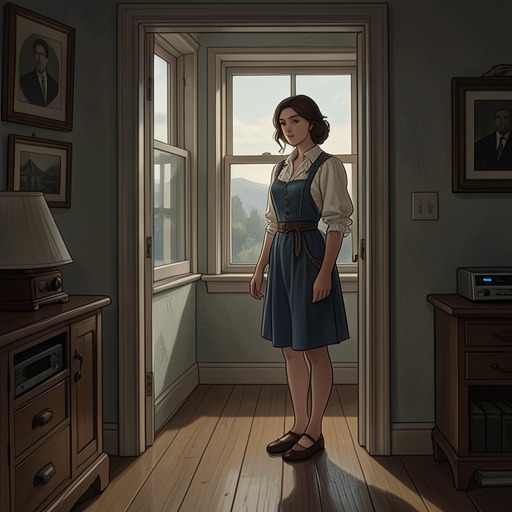
A person makes his own luck
The Staircase“A person makes his own luck” is a maxim Lizzy Enders attributes to her father, Mr. Enders. It enters the novel not as a detached piece of advice but as an unplanned recollection: while discussing belief and taking action, Lizzy finds herself speaking of the father she has not mentioned since he left her. The saying’s force lies in that conjunction of self-reliance and separation.
Meaning and Context
The exchange weighs faith against practical effort. One speaker affirms the value of belief and the need to undertake a task oneself; the man measuring as he works answers, “A little of both is the answer, I think,” before returning to his task. The maxim about making one’s own luck therefore arises in a conversation that does not treat hope and action as opposites. Its immediate context gives it a measured, practical sense: a person can believe while also trying to bring about what they need.
Mr. Enders and the Saying
Lizzy’s recollection surprises her. She recognizes that she has not spoken to anyone about Mr. Enders since he left her, so the old saying brings a newly exposed family wound into an otherwise ordinary conversation. When her companion calls her father a good man, Lizzy explains that he lost an arm in the war but can do most things with one arm. She also states the painful circumstance alongside that account of his ability: he left her there and went on to Colorado.
Significance in Lizzy’s Story
The maxim’s confidence sits beside Lizzy’s sadness at being left behind. Her father’s words present luck as something a person makes, yet her own circumstances include a separation she did not choose. The moment does not resolve that tension; instead, speaking the saying unexpectedly allows Lizzy’s sorrow to be recognized. Its significance is thus both practical and personal: it expresses an ethic of effort while revealing how strongly her father’s absence remains present in her thoughts.