Cats
The StaircaseCats are represented chiefly by Cleo, the kitten Lizzy Enders chooses in the midst of grief and comes to love as family. Cleo’s movement from warmth and companionship to injury, blindness, and apparent recovery makes her more than a comforting pet: her story gathers the book’s uncertainty about harm, care, and miracles into a small, closely observed life.
The Kittens and Cleo’s Selection
After two days of confusion, and on the night of her mother’s funeral, Lizzy receives a welcome reprieve. With Jean Baptiste Lamy away at his farm, Sister Roberta lets her into his study to choose a kitten. Four are there, each soft, helplessly mewing, and eager to cuddle in her hands. Because they look so much alike, the choice is difficult until Lizzy notices a small patch of amber on one kitten’s left paw. She selects that one for herself.
The kitten’s warmth and purring recall the cats Lizzy had known before, and the resemblance breaks through her grief: she cries, acknowledging that the moment has reached the part of her identified with the Cheyenne and Blackfoot. Naming the female kitten Cleo, she also connects her to the cat she left behind in Independence, Missouri. Lizzy imagines that the earlier Cleo would be flattered by the name, and promises the new kitten that she will take her home. The promise gives the choice a future-facing tenderness, even as it arises on the night of a burial.
Cleo as Companion
Cleo quickly becomes part of Lizzy’s daily life. Lizzy holds her in her lap, and the kitten is there during a gathering in which Lucy’s beads spill onto the floor. Cleo leaps down and pounces on them, scattering them as she races about. The playful disruption brings the convent’s prohibition against kittens into the open: Rosalyn picks Cleo up by the back of the neck, and Lizzy immediately rises to reclaim her.
The incident shows how exposed Cleo is in a place where she is not permitted. Her smallness and dependence are not abstract; they shape what Lizzy must do when someone else takes hold of her. Elinora’s subsequent threat to have Cleo dropped into a fireplace or drowned makes that vulnerability more ominous. Cleo’s place in the story thus shifts from a private comfort to a source of conflict, putting Lizzy’s attachment to her directly at risk.
Injury and Blindness
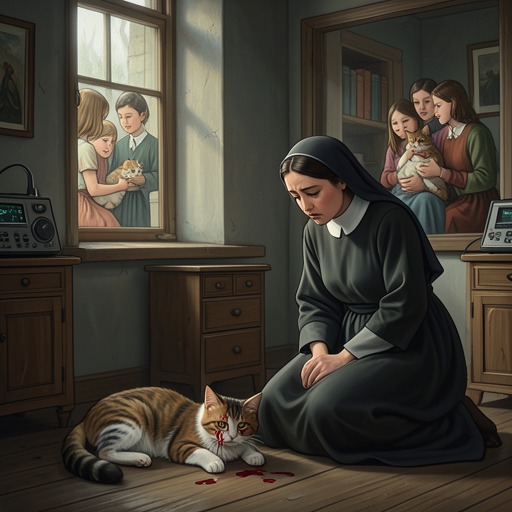
Lizzy runs out to find Cleo and searches for twenty minutes. She discovers the kitten dirty, frightened, and cold, huddled inside an old pipe in the ground. Blood is running from Cleo’s eyes. The discovery gives Elinora’s threat an immediate, bodily consequence, although Lizzy cannot establish at once exactly what has happened. Her question about what Elinora did to Cleo conveys both suspicion and uncertainty.
Later, Cleo emerges from Lizzy’s pocket while Lizzy is speaking with José. He cups his hands, and Lizzy places the kitten in them and explains that she is blind. When José asks whether she was born that way, Lizzy says no and hesitantly tells him what happened. His response—that Cleo might see again, and that Lizzy must love and care for her—offers hope without promising a cure. Cleo’s blindness is presented first as the consequence of an injury and as a real condition Lizzy must face, not simply as a symbol whose meaning is already settled.
The Yarn and the Unresolved Miracle
Elinora later insists that Cleo is not blind and invites Lizzy upstairs to prove it. Cleo is asleep on Lizzy’s bed. Elinora takes a ball of yarn from a drawer, unwinds it, and waves it over the kitten’s face. Cleo raises a paw toward the yarn and follows its movement with eyes that now seem bright and alert. Lizzy is astonished. The scene offers visible evidence of change, but does not explain how it occurred or establish what Cleo’s sight will be like thereafter.
Near the story’s end, Lizzy revisits that change in memory. She recalls Sister Roberta handing Cleo back and saying that the kitten was blind; Lizzy is certain that this had been true. She also remembers José holding Cleo and saying that she might see again. The recollection does not resolve the cause of Cleo’s apparent recovery. Instead, Lizzy wonders whether Saint Joseph could have been involved, placing the kitten’s experience among the other events she considers miracles while preserving her uncertainty about what to believe.
Narrative Significance
Cleo’s story moves through a series of sharply contrasting states: the warmth of a kitten held close, the danger of being seized, the cold shelter of a pipe, and the startling response to a moving strand of yarn. Each change is grounded in Lizzy’s attention to a particular detail—the amber paw, the blood at Cleo’s eyes, the kitten in José’s hands, the eyes tracking the yarn. That close attention makes the cat’s welfare consequential in its own right while also giving Lizzy a concrete experience through which to consider care and faith.
The final recollection brings the kitten back into the book’s unresolved account of miracles. Cleo’s apparent recovery supports hope, but the story offers no definite explanation that would settle Lizzy’s question. Her uncertainty matters: the miracle is not presented as a simple answer so much as a possibility attached to the care Cleo has received and the people who have spoken for her. Cleo’s small life therefore joins grief, danger, tenderness, and belief without making any one of them disappear.