Delvina's Death and Baby Elena's Remaining at the Convent
The StaircaseDelvina’s death leaves baby Elena at the convent, where the Bishop directs that she remain because her only known family is a drunken, violent father. The episode joins a mother’s death to the uncertain fate of her newborn, making practical care, local law, and religious authority part of the same crisis.
The danger before the death
Before learning that Delvina has died, Lizzy is trying to get her and the baby back to the convent. Sister Roberta explains that Santa Fe requires midwives to hold a license granted by a municipal judge and a certificate from their parish priest attesting that they know how to administer baptism. In her view, Delvina needs a proper midwife, so bringing her back is urgent as well as compassionate.
The baby’s survival weighs on Lizzy during the journey. She realizes she has not even asked whether the child is a boy or a girl, worries that it might die before they can return, and fears it would then be condemned to Limbo for Unbaptized Infants—and that she would be blamed. She regrets leaving the baby in the cold, while recognizing that carrying it would have made it harder to manage Ben. Her anxiety gives the later news a concrete human cost: the child’s safety had already depended on decisions made under pressure.
News and mourning
When Lizzy returns late that afternoon, Ramona tells her in halting English that Delvina has died. Lizzy knows the death was coming, but it still weighs heavily on her; after losing Mama, she had thought no death could diminish her in the same way again. The reaction links this loss to her earlier bereavement without making the two deaths interchangeable.
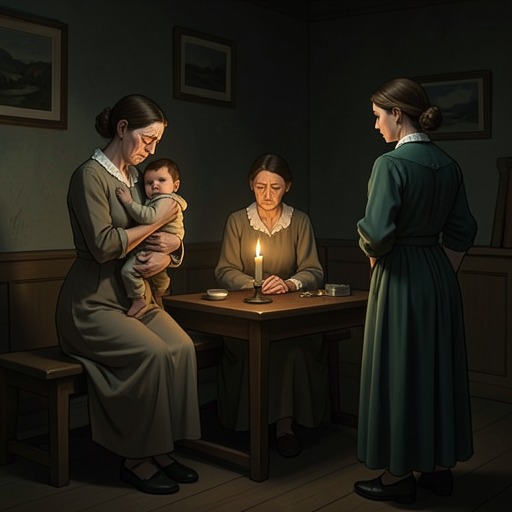
The convent marks Delvina’s death through a sudden change in its ordinary atmosphere. Candles that are usually unlit glow, mirrors are covered, prayers accompany the girls’ folded hands and lowered eyes, and the nuns hurry past with what Lizzy recognizes as winding sheets. The church bell tolls. These customs make grief visible throughout the school, while the preparations also reflect the urgency imposed by Santa Fe’s burial rule.
Funeral and Elena’s future
Mother Magdalena tells Lizzy that bodies must be buried within twenty-four hours in Santa Fe. Since the next day is Sunday, Delvina’s funeral will take place that evening. The compressed timetable leaves no room for a prolonged interval between death and burial: the convent must attend to the funeral at once while also deciding what will become of the infant.
The Bishop’s wish is that the convent keep baby Elena. Mother Magdalena explains that no relatives seem to be available apart from Delvina’s drunken, violent father. Lizzy has reason not to trust the danger he represents: she has been attacked by the man, but does not tell Mother Magdalena, thinking he is likely dead anyway. The decision therefore places Elena’s immediate safety in the convent’s hands, rather than with the only family member the adults can identify.
Care, authority, and religious anxiety
The episode sets formal religious and civic requirements beside acts of care. A municipal license and a priest’s certificate define who may serve as a midwife; the Bishop’s decision determines where the orphaned child will stay. For Lizzy, these institutional questions are inseparable from fear that the baby might die without baptism and be denied heaven. The convent’s response does not erase her distress, but it gives Elena a place to remain after Delvina’s death.
Delvina’s funeral and Elena’s continued presence at the convent thus form one consequence of the same loss. The law sets the hour of burial, while the Bishop’s intervention answers the more enduring question of the child’s protection. In a story already shaped by Lizzy’s grief for her mother, the event makes care for a living child a matter of urgent responsibility rather than abstract doctrine.