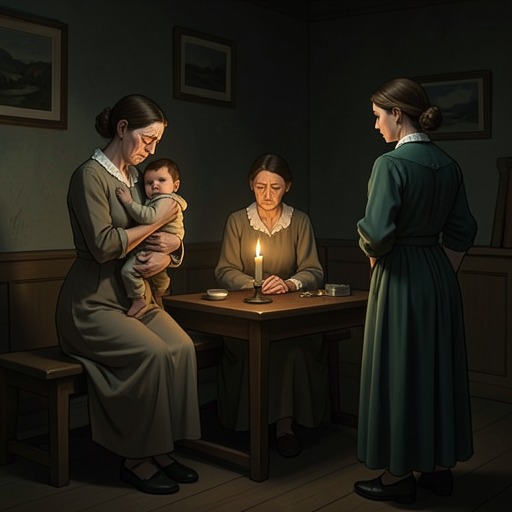
Delvina’s abuse and hiding from her husband
The StaircaseDelvina’s abuse and hiding from her husband form a continuing crisis in the novel: she is pregnant, living in an abandoned fort, and afraid that her husband will kill both her and their child. Her refuge depends first on Violate Lacey’s secret acts of care, then on whether the convent will risk sheltering her. The danger does not end when Delvina and the baby are brought to safety; her husband’s search for them later turns the threat against Lizzy Enders into a violent confrontation.
Life in Hiding
Delvina lives at the fort because she cannot return home safely. Violate Lacey describes her husband as a violent man who strikes her and whom Delvina fears will kill her and the baby when it is born. The account makes her refuge more than temporary inconvenience: the fort is the place she has found to escape an immediate danger, but it is an abandoned building rather than a secure home.
Violate visits Delvina and brings food and extra blankets. Her care is practical and repeated, and she calls Delvina her friend. She also keeps the arrangement secret, warning Lizzy not to tell anyone. The danger surrounding Delvina is made concrete by the presence of her husband nearby and the risk that he will discover her location. Violate says that Jesse James gave Delvina a twenty-dollar gold piece, a striking detail that Lizzy initially takes as another sign that Violate is confused. Yet the coin also belongs to the small resources available to a woman living in hiding, while the secrecy around it reflects how little protection Delvina can count on.
The Convent’s Refusal
When Lizzy proposes bringing Delvina to the convent, she is asking for more than a warmer room: she wants the institution to provide the safety that the abandoned fort cannot. The reply is an emphatic refusal. The convent’s leader says Delvina’s husband is a known brigand, a drunkard, a wife-beater, and a thief, and argues that sheltering her could endanger the girls. The convent therefore recognizes the seriousness of the threat but treats it as a reason not to admit Delvina.
That decision places institutional caution against personal responsibility. Lizzy cannot understand how those who claim the True Faith could allow a pregnant woman to remain in an abandoned fort. She thinks of what her own mother would do, measuring the refusal against a form of care that acts rather than merely acknowledges danger. The threat to forbid Violate from visiting her son Robert Lacey’s grave further reveals the leverage used to enforce silence: Violate’s access to the grave is made conditional on her keeping Delvina’s situation secret. The arrangement protects the institution’s rules while leaving Delvina exposed.
Rescue and a Fragile Sanctuary
The situation changes when Lizzy and Violate hear a baby crying at the fort. They hurry toward the remaining crumbling building, where they find Delvina after the birth. Lizzy has brought blankets and tells her that Sister Roberta wants her and the baby to come to the convent, which now has a place for them. The movement from the sound of the child to the offer of shelter gives the scene a practical urgency: the decision can no longer be postponed as an abstract question about policy.
Delvina hesitates because she knows that the convent may not be safe if her husband learns where she is. Her fear is not a refusal of help; it is an assessment of the danger that might follow her into the refuge. Lizzy answers that Bishop Jean-Baptiste Lamy has returned and assures her that he will not allow anyone to be harmed. With Violate’s support, Lizzy is sent to ride back for a wagon. Delvina’s move to the convent follows a chain of care—Violate’s visits, Lizzy’s appeal, and the arrangements for transport—but it remains a vulnerable sanctuary, dependent on keeping her husband at a distance.
The Threat Follows
Delvina’s hidden location is eventually connected to a direct search by her husband. At Robert Lacey’s grave, Lizzy is lighting the lantern and leaving a note for Jesse James when a man rushes at her and demands to know where his wife has been taken. He accuses Lizzy and Violate of knowing, shakes and drags her, and threatens to kill her unless she tells him. When he releases one shoulder, it is only to draw a knife.
A shot interrupts the attack. Lizzy hears the gunfire, sees the man’s hand fall from her shoulder, and then hits the ground. The scene does not identify the person who fired or establish the attacker’s ultimate fate, but it makes plain that Delvina’s husband’s violence has reached beyond the woman he abused: the attempt to protect her exposes Lizzy to the same danger. Delvina’s refuge thus remains precarious even after the convent agrees to take her in. The sequence also changes the meaning of the earlier secrecy. Concealment was not needless rule-breaking; it was a response to a man willing to use threats and a knife to find his wife and child.