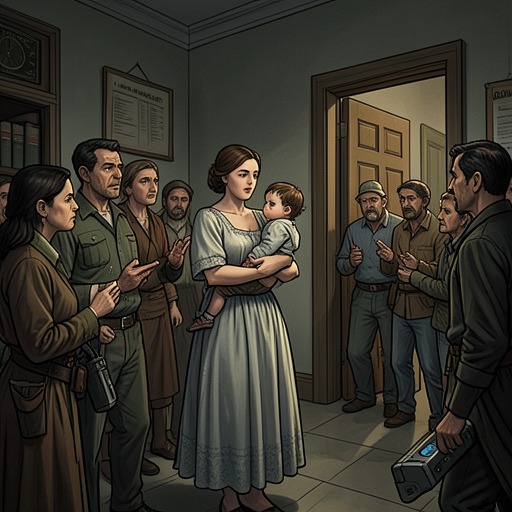
Elena Is Permitted to Go to Texas with Lizzy
The StaircaseElena’s permission to travel to Texas with Lizzy Enders turns a vulnerable baby’s uncertain future into a concrete journey and gives Lizzy a new responsibility beyond the convent. The decision is not granted at once: Elinora St. Clair proposes a home for Elena, Bishop Jean-Baptiste Lamy insists on verifying the plan, and the eventual departure depends on family assurances and an organized escort. By the time Lizzy leaves Santa Fe, the baby is traveling with her toward a household that promises care, while Lizzy herself discovers that departure can feel like leaving home.
The question of Elena’s future
The proposal takes shape after Elinora St. Clair says she has been thinking of asking Abeyta’s family to help find Elena a home. Lizzy Enders answers that she has thought of something that might make amends for the harm Elinora has done to her and her cat, Cleo. The suggestion becomes a plan to take Elena to Texas with Lizzy, rather than leave the child’s future to an influential local family.
Elinora presents the practical case to her uncle, Bishop Jean-Baptiste Lamy. Lizzy Enders’s father is expected to become foreman at one of the Southwest’s largest ranches, in Texas, and has asked his daughter to join him. Elinora argues that Elena could grow up there in an atmosphere of health and love. She also warns that if Elena remains anywhere in New Mexico, Ramon Baca will find her. The proposed journey is therefore both an offer of a home and an answer to a danger Elinora identifies.
The ranch gives the proposal a specific destination rather than a merely hopeful one. Lizzy Enders names Santa Gertrudis Ranch, near Eminence, and explains that her father expects to run it as he ran his plantation before the war. Bishop Jean-Baptiste Lamy knows Mr. King, the ranch’s owner, and has visited there. His familiarity makes it possible for him to assess the plan through people and circumstances he can check, not simply through Elinora’s appeal.
Permission with conditions
Bishop Jean-Baptiste Lamy responds first by asserting his jurisdiction over Elena. He will not consider the arrangement until he has written to Mr. King and to Lizzy Enders’s father to learn whether they agree. He also requires them to guarantee that Elena will have a good home. At this stage, the plan is not yet final permission: it is an application whose success depends on answers from Texas and on the conduct of the two girls.
Elinora points out that ordinary mail takes a long time and proposes using Abeyta’s father’s influence to send a message quickly to the ranch. The bishop agrees to write the letters and send them with Abeyta’s father’s messenger. He says that, if Mr. King and Lizzy Enders’s father both agree and guarantee a suitable home, he will consider the request. His conditions preserve his authority over Elena while allowing Elinora’s practical suggestion to move the plan forward.
The exchange also reveals a difference between Elinora’s confidence and the bishop’s measured decision-making. Lizzy Enders suspects that Elinora has been using her uncle’s concern for her behavior to advance her own intentions, but the bishop is not simply being maneuvered: he sets the terms, arranges the correspondence, and makes the outcome depend on verifiable consent. His knowledge of the ranch and its owner gives the proposed placement a basis beyond persuasion.
From a feared responsibility to a planned journey
Lizzy Enders’s readiness to take Elena is framed by an earlier anxiety about the baby’s survival. While hurrying to obtain help for Delvina, Lizzy recalls Sister Roberta’s explanation that midwives in Santa Fe must hold a municipal license and a certificate from their parish priest confirming that they know how to administer baptism. The rule makes the baby’s return to the convent for a proper midwife urgent in Lizzy’s mind. She worries that the child might die before they could bring her back and that she would be blamed. The later plan for Elena’s care turns this earlier fear into sustained responsibility rather than a passing rescue.
That concern exists alongside Lizzy Enders’s own uncertain place in the convent. Evening prayers have become a quiet interval in which she can sort through her thoughts and remember her mother. Sister Roberta, meanwhile, combines convent life with acts of practical care: she sets out medicine for Mrs. Lacey and sweet coffee with milk and nutmeg. These details do not determine Elena’s destination, but they establish a world in which protection is expressed through daily attention as well as religious authority. Lizzy’s proposed care for Elena belongs to that practical register: a child needs a secure home, not only a decision about where she should live.
Departure for Texas
Four months later, the plan has become a journey. The new Santa Fe Railroad has reached the plains of New Mexico, only sixty-five miles from Santa Fe, but Lizzy Enders is not traveling by that route. She is leaving for Texas, where her father has become an important manager at Santa Gertrudis Ranch. He has an adobe house with a courtyard; a Methodist circuit rider visits monthly, and the ranch has a school for its children. Lizzy confirms that she can bring Elena.
Bishop Jean-Baptiste Lamy has arranged the trip. Teresa Espinosa, Elena’s wet nurse, will accompany Lizzy with her husband, Georgio, and their baby boy. Abeyta’s father supplies an escort of six expert riflemen and scouts, and the party travels in three wagons. Elena is already asleep in one of them as Lizzy prepares to mount Ben. The arrangements make the permission tangible: Elena does not leave alone with a child, but with a nurse, a family, an armed escort, and a destination where Lizzy’s father can provide a household.
The departure takes place on a fine April morning, with fruit trees in bloom. Abeyta and Elinora St. Clair stand hand in hand as Lizzy makes ready to go. Elinora whispers something just before Lizzy mounts, but Lizzy’s uncertainty about what she heard remains unresolved. After the wagons set off down Santa Fe’s main street amid waves and cheers, Lizzy realizes that she feels as if she is leaving home. She expects to miss everyone, including Elinora, and promises to invite her to the ranch in the future. The journey gives Elena a place in Texas, but its emotional consequence is also a changed understanding of the convent: the institution Lizzy once entered as an outsider has become a home she must leave.