Elinora blames Lizzy for their secret outing
The StaircaseElinora’s false account of the secret outing turns a shared act into Lizzy’s apparent misconduct. Before Bishop Jean-Baptiste Lamy and the convent household, Elinora presents herself as a protective friend and Lizzy as the one who wanted to break the rules; the resulting punishment falls on Lizzy, while Sister Roberta privately acknowledges that she is not the culprit.
Return and Public Explanation
The episode begins as Lizzy and Elinora are brought back through a gate after a beggar lets them in. Consuello sees them in the courtyard and announces their return to the assembled household, addressing the arriving bishop as Your Eminence. Bishop Lamy strides toward them in a buckskin riding coat, dusty boots, and a wide-brimmed hat. His appearance combines the authority of his office with the visible signs of travel, while the people around him gather to witness the reunion.
Elinora runs to her uncle, kneels at his feet, and asks forgiveness. She says that Lizzy wanted to sneak out and that she had gone along because she feared for Lizzy’s safety. By describing herself as a friend who had accompanied Lizzy, Elinora makes the outing sound like an act of care rather than a choice she shared. Her account does not deny that she was there; instead, it rearranges the responsibility between them. Lizzy, watching, recognizes the explanation as a lie and is stunned by both its content and Elinora’s performance of remorse.
A Blame Shift in Front of the Household
The account is delivered before more than the bishop. Nuns, boarding girls, household workers, and strangers drawn in from the street have gathered around Elinora and Lamy. The scene therefore makes the explanation public: Elinora’s version is heard at the same moment that Lizzy is left without an opportunity to correct it. The crowd’s applause follows the bishop’s embrace of Elinora, giving her visible welcome as Lizzy’s treatment turns sharply in the opposite direction.
Mother Magdalena steps forward, takes Lizzy by the arm, and accuses her of causing the night’s trouble. Her response shows the immediate force of Elinora’s story: the girl identified as the instigator is led away for discipline, while the person who accompanied her is embraced. The scene establishes the practical consequence of the lie without showing the gathered crowd investigating whose account is true. Its contrast is especially stark because Sister Roberta, looking at Lizzy, silently signals that Mother Magdalena has the wrong culprit.
Punishment and Private Care
Mother Magdalena gives Lizzy a switching with the switch kept in her office. It cuts through Lizzy’s long purple uniform and underclothes. Lizzy has never been switched before; although the physical pain is severe, she describes the humiliation as worse. Her punishment thus extends beyond the immediate sting: in the public aftermath of the outing, she is treated as guilty and made to bear the visible cost of Elinora’s explanation.
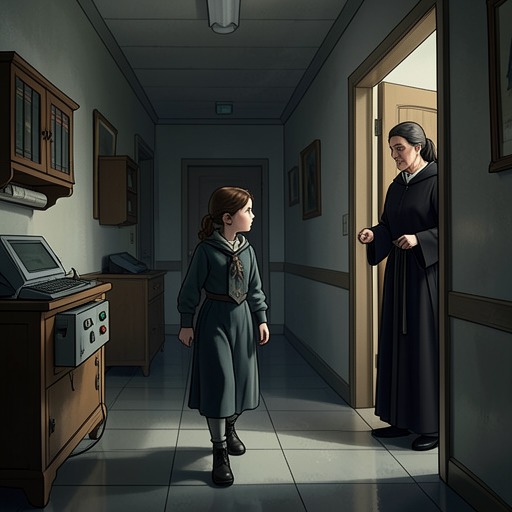
Afterward, Lizzy is sent to the room the girls call the dungeon, though it is a small room beside the kitchen rather than a dungeon. It contains a hardboard bed without a mattress, pillow, or more than a thin blanket; a high, small window; a crucifix; a nightstand with a bowl and pitcher of cold water; and one candle burning in an alcove. The nuns call it the penance chamber. Lizzy shivers and weeps there, alone with the consequences of the accusation.
Sister Roberta’s response provides a quiet counterpoint to the punishment. She comes after the house has settled, brings a pillow and blanket, and warms Lizzy’s feet with a brick wrapped in a towel. She explains that the Sisters sometimes use the room when fasting and doing penance, but that Lizzy has no need to do penance; in bringing comfort, she knowingly breaks the rules. She returns from the kitchen with hot chocolate, sits beside Lizzy, and holds her. Her care does not reverse the sentence or expose the lie publicly, but it refuses to treat Lizzy as deserving of the suffering imposed on her.
What the Scene Leaves Unsettled
Lizzy fears that Bishop Lamy will hate her or put her out. Sister Roberta tells her not to worry and suggests that he is not anyone’s puppet and likely already knows his niece has lied. That is Sister Roberta’s belief, not a confirmed judgment from the bishop: the scene supplies no direct response from Lamy about the truth of Elinora’s account. The uncertainty matters because the public display seems to settle the matter against Lizzy, while the private exchange keeps open the possibility that the bishop sees through it.
The episode makes truth and authority unevenly visible. Elinora’s explanation gains force from its timing, her performance of contrition, and the audience before which it is given; Lizzy’s knowledge of what happened cannot protect her from immediate punishment. Sister Roberta’s silent protest and subsequent kindness offer a different form of recognition, grounded not in public authority but in attention to the person being blamed. The outing’s aftermath therefore leaves Lizzy isolated and humiliated, yet not wholly disbelieved: someone in the convent recognizes the false accusation and acts on that recognition in the only private way available to her.