Elizabeth's Father's Letter
The StaircaseMr. Enders's letter is both a practical report of his changing plans and a stark measure of the emotional distance between him and Lizzy Enders. It offers her a possible future at a Texas ranch, but says almost nothing about leaving her behind; its account of cattle, acreage, and wages gives concrete shape to the life he is arranging while making the absence of an apology or tender concern all the more conspicuous.
The Letter Arrives
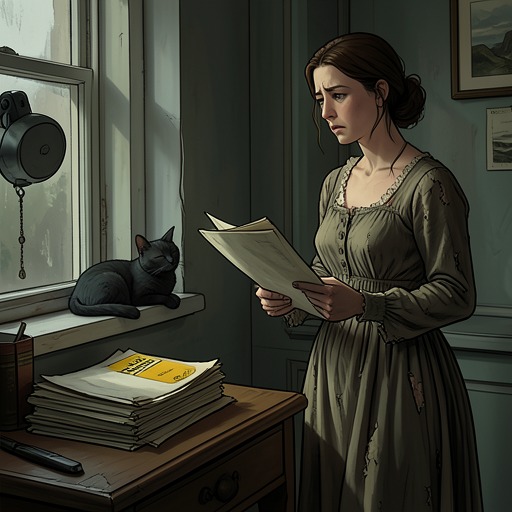
Mother Magdalena gives the letter to Lizzy after telling her that Delvina's funeral will take place that evening, in accordance with Santa Fe's requirement that bodies be buried within twenty-four hours. The convent is keeping Delvina's baby because, as Mother Magdalena explains, the child has no known relatives except a drunken and violent father. In this moment of death, danger, and uncertain family belonging, the arrival of a letter from Lizzy's own father carries a heavy charge. Mother Magdalena addresses her as Elizabeth, and the writing begins “Miss Elizabeth Enders.” Lizzy recognizes Mr. Enders's familiar scrawl, but can scarcely move to accept the paper. She is afraid it might burst into flames in her hands; even its writing seems to burn into her.
She is excused from supper to read it. The letter rests in her lap “like some dead thing,” an image that makes the message feel less like a living connection than a painful object she must confront. Its opening, “Dear Lizzy,” unsettles her. She questions how Mr. Enders can call her dear after leaving her when she needed him most, and recalls that she has always considered such letter-opening endearments foolish. The word therefore does not reassure her: its conventional affection clashes with the abandonment she remembers.
A Change of Destination
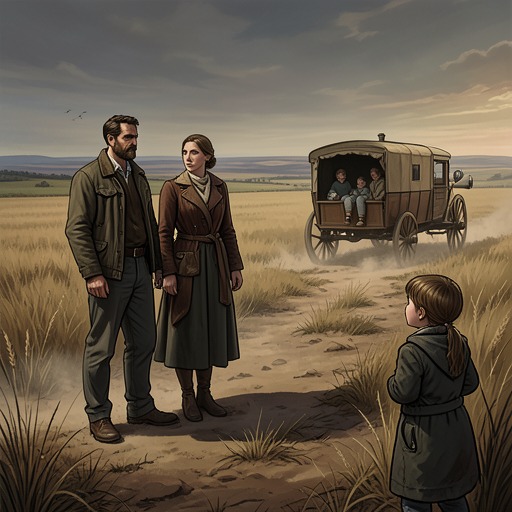
Mr. Enders reports that he is on his way to Texas. He had initially set out along the Gila Trail intending to go to Colorado, but met a drover employed by the Santa Gertrudis Ranch, a Texas property owned by King. The drover had recently driven a herd north to the Plains and told him that the ranch needed capable men. Mr. Enders, who had once run a plantation, changes course at once after hearing that the work would pay well. The letter presents his decision as a response to opportunity: a new route follows from a recommendation and the promise of employment.
The proposed job is unusually specific. Mr. Enders writes, “Especially, he needs a foreman,” explaining that Texas is sending millions of cattle to eastern markets. King owns six hundred thousand acres and needs someone to hire and oversee responsible men taking about five thousand market-ready steers to Kansas. Mr. Enders estimates that he can earn more than five thousand dollars a year. The figures make the ranch's scale and the prospective wage vivid, but they also give the letter its governing vocabulary: work, responsibility, cattle, markets, and money. Lizzy reads the message as being about “profits” and the cattle market, not about the relationship the letter might have repaired.
The Future Mr. Enders Offers
Against this detailed business account, Lizzy notices how little space is given to her. She judges that there is only one line about her and no sentiment about having left her. Mr. Enders writes, “I know you will do well at school,” and says that after her education she can come live with him at the Santa Gertrudis Ranch. If he gets the job, he adds, he is to have his own small hacienda. His plan thus includes Lizzy, but only as a later prospect: first comes the work and the ranch, while their reunion is deferred until she has completed her education and his employment is secured.
That future remains conditional. Mr. Enders has changed direction because the ranch appears to offer good-paying work, yet the job is not confirmed in the letter. The hacienda is also contingent on getting it. His assurances offer Lizzy a place in a possible future without acknowledging the immediate fact that he has left her at school. The gap between the definite figures he supplies for the cattle operation and the distant, conditional terms of his promise to her gives the letter its particular emotional imbalance.
Lizzy's Reading of Its Silence
Lizzy's response is divided. Tears roll down her face as she considers what the cattle market might be like by the time her education is finished, and what place there might then be for a daughter who hates her father and still yearns for him. The letter does not resolve that contradiction. Its practical promise is enough to keep a future with Mr. Enders imaginable, but its failure to express regret leaves the wound of his departure untouched. The message can be read as an invitation to join him eventually; Lizzy experiences it as evidence that he has not understood what his leaving meant to her.
After reading, Lizzy goes to the barn and feeds Ben. The oats and the animal's steady eating comfort her, offering a simple, dependable act in contrast to the uncertainties of human affection. She tells Ben that Mr. Enders has written without even saying he was sorry he left, and that he now wants her to write back. Her question about how she can answer shows the letter's consequence: it has reopened communication, but has not made replying emotionally possible. As an object, it carries both the prospect of reunion and the proof, as Lizzy sees it, of what remains unsaid.