Enders’s father’s disability from losing an arm
The StaircaseMr. Enders’s missing arm is both a visible reminder of the Battle of Buzzard Roost Gap and a lasting condition that shapes his family’s life after the war. The injury is not presented as an isolated wound: it accompanies lost wealth, diminished confidence, and conflict over what it means to provide for his family. For Lizzy Enders, the empty sleeve first belongs to the father she resents; later, it becomes part of the face of a man whose grief and hardships she is only beginning to understand.
The War and Its Aftermath
Mr. Enders lost his arm in the Battle of Buzzard Roost Gap during the American Civil War. Lizzy recalls that the injury belonged to a wider upheaval in the family’s fortunes. After the war, General William Tecumseh Sherman issued Sherman's General Order No. 15, and the family’s ruined plantation was given to formerly enslaved people. Mr. Enders and Mama went to Independence, Missouri, where Mama’s family gave him work in their mercantile business. They lived in the family’s large house, but employment and shelter did not restore his former sense of independence: Lizzy remembers him moving through the house with his spirit cast down because he could no longer keep a roof over his own family’s heads.
The injury is thus set against an economic and personal loss that cannot be reduced to the body alone. The novel identifies the arm as a physical consequence of war, while the family’s dependence on Mama’s relatives gives that consequence a social dimension. Mr. Enders has a job and a home, yet Lizzy understands that he feels diminished by relying on others. That tension helps explain why the family’s move west is not simply a search for opportunity. When Mr. Enders says they must go to Colorado to seek gold, the decision carries the pressure of a man trying to reclaim the ability to support his household, even as Mama mourns the life they are leaving in Independence.
The Empty Sleeve in Lizzy’s Memory
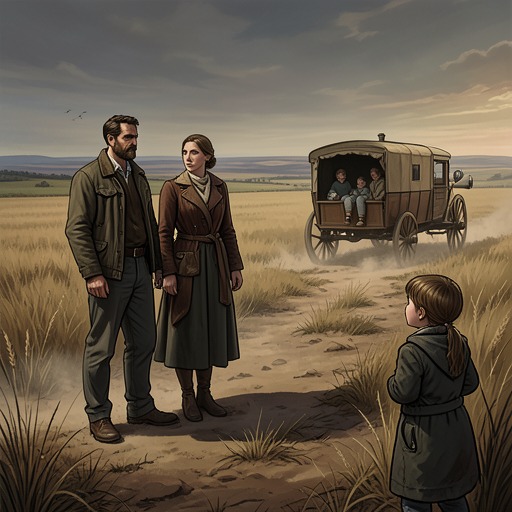
Lizzy’s recollection makes the injury concrete through the image of Mr. Enders’s empty shirt sleeve, pinned up. Looking at the sharp outline of his face, she remembers what Mama had said about his eyes: they had seen hell in the war and still recalled what it looked like. The pinned sleeve and the sadness in his eyes hold different traces of the same history. One is plainly visible; the other has been described to Lizzy by her mother, giving the child a way to read a sorrow she does not yet fully comprehend.
That image appears at a moment when Lizzy’s feelings begin to shift. She has covered her old love for her father with anger at his decision to take her and Mama away from Independence. On the journey west, anger seems safer than other feelings, and Uncle William’s advice gives it a practical purpose: “Keep your anger if you can keep nothing else, Lizzy.” Yet seeing her father’s face and pinned sleeve allows some of her old affection to rise again. Her changing response does not erase the anger; it shows that the injury has become part of a more complicated recognition of the person she has been resisting.
Work, Protection, and Separation
The arm’s consequences also surface in the account of a robbery at the mercantile. A gunman held up the store, and Mr. Enders, who had refused to use a gun since the war, did not stop the robber from escaping. Uncle William was disappointed in him, while Lizzy was disappointed that the robber was not Jesse James. The episode places Mr. Enders between two judgments: an adult’s expectation that he should have prevented the robbery and a child’s romantic wish for an outlaw adventure. The account states his refusal to use a gun, but does not say that the missing arm made resistance impossible. Its significance lies instead in the contrast between the violent world the family has survived and Mr. Enders’s postwar refusal to take up a weapon.
His injury remains part of Lizzy’s understanding of their relationship even when she speaks of it indirectly. At the grave of Mama, when Lizzy asks whether her father will leave her, Mr. Enders corrects her grammar and invokes her mother’s education, then tests the firmness of the cross before turning toward the fire. The gesture of tending the grave offers a brief picture of care amid their argument. Later, Lizzy’s thoughts about the religious rules at the convent return to his arm: she remembers that he has not prayed since he lost it in the war. His disability is linked not only to work and status, but also to a rupture in religious belief that she cannot repair by being told to pray for him.
What the Injury Means to the Family
When Lizzy explains her background to Mrs. Lacey, she says that her mother died on the Trail and that her father has been nothing since the war; when asked directly, she confirms that he lost an arm. The exchange makes the injury one part of the family’s bereavement and displacement, rather than a fact detached from them. Mrs. Lacey’s own account of having lost Robert follows, and the conversation brings two losses into proximity without making them identical: one concerns a son who died, the other a father living with the aftermath of war.
The novel also places Mr. Enders’s loss beside Lizzy’s sense of abandonment. She is expected to pray for him, love him, and forgive him for walking away without saying goodbye. The evidence does not make his arm a simple explanation for his choices, nor does it erase their effects on his daughter. Instead, the missing sleeve recurs as a material sign of a past that has altered his confidence, his relationship to weapons and prayer, and his understanding of his role as provider. Through Lizzy’s changing attention to that sign—from anger, to recognition, and back to the pain of separation—the injury registers as an ongoing family history, not merely a battle wound.