José
The StaircaseJosé, the carpenter who arrives as a beggar, stands at the meeting point of practical labor and religious expectation. He makes a coffin for a dead woman, is ordered to pause his work on a chapel staircase, and ultimately completes that staircase before leaving. To Lizzy Enders, he is not simply a mysterious craftsman: his discomfort with charity and his response to Cleo’s suffering expose the human costs that the convent’s language of holiness can obscure.
Identity and Work
José is identified in the scenes as a carpenter, but his work is not confined to the staircase. When he comes to the barn to ask Lizzy Enders whether the coffin he made is all right, he explains that he had made it in a hurry for the woman. The exchange gives his craft an immediate, unceremonious purpose: before his work becomes the focus of a religious controversy, it has served a bereaved community’s most urgent need. He does not ask Lizzy for praise; he wants to know whether the coffin is acceptable.
His place at the convent is also marked by poverty and dependence. Later, Lizzy finds him mending his sandals on a bale of hay. She hopes to persuade him to stay, but José answers that he is not wanted and that knowing this is worse even than accepting charity. His words distinguish material assistance from belonging. Food or shelter may answer a need, but they cannot make a person feel welcome; the fact that he must depend on others does not erase his sense of being unwanted.
The Coffin and the Interrupted Staircase
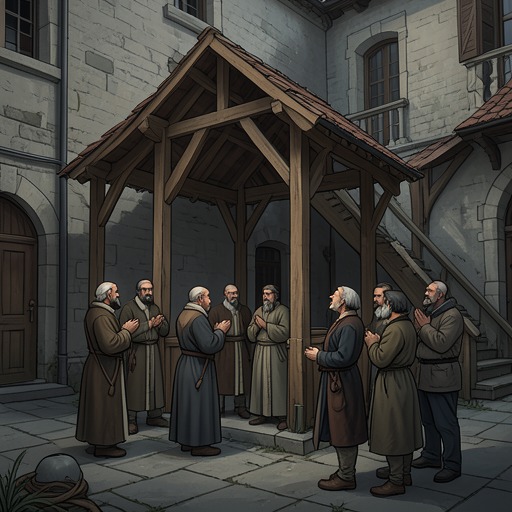
The coffin scene brings José’s two kinds of work into sharp proximity. While he has been engaged on the staircase for the chapel, Bishop Jean Baptiste Lamy has asked him to leave that project for a while and make the coffin. The bishop’s decision is connected to the schoolgirls’ request that he wait before proceeding with the staircase, so that Saint Joseph might have a chance to provide a miracle. The girls have traveled to the Bishop’s farm to present their appeal, and the bishop agrees to give their faith a chance.
José explains that the bishop’s pause also reflects the appeal of a girl who says she has a calling to become a nun. The decision therefore rests on both a collective religious hope and a personal claim that the bishop chooses to honor. Lizzy recognizes that Elinora has persuaded her uncle that her calling is real. She also sees the practical consequence: with the staircase work suspended, she doubts José can finish it by Christmas. The delay makes the project’s spiritual meaning inseparable from its material deadline, and José is the worker caught between those demands.
Compassion and Belonging
José’s exchange with Lizzy over Cleo reveals a tenderness that is distinct from his skilled work. When the kitten emerges from Lizzy’s pocket, he first looks startled, then cups his hands so she can place Cleo in them. Lizzy tells him the kitten is blind and, hesitantly, explains what happened to her. José strokes Cleo gently. His sorrow, as Lizzy perceives it, reaches beyond the kitten to cruelty done to both animals and people.
His response is to question the convent’s holiness: he had thought it was a holy place. Lizzy answers urgently, defending the school and convent by pointing to the nuns’ care for Elena and praising the bishop. The exchange does not settle whether the place deserves its sacred reputation. Instead, it sets José’s attention to an injured creature against Lizzy’s need to defend an institution that has also sheltered the vulnerable. His compassion makes the contradiction difficult to dismiss: a place can offer care and still contain cruelty.
The scene also deepens the significance of José’s statement that he is unwanted. He is capable of receiving Cleo with gentleness, yet he does not experience his own need as an invitation to remain. Lizzy wants him to stay, but her wish does not undo the rejection he describes. The narrative places his vulnerability beside his concern for Cleo without turning either into a simple lesson: kindness is present, but it does not automatically create security or belonging.
Completion and Departure
José’s return to the staircase turns the construction dispute into a question about what human work can accomplish. When Elinora announces that the staircase is finished, she says Ramona had gone to take José his supper and found the work completed; José himself is gone. The finished structure has no railing and no visible supports. Sister Roberta describes two complete three-hundred-and-sixty-degree swirls, with splices at seven points on the inside and nine on the outside, and calls it an incredible piece of work that no one man could have finished in so little time. Mother Magdalena asks whether it will hold. Sister Roberta proposes testing it herself, as the heaviest person present.
The construction thus leaves room for wonder without removing the evidence of craftsmanship. Its spirals and numerous splices are concrete features to inspect, while its unsupported appearance and speed of completion invite the observers to ask whether ordinary explanation is enough. José’s absence intensifies that uncertainty: he completes the work but is not there to explain or claim it. The story presents the result through the astonishment of those who examine it, not through a final account of what happened during its making.
After supper, Gregorio had seen José’s mule in the barn while checking on the animals. When Lizzy later asks about the morning, the question follows the discovery that José and the mule are no longer there. The closing attention to his whereabouts keeps his departure in view without supplying a detailed account of where he goes. He leaves behind the staircase, a structure that is at once a practical passage and the focus of competing expectations about faith and labor. His arc ends in that contrast: the work remains, while the worker who felt unwanted has gone.