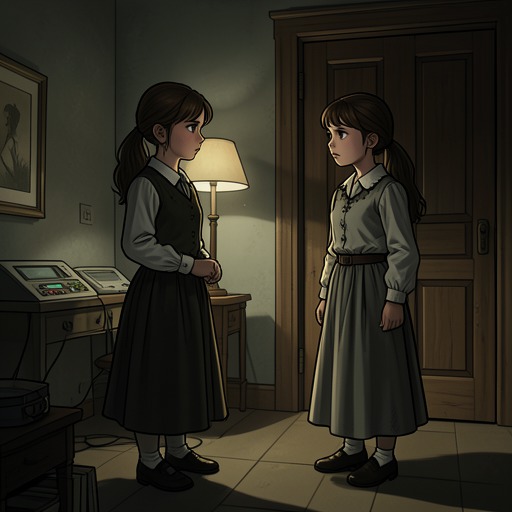
Lizzy Enders's Relationship with Elinora St. Clair
The StaircaseLizzy Enders’s relationship with Elinora St. Clair is an unsettled companionship shaped by rivalry, mistrust, and repeated reversals of blame. Elinora’s sharpness tests Lizzy at moments of grief and abandonment, while Lizzy’s anger turns suspicion into open confrontation. Yet the novel does not leave their connection at the level of childhood antagonism: in the author’s account of Lizzy’s changing outlook, Elinora herself becomes one of the people through whom Lizzy can recognize a small, human miracle.
An Uneasy Companionship
Their friction is already plain beside Lizzy’s mother’s grave. As Lizzy’s father digs with one arm, Elinora suggests that he hang the body between tree branches to keep wolves away. Lizzy rebukes her and insists that her mother will not be left in a tree. Elinora proposes that her uncle could give the dead woman a proper burial, but the offer does not soften the exchange. When Elinora later urges Lizzy to stop threatening her and calls the grave holy, Lizzy rejects the idea that any grave is holy. Elinora then calls her a heathen and says she needs the Sisters of Loretto. The argument exposes their opposing instincts: Elinora reaches for religious rules and proper conduct, while Lizzy refuses consolation that does not feel true to her.
Lizzy’s narration makes clear that she has not yet learned what grief is, even as her mother has just died. That difference matters to their quarrels: Elinora treats Lizzy’s resistance as irreverence, while Lizzy experiences Elinora’s moralizing as an intrusion at a moment when she cannot yet name what she feels. Their conflict is not simply over belief; it is also over who gets to define the meaning of Lizzy’s loss.
The journey to Santa Fe gives their rivalry a more ordinary, recurrent form. Lizzy is allowed to ride Ben, her saddle pony, because he will be useful on the trail. Elinora becomes jealous and cries until Lizzy either sits in the wagon with her or lets her ride Ben. After Elinora nearly kills herself by falling, Lizzy’s mother forbids her to ride again. The episode places their competition inside the practical arrangements of travel: Lizzy’s independence and possession of the pony become things Elinora wants, while the adults’ decisions repeatedly set limits on both girls.
Separation, Suspicion, and Blame
Their companionship is tested most severely when Lizzy discovers that the caravan is leaving without her. Seeing her father and the other travelers from the window, she tries to reach her traveling dress but finds the wardrobe door stuck. Elinora wakes and asks what is wrong. Lizzy tells her the caravan is departing and demands to know why she was not warned; Elinora says she did not know. But when the door will not open and Lizzy cannot get to her father, fear hardens into accusation. She tells Elinora that she knows she wants Lizzy to stay and suspects she made an arrangement with her father.
The scene turns a practical separation into a crisis of trust. Lizzy pounds on the door, calling to her father and insisting that she is coming. When she is held back, she sobs and begs, then hears the caravan setting out. She breaks free from Mother Magdalena and strikes Elinora in the face, calling her a pious name and declaring that she hates her. The blow is not presented as a settled judgment about Elinora’s actual role in the departure; it is Lizzy’s furious response to believing that her companion has helped keep her from her father. Mother Magdalena rebukes the violence, but the force of the moment comes from how completely Lizzy’s fear of being left alone has overwhelmed whatever closeness the girls had formed.
Another dispute over blame follows their secret outing. When Bishop Jean Baptiste Lamy returns, Elinora kneels before him, begs forgiveness, and claims that Lizzy wanted to sneak out and that she went only to protect her. Lizzy is stunned by the performance. Sister Roberta silently signals that Mother Magdalena has blamed the wrong girl, but she is among only a few who know the truth. Mother Magdalena drags Lizzy inside, switches her, and sends her to sleep in a small, bare room off the kitchen. The punishment makes Elinora’s account consequential: Lizzy bears the public blame and the physical discipline, while Elinora is embraced by her uncle and applauded by the gathered community.
Competing Claims to the Carpenter
Elinora’s supposed religious vocation becomes another source of tension between the girls. After hearing Dolores speak, Elinora says she has a calling to become a nun. Lizzy had seen Elinora tolerate the man and his mule on the way back, and she now doubts the sudden declaration. When other girls tell her that Elinora has a calling, Lizzy interprets it as a performance designed to restore Elinora to her uncle’s good graces. In Lizzy’s view, Elinora can use that claim to persuade the Bishop to dismiss the hungry carpenter, leaving the girls to wait for a miracle instead of accepting the practical help he might offer.
That disagreement carries their rivalry into the school’s larger dispute over faith and action. Lizzy has brought the carpenter to the Bishop’s attention because he needs work and is capable of building the chapel staircase. The Bishop agrees to let the hungry man inspect the problem, while the nuns have been praying a novena to Saint Joseph. Lizzy sees the carpenter as a person who can act; she suspects Elinora’s vocation will reinforce the school’s expectation that a miracle, rather than a worker, should solve the problem. The evidence supports Lizzy’s interpretation of Elinora’s behavior, but it does not make that interpretation an objective account of Elinora’s motives. Their relationship is filtered through Lizzy’s suspicion, and the novel lets that suspicion remain part of the conflict.
Rivalry and the Possibility of Change
When the staircase is finished, the girls and nuns gather at the back of the church to look up at it. It rises in a polished circular sweep to the choir loft, with thirty-three carefully trimmed steps. Mother Magdalena declares that the carpenter must have been Saint Joseph, and the nuns kneel to pray. Lizzy rejects that explanation: she knows the carpenter as a man who spoke with her, listened to her troubles, held her kitten, and told her about his own sadness at leaving his family. The same event that invites the school to turn a worker into a saint therefore sharpens the difference between institutional belief and Lizzy’s attachment to a particular person.
The final significance of Elinora and Lizzy’s relationship is not a simple reconciliation scene. The author’s note describes Elinora as Lizzy’s childhood nemesis, a rival who breaks rules and nevertheless seems to land on her feet, but also says that Lizzy comes to recognize miracles in people, including Elinora. Lizzy leaves the convent a better person while remaining unsure whether she has met Saint Joseph. That uncertainty gives their relationship its quieter resolution: Elinora remains difficult and does not become an uncomplicated figure of trust, yet Lizzy’s view of what can count as a miracle has widened enough to include her.