Lizzy Enders's Relationship with Her Father, Mr. Enders
The StaircaseLizzy Enders’s relationship with her father, Mr. Enders, moves between love and anger as bereavement turns their westward journey into a separation. After Mama’s death, Lizzy tries to protect herself by holding on to anger; at the same time, she watches over her grieving father and hopes to remain with him. His eventual decision to leave her at the Santa Fe convent, delivered by Mother Magdalena rather than by Mr. Enders himself, makes that unresolved attachment a lasting wound.
Identity and Background
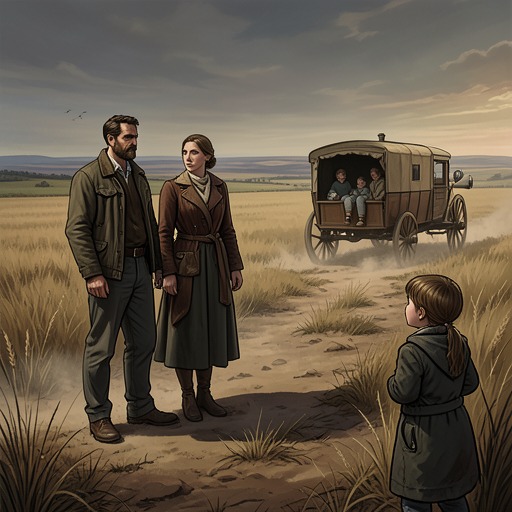
Lizzy’s understanding of Mr. Enders begins with what she sees in him and what Mama had told her. His face still has the sharp outline of a face that had once been handsome; one shirtsleeve is pinned up empty. Mama had said that his eyes had seen hell in the war and still remembered it, which was why they looked so sad. His lost arm is not merely a biographical fact for Lizzy: she watches him do the work of the trail with one hand and wonders at his capability.
The family’s departure from Independence, Missouri, had already unsettled Lizzy’s attachment to him. She had covered her former love with anger at being taken west with Mama, and she remembers trying to keep that anger alive as they traveled. Uncle William had taught her that anger could be safer to show than tears and that people might respect it more. Lizzy makes that advice part of her effort to manage what she feels toward her father, even before she can decide what the feeling means.
Grief on the Trail
After Mama is buried near the Sangre de Cristo Mountains, Lizzy cannot eat supper. The grave is close by, and eating feels wrong to her. Mrs. French reminds her that travelers must eat and drink to stay alive, but Lizzy is not sure she wants to live. Seeing Mr. Enders bent over the fire, staring into it and not eating either, changes her immediate resolve: Lizzy thinks she must stay alive for him because Mama would want that, and because he sometimes forgets to care for himself. Her attachment appears in this practical decision to keep going for his sake.
Mr. Enders, in turn, briefly recognizes her distress. He grips her shoulder, apparently taking her for someone overcome by grief, and releases her when she says she is all right. Later, when Lizzy cannot eat, he tells Mrs. French to leave her be. That small defense matters to Lizzy: for the moment, she feels her old love for him again. Her response is not a settled reconciliation but a passing return of tenderness within grief.
The next morning, the family prepares to leave the grave. Lizzy watches Mr. Enders hitch the oxen and check that the wagons, water buckets, and feed box are secure, noticing how he accomplishes the work with one arm. Yet the practical competence she admires does not reassure her about their bond. As they travel away from Mama’s grave, he scarcely speaks to or looks at Lizzy, and when their eyes meet he looks away. The outward movement of the wagons thus coincides with a growing emotional distance.
Fear of Being Left
Lizzy asks directly whether Mr. Enders will leave her in Santa Fe and go on to Colorado alone. As he works at Mama’s grave, using a rock as a hammer to secure the cross, he responds indirectly rather than giving her the assurance she seeks. When she asks again whether he will leave her, he tosses down the rock, tests the cross, wipes his hand on his pants, and turns toward the fire. Lizzy reads his indifferent tone as a sign that he is lying. She then recognizes the feeling in her body as fear, accompanied by the same foreknowledge she remembers from the time Mama became sick.
That fear is followed by an act of care. At breakfast, Lizzy serves bread, bacon, and beans to the Wade boys, taking only coffee and bread for herself. Her appetite has failed, but she still attends to other people’s needs. The scene places her practical helpfulness beside her private dread: she continues to take responsibility even while suspecting that her own place with her father is uncertain.
When Lizzy wakes at the convent and finds Mother Magdalena beside her, she asks to be sent outside to join her father. She insists that he thinks she is already in the wagon and has forgotten her. Mother Magdalena tells her that Mr. Enders has not forgotten her; he has decided to leave her with the Sisters of Loretto and could not bring himself to tell her. Lizzy recognizes that she had sensed the decision for days but refused to acknowledge it. The confirmation converts anticipation into abandonment: she begs to go with him to Colorado because she believes he needs her, while the choice has already been made without her participation.
Separation and Recollection
Mr. Enders’s departure is especially painful because Lizzy receives no goodbye from him. In a later conversation, she describes him as having sneaked away in the middle of the night and says he left without even saying goodbye. She also recalls that he lost an arm in the war yet can do most things with one arm. The contrast is sharp: she can admire his resourcefulness and still condemn the manner in which he left her. Her description holds respect for his abilities alongside anger at his refusal to face their parting directly.
In the same conversation, Lizzy unexpectedly repeats her father’s belief that a person makes his own luck. The thought surfaces after she has not spoken to anyone about him since he left. Her repetition shows that separation has not erased his influence: his practical maxim remains available to her even when she resents the person who taught it. When the listener observes that she is sad, Lizzy answers that she is angry. The exchange does not resolve the difference between those emotions; it makes their coexistence visible.
Lizzy’s letter to Uncle William further reveals the consequences of the separation. She asks whether Mr. Enders has written since leaving her on the trail and says that she has heard nothing from him. She wants to return to Independence, offering to live in Uncle William’s house and run it herself. She points to her chores, her lessons, and her growing competence, and notes that the nuns could find her a family traveling north. Her appeal combines longing for home with a case for her own capability. She also says that she has projects to finish before she can leave, so the wish to return does not prevent her from attending to the life she has begun at the convent.
Change and Significance
Across these episodes, Lizzy’s bond with Mr. Enders never settles into a single judgment. She recalls old love rising after Mama’s death, tries to preserve anger as protection, worries that her father will leave her, and then names anger when another person recognizes her sadness. His care is present in small moments, such as gripping her shoulder and asking that she be left alone when she cannot eat; his failure to say goodbye is equally decisive. The relationship is defined by both gestures, not by either one alone.
The separation also changes how Lizzy carries her father with her. At the convent she continues to use what she learned from him, even as she tells others that he abandoned her and asks Uncle William to arrange a return home. Her account therefore makes the father-daughter bond a conflict between inherited guidance and present hurt: Mr. Enders’s lesson about making one’s own luck persists, while Lizzy must begin making choices in a life he has chosen for her. The distance remains unresolved in the available episodes, but Lizzy’s ability to name her anger, describe her work, and make a practical plan shows her moving toward agency without ceasing to care about him.