Lizzy Enders’s relationship with Ben
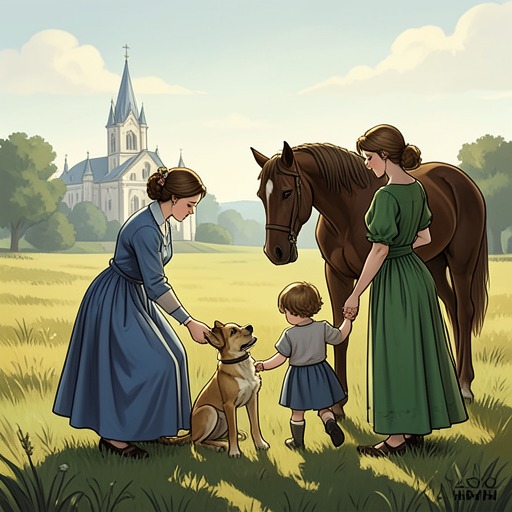
The StaircaseBen is Lizzy Enders’s saddle pony and closest animal companion, a working partner on the Santa Fe Trail and a dependable source of comfort as she grieves her mother and faces separation from her father. Their bond is expressed through shared travel, daily acts of care, and Lizzy’s repeated instinct to seek him in moments of fear or loss. When people and places become uncertain, Ben remains familiar: a living connection to home and a companion whose presence steadies her.
A companion on the trail
Before the journey, Lizzy is allowed to bring Ben because he will be useful on the Trail. She rides beside the wagon, but the arrangement becomes tangled with Elinora St. Clair’s jealousy: Elinora cries when Lizzy rides him, so Lizzy must either sit in the wagon with her or let Elinora ride. After Elinora falls and nearly seriously injures herself, Mama forbids her from riding Ben. The episode establishes that Ben is not simply transport. He is Lizzy’s own companion, and sharing him becomes one more demand imposed by the adults’ effort to deliver Elinora safely.
That closeness is visible in small routines. Lizzy tends to Ben at night and gives him sugar, while he stays near the wagon as the caravan settles. She recalls the rides they shared in the fields outside Independence, Missouri, with Uncle William when he was home and with Mr. Enders. Her memories also preserve the care Mama gave Ben: special treats and lessons in weaving ribbons into his mane. The pony’s present company thus carries a whole domestic past with it. In the wake of Mama’s death, looking after Ben lets Lizzy keep hold of practices and affections that belonged to life before the loss.
Grief and the meaning of home
After Mama dies, Lizzy stays with Ben for a while, brings her face close to his, and believes he can recognize her grief. She remembers Mama’s assurance that animals know when people are grieving. She tells Ben that they are going on to Colorado to look for gold and that someday they will return for Mama and take her home for a proper burial. The promise joins practical forward motion to an impossible wish for restoration: Ben is the listener beside whom Lizzy can give shape to a future that still includes her mother.
The night after Mama’s death, Lizzy settles in the wagon without the kitten she had wanted to bring and aches for the good-night kiss her mother used to give her. She compares the pain of absence to the phantom pain Mr. Enders has described after losing an arm. In that setting, her longing for an animal companion is not incidental: Ben is already with her, and the thought of a dog offers another imagined comfort, but neither erases the particular place of Mama or the consolation of the pony who shared the journey with them. Ben stands beside grief without turning it into a problem he can solve.
Separation, return, and flight
When Lizzy is left at the convent, one of her first urgent concerns is whether Ben is there or whether her father took him. She had been too dazed and ill to ask the night before, and uncertainty about the pony compounds the disorientation of being left behind. On finding him in the last stall of the barn, she throws her arms around his neck and holds on. His familiar smell recalls home, the rides with her family, time on the Trail, and Mama’s treats and ribbons. Lizzy weeps for a past that cannot be recovered; Ben nuzzles her, and she understands his presence as a promise that he will stay with her.
The reunion quickly becomes action. Lizzy feeds Ben oats, gives him water, finds his blanket, saddle, and bridle, and prepares to ride away. The ordinary sequence of care becomes the beginning of an attempted escape: she leads him from the barn and mounts while a morning star is still visible. Yet she has no safe route to follow. She imagines finding Mr. Enders on the Santa Fe Trail, then recognizes that he has taken the southern route, which she does not know; alone, she could become lost in the desert. Ben gives her mobility, but not knowledge of where to go. Ramona’s entreaty redirects her, and Lizzy rides with Ben to Fort Marcy, where she eats coffee and corn bread on his back while he searches for grass and dandelions. Their partnership enables flight, but the scene also marks the limit of what the pony can provide: a companion can carry her, while another person must help her find a destination.
Care under pressure
Ben remains present as Lizzy’s responsibilities extend beyond her own danger. After riding to seek help and returning to the school with him, she is so relieved to see Gregorio that she slips off Ben, nearly falls, and collapses after trying to explain what has happened. At this point, the pony is both the means by which she has come back and the familiar presence accompanying her as exhaustion overtakes her.
The bond is especially vivid after Delvina’s husband attacks Lizzy at Robert’s grave. Lizzy fights, is threatened with a knife, hears a shot, and falls hard. When she wakes, Ben is nuzzling her face. The attacker is gone; blood, signs of a struggle, and the restored lantern remain, while the identity of the rescuer is unknown. Ben does not resolve that mystery or replace the person who intervened. Instead, his touch helps Lizzy orient herself after the violence: she gets to her feet and leans against him, assuring him she is all right. Later, she rides back to the convent with him and chooses not to tell anyone about the attack, fearing that the authorities might send Delvina away and end Lizzy’s afternoon rides. The choice shows how their companionship is woven into her fragile daily life, even as it sits beside her concern for another woman’s safety.
Continuity without rescue
Ben’s importance lies in the consistency of his presence, not in a claim that he can protect Lizzy from every danger. He accompanies her across the Trail, receives the memories she attaches to home, and is there when she wakes after an assault; at other moments he offers the bodily reassurance of a nuzzle or the familiar work of riding and feeding. The narrative preserves his animal presence through particular actions—eating oats, drinking water, seeking dried grass and dandelions—rather than treating him only as a symbol.
For Lizzy, caring for Ben is reciprocal in feeling even though their roles are not interchangeable. She feeds and equips him; his nearness comforts her and helps her move through an unfamiliar landscape. He cannot return Mama, locate Mr. Enders, or explain who rescued Lizzy. What he can offer is a durable connection across those ruptures. As Lizzy faces abandonment and danger, Ben’s repeated return to the scene makes companionship tangible: not a cure for loss, but a reason she does not have to meet each new uncertainty entirely alone.