Lizzy’s bereavement and abandonment
The StaircaseLizzy Enders’s bereavement and abandonment are intertwined losses that unsettle her sense of family without extinguishing her desire to belong to one. At thirteen, displaced from Independence, Missouri, and left by Mr. Enders at a Catholic convent in New Mexico, she is already mourning Mama when Delvina’s death brings grief back with force. A letter from her father deepens the wound: it describes work, cattle, and a future ranch, but offers no apology for leaving her. Lizzy’s anger is real, yet so is the hope she cannot stop carrying for him.
Identity and Circumstances
The novel’s framing places Lizzy in a succession of dislocations. She has come from the small-town world of Independence, Missouri, to a neglected part of the frontier, where she is the only Methodist in a houseful of Catholics. Her mother has died, and Mr. Enders has left her at the convent. He has also lost one arm in the war and his Georgia plantation; those facts form part of the circumstances surrounding the family’s displacement, but they do not soften Lizzy’s experience of being left behind.
The losses arrive in a life where security has already been made uncertain. Lizzy’s mother is gone, her father is elsewhere, and the convent is not a replacement for the family she has lost. She must make sense of grief while living among people whose religious customs differ from her own. Her abandonment is therefore not simply physical separation from Mr. Enders: it is the painful question of whether he still wants her, and whether she can rely on the bond she has with him.
Delvina’s Death and Renewed Grief
When Lizzy returns to the school late one afternoon, Ramona tells her that Delvina has died. The news lands heavily, even though Lizzy had known Delvina’s death was coming. She thinks she will never again be so diminished by a death after Mama’s, but Delvina’s loss proves that grief is not finished with her. The second death does not replace the first; it makes Lizzy feel again how exposed she is to loss.
The convent turns mourning into a visible, collective atmosphere. Candles that are never lit seem to glow; mirrors are covered; prayers sound throughout the building as girls move with folded hands and lowered eyes. The nuns hurry with winding sheets, and the church bell tolls mournfully. Against this ritual display, Lizzy’s private knowledge that Delvina’s death was expected does not make it easier. The solemnity of the school gives shape to the death, while her inward response remains bound to the earlier, more devastating loss of Mama.
The Letter and the Father-Daughter Conflict
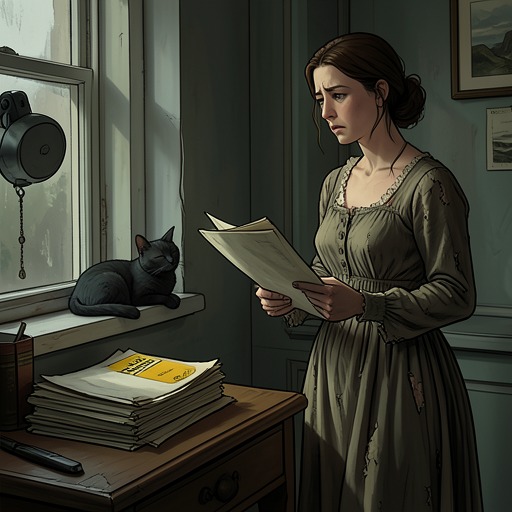
Mr. Enders’s letter makes the distance between them painfully concrete. Its main subject is a possible job in Texas: a rancher named King has six hundred thousand acres and needs a foreman to hire men and oversee a market-ready herd of about five thousand steers on its way to Kansas. Mr. Enders writes that he could earn more than five thousand dollars a year. Lizzy notices that the letter is about money, profits, and the cattle market, with only one line about her and no expression of regret for leaving her.
The proposed future is not wholly without a place for Lizzy. Mr. Enders expects her to finish her education and then come live with him at the Santa Gertrudis Ranch; if he gets the job, he hopes to have a small hacienda. But that plan does not repair the hurt of his departure. Sitting with the letter in her lap, Lizzy weeps and wonders what sort of market there will be for a daughter who hates her father and yearns for him at the same time. The letter offers a practical future while leaving the emotional question unanswered.
Lizzy later explains to a man who has treated her kindly that she cannot find it in her heart to write back. She describes the letter as being about the Texas ranch, earnings, and cattle prices, and stresses that Mr. Enders never said he was sorry for leaving her. The man responds that finding work weighs heavily on fathers and that work can seem more important to a family than the fathers themselves are. Lizzy hears the reassurance but remains unwilling to write. His explanation does not cancel her grievance or make separation feel chosen.
Writing, Hope, and the Unresolved Wound
After promising the carpenter, Lizzy begins a letter to her father, but even its greeting exposes her divided feelings. She questions how she can call Mr. Enders dear when he abandoned her at the moment she needed him most. She explains to herself that she is writing to please the carpenter, in the hope that he will stay. The act begins as a favor to someone else, not as a reconciliation with her father.
As she writes, however, the letter reveals what her refusal had concealed. Lizzy assumes that Mr. Enders does not want her and imagines him away on cattle drives, earning the money he described. Yet she ends by admitting that she hopes he wants her. That hope does not erase her anger: it makes the anger more painful, because the person she resents is still the person whose affection she wants. The contrast between her controlled explanation and the longing that emerges in the act of writing gives the letter its emotional force.
Earlier, after reading Mr. Enders’s letter, Lizzy goes to the barn to feed Ben. The oats’ fragrance and the simple certainty of watching him eat calm her. She reflects that animals depend on the care given to them and that Ben never doubts her. The scene offers a small, immediate contrast to her uncertainty about her father: with Ben, care is present and trust is not in question. Lizzy’s sorrow is not resolved by that comfort, but the scene shows her trying to give steadiness where she can.
Narrative Significance
Lizzy’s bereavement and abandonment persist as a tension rather than a wound neatly closed. Delvina’s death recalls the force of losing Mama; Mr. Enders’s businesslike letter turns separation into an explicit failure of acknowledgment; and Lizzy’s own letter exposes the longing beneath her refusal. Her circumstances are framed by displacement, religious isolation, and the loss of the life her family once had, but her response remains specifically personal: she can hate her father for leaving and still hope that he wants her back. By allowing that contradiction to surface through the letter, the narrative makes writing an act of discovery, not proof that reconciliation has already occurred.