Lizzy's Letter to Her Father
The StaircaseLizzy's Letter to Her Father is at once a message about her life at school, an attempt to persuade the carpenter to remain, and a vulnerable demand for clarity from Mr. Enders. Lizzy begins by treating the letter as a promise she must fulfill for the carpenter, but writing it exposes the feeling she has tried to suppress: she wants her father to want her. Its practical destination is the Santa Gertrudis Ranch; its emotional destination is the uncertain relationship between a daughter left behind and a father whose invitation has not yet sounded like a firm commitment.
Purpose and Circumstances
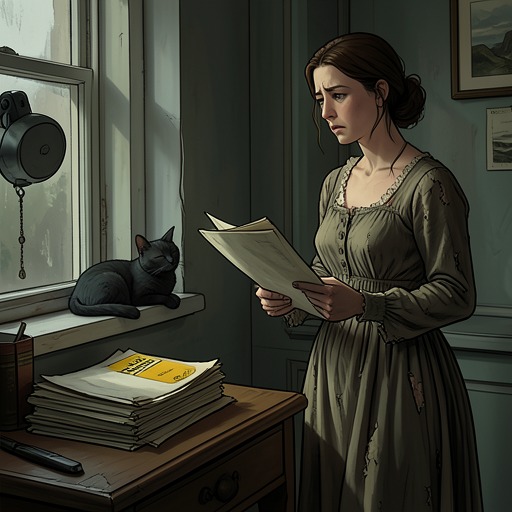
Lizzy writes the letter because she has promised to do so, and because she hopes the carpenter will stay if she makes him happy. The request gives the document an immediate practical purpose, but it also draws a private confession out of her. At first she insists that the conventional opening does not reflect what she feels: Mr. Enders abandoned her when she needed him, so calling him dear seems false. She likewise questions whether she means the affectionate sign-off. Yet as she continues, her guardedness gives way to an admission she had not understood until she began writing: she hopes he wants her.
She sends the letter to the Santa Gertrudis Ranch, following her father’s suggestion, and supposes he will be there by the time it arrives. She hopes he has found a job. The ranch setting sharpens her awareness of what he has lost: she imagines that working for someone else may be difficult for a man who once had his own plantation, and remembers that he disliked being a storekeeper for Uncle William. Her concern does not erase her resentment. The letter holds both together, addressing the father whose circumstances she tries to imagine and the father whose absence has hurt her.
Life Reported from School
The letter offers Mr. Enders a concise account of Lizzy’s current life. By the standard of her grades, she says, she is doing adequately: she is not the top student, but Mother Magdalena considers her to be acquitting herself proudly, even while scolding her at other times. The qualification matters. Lizzy presents herself as managing, not flourishing, and makes clear that school remains difficult.
As the only Methodist among Catholic girls, she must attend their services and endure the prayers, incense, and continual murmur of worship. She compares her classmates’ behavior with that of students in Independence, finding no improvement in deportment and suspecting that the girls at her present school may be worse. This comparison resists the idea that her hardship can be explained simply by being among Catholics: the religious difference is real, but the ordinary frictions of school life are familiar too.
Her domestic circumstances are similarly unsettled. She still rooms with Elinora, whom she now regards as more troublesome than she was during the journey. She has also written to Uncle William to ask whether she might return to Independence, where she believes she could resume school and keep house for him. The letter therefore does not present reunion with her father as her only imaginable future. It sets out another possible home, making the choice facing her father more concrete without pretending that the alternative is already settled.
The Conditional Invitation
The most consequential passage answers Mr. Enders’s suggestion that Lizzy might live with him after her education. She needs him to explain what that condition means and how long he expects her to remain at school. More than a timetable, she asks for plainness: if he truly wants her to come, he must say so clearly. She fears that his invitation may be politeness rather than genuine desire, and refuses to treat an ambiguous offer as proof that she is wanted.
Lizzy imagines what joining him might involve. She could bring Ben, whom she thinks would suit ranch life, and she has a kitten who is blind. She hopes that, the following summer, her father might let her invite Cassie as well. Each detail turns an abstract offer into the beginnings of a shared household, while her insistence on a clear answer keeps that imagined future conditional. She says she will go first to Uncle William if Mr. Enders cannot make up his mind. The alternative is not merely a threat: it shows that Lizzy is trying to claim some agency over where she will live, even as the decision depends on an assurance she cannot give herself.
Her questions about ranch work reveal how closely she has been thinking about her father’s prospects. She wonders what his duties will be, whether watching drovers rope cattle will make him envy their skill, and whether he still refuses to fire a gun. She also wonders whether veterans of either side of the war work there, and, if Union veterans do, whether they will take orders from him. She asks about his quarters and hopes he is at the ranch rather than away on a cattle drive to the eastern markets. These concerns make the letter more than a plea for affection: Lizzy tries to picture the circumstances of his life, even while she fears those circumstances may leave no room for her.
Reading and Effect
The letter’s sincerity becomes clearest in its contradiction. Lizzy has written it partly to satisfy the carpenter and help keep him in Santa Fe, yet the act of writing reveals a wish that belongs to her, not to that immediate purpose. Her closing hope that her father wants her unsettles the self-protective insistence that the words are only a performance. The letter cannot guarantee a reply or settle where Lizzy will live; it makes the question she needs answered impossible to mistake.
Lizzy takes the letter to the carpenter in the barn and asks him to read it. The scene places the document between several forms of uncertainty: she is a daughter waiting on her father, a stranger asking a carpenter’s approval, and a girl trying to decide whether an offered future is genuine. The carpenter reads slowly, stroking his beard and nodding. He calls the letter good and says it bodes good feeling. His response supports the letter’s practical purpose of encouraging him to stay, but its deeper consequence is Lizzy’s recognition of her own longing. A message framed as an obligation becomes the clearest statement yet that she wants not merely to be permitted to join her father, but to be wanted by him.