Mama
The StaircaseMama’s death from fever on the journey west turns the landscape into the first measure of Lizzy Enders’s grief. Though she is gone before the family reaches Santa Fe, Mama remains present in her daughter’s memories: in stories of home and ancestry, in the visit they meant to make together, and in the pain Lizzy comes to recognize as the ache of an absent part of the self. The novel makes her both a particular woman, with a life rooted in family and community, and the loss around which Lizzy’s early journey changes course.
Identity and Background
Mama was a member of the Bent family, a family of consequence in Independence, Missouri. Her father had been a fur trapper who became wealthy and had three Indigenous wives. Mama’s family history gave Lizzy Cheyenne and Blackfoot cousins she had never met; Lizzy also understood herself as having some Blackfoot ancestry through her mother. The family’s fortunes had diminished by the time Lizzy was born, but it still owned the largest mercantile business in Independence. Mama’s brothers continued to trade in furs, sell blankets from New Mexico, drive New Mexican sheep to Missouri, and trade horses and mules.
Her own remembered life in Independence is associated with the domestic and civic work that made a home there. Lizzy recalls her as lively and lovely, growing roses in the garden, starting the women’s literary guild, and baking cakes for church fairs. That image of rooted abundance contrasts sharply with the exposed country through which the family travels after leaving home. The contrast is not simply between comfort and hardship: it is between the settled life Mama had helped sustain and the vast, unfamiliar journey on which she dies.
Illness and Death on the Trail
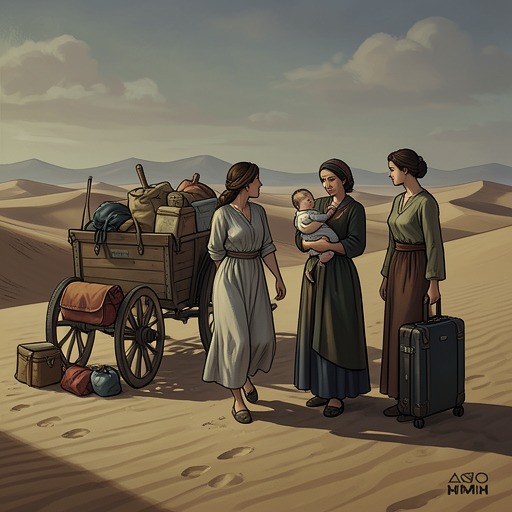
Mama is already feverish and gravely ill as the wagons move west. She tells Lizzy that the country’s starkness troubles her, describing its immensity as an eternity with no end. At night, a coyote’s howl makes her whimper. When the travelers pass an old Indigenous man sitting wrapped in a blanket before a pueblo, she clutches Lizzy’s hand and says that he is waiting for her. These moments show a woman confronting the landscape and her approaching death through fear, rather than the composed certainty her daughter might wish to find in retrospect.
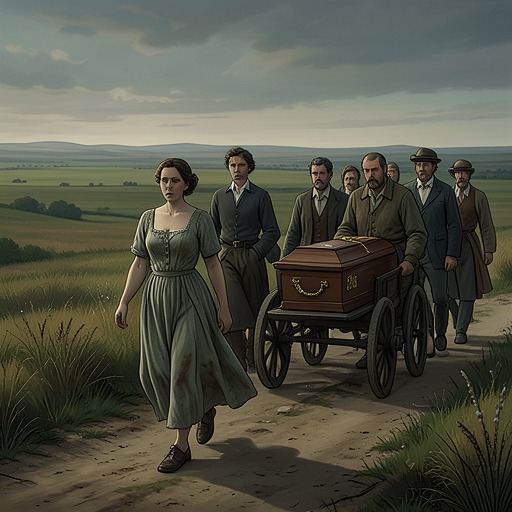
Mama dies the following day of a putrid fever. Her death follows the family’s movement from Georgia to Independence and then onto the trail: Lizzy recalls that the war had taken her father’s arm at the Battle of Buzzard Roost Gap, and that the life her mother had known had changed before the family set out. In the immediate aftermath, Mr. French digs her grave in the open country. The ground seems to resist him, while the distant Sangre de Cristo Mountains, edged with the gold of aspens, make the people beside the grave seem small. A fire is burned because Mama died of the fever, a practical response that also fixes her death in the camp’s darkness.
Mother and Daughter
Mama’s absence becomes most legible through Lizzy’s physical understanding of grief. At night, she aches for the way Mama used to kiss her goodnight. She recalls her father describing the pain of losing his arm as an ache in the part of oneself that is no longer there; after Mama’s death, Lizzy recognizes the same paradox in bereavement. The comparison connects two losses in her family without making them identical: her father’s missing limb and her mother’s absence are both felt as continuing bodily pains.
Lizzy’s grief is also entangled with responsibility for her father. At one point she is unsure she wants to stay alive, but seeing Mr. Enders bent over the fire, staring and not eating, gives her a reason to continue. She thinks that Mama would want her to live and that she cannot leave him alone, since he sometimes forgets to eat. When he tells Elinora to leave Lizzy be, Lizzy briefly feels her old love for him again. The exchange places Mama’s death between father and daughter: her memory helps Lizzy endure, while the altered state of her family makes love and care newly urgent.
The grave prompts Lizzy to imagine what Mama’s family would think of her being buried in the shadow of the mountains, far from the garden and community remembered in Independence. Lizzy asks her father to write Uncle William and tell him of the death; he promises to do so once they reach Santa Fe. Mama’s place in her birth family matters even in this isolated burial, because her daughter understands the distance not only as miles but as a separation from the people and home that had known her.
The Journey’s Unshared Destination
Santa Fe had been something Mama and Lizzy planned to experience together during the two days Mr. Enders had promised the family would stay there. After Mama’s death, Lizzy arrives still determined to look at the place at least for her mother’s sake. The town disappoints her: she sees small, squat red-sand houses, wandering dogs, goats and burros, and people in blankets. The disappointment acquires an added force because the anticipated visit has become impossible; the city is no longer the shared destination Mama and her daughter had imagined.
Later, in the convent dining room, familiar comforts sharpen that absence. As the Wades and Frenches eat a special dessert and Lizzy is given coffee topped with foamy milk and shaved chocolate, she thinks of the bitter coffee on the trail and the times she had to share wash water with Mama. Through tears, she thinks she sees Mama’s face in Mother Magdalena’s starched wimple and calls out to her. The vision is not presented as a settled supernatural fact: it occurs in grief, amid memories of deprivation and intimacy, and ends when others lift Lizzy from her chair. Mama’s remembered face briefly gathers the distance between trail and convent, hunger and comfort, loss and the wish to be cared for.
Memory, Presence, and Narrative Role
Mama’s influence persists without erasing Lizzy’s uncertainty or skepticism. Much later, as snow falls at the windows, Lizzy feels an unexpected peace and senses an unseen presence close by. She wonders whether it is Mama or Mrs. Lacey, but cannot identify it. The moment does not confirm Mama’s return; its importance lies in Lizzy’s willingness not to dismiss the feeling. Her mother remains one possible source of reassurance within an experience that the narration deliberately leaves unresolved.
Across these recollections, Mama is not only the dead parent whose loss initiates Lizzy’s bereavement. Her family history complicates Lizzy’s sense of where she belongs; her illness gives the western landscape an intimate human cost; and the plans she made with her daughter give Santa Fe the shape of a future that can no longer be shared. The novel keeps her presence in concrete traces—a grave, a remembered goodnight kiss, a cup of coffee, the face Lizzy thinks she sees—while allowing the question of spiritual presence to remain open.