Mama’s fatal fever
The StaircaseMama’s fatal fever is the illness that kills her on the Santa Fe Trail and reshapes the journey for her daughter, Lizzy Enders. Its force in the narrative lies not only in the death itself, but in the changes that follow: a grave beside the travelers’ camp, a fire made because Mama died of fever, and a child who must find a reason to keep eating and remain alive. The loss becomes a bodily memory that returns whenever Lizzy confronts fear, absence, or the possibility of a presence beyond the living.
Illness on the Trail
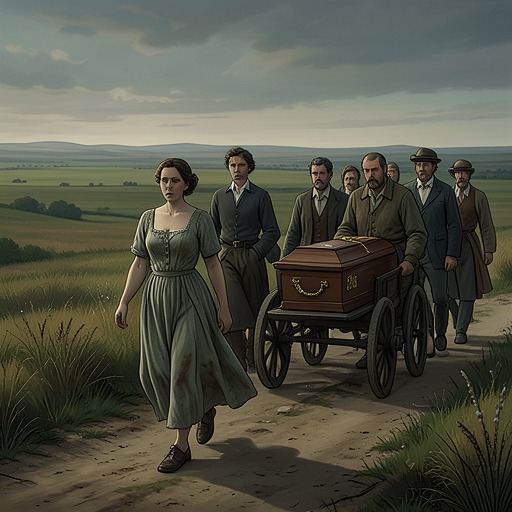
In Mama’s last days, she lies feverish in the wagon as the party travels through an immense country. The landscape has already become part of her distress: its apparent endlessness makes her feel that there is no end to it, that it is eternity. At night, as coyotes howl, Lizzy hears her whimper. Mama’s fear is not presented as a general complaint about travel; it gathers around the wilderness’s scale and the prospect of death within it.
One encounter gives that fear a more intimate shape. Passing a motionless old man wrapped in a blanket outside a pueblo, Mama clutches Lizzy’s hand and says that he is waiting for her. The moment links the ordinary sights of the road to Mama’s sense of her approaching death. The narrative does not establish that the man is supernatural or that Mama’s words are prophetic in any literal sense. Instead, her fever and fear make the journey seem inhabited by the nearness of death before she has died.
Mama’s illness occurs against a history of displacement and loss. She came from Georgia, and the family’s earlier life was altered by the war that cost Mr. Enders an arm at the Battle of Buzzard Roost Gap. They then went to Independence, Missouri, where Mama’s family sheltered them; Lizzy remembers that refuge as having nearly squeezed the life out of her father. The westward journey is therefore not an uncomplicated adventure: it follows war and upheaval, and Mama dies before the family can reach the life they are traveling toward.
Death and Its Immediate Aftermath
Mama dies the day after the encounter by the pueblo, of what Lizzy calls the putrid fever. The speed of the change gives the illness a stark, irreversible shape: the fear that had been voiced in the wagon becomes a death the travelers must face while still on the road. Mama is buried nearby. At supper, Lizzy cannot eat with her mother lying in her grave only a short distance away. Mrs. French urges her to eat and drink when she can, explaining that on the Trail survival does not depend on whether one feels like taking food.
Lizzy is unsure that she wants to stay alive. Seeing Mr. Enders bent over the fire, staring into it and not eating either, alters her resolve. She decides she must live for him, because Mama would want it and because he sometimes forgets to eat. Her grief thus becomes entangled with care: the child who has lost her mother recognizes that her father is also bereaved and may need her. When Mr. Enders tells the others to leave Lizzy alone, she briefly feels her old love for him again. His response does not undo the death, but it restores a point of connection between them.
The fever also determines what the family does after the burial. Mr. Enders burns a fire because Mama died of it; Lizzy sees sparks rising into the dark when the wagon canvas is lifted. The text gives the act as a direct consequence of the illness without explaining a medical procedure or naming a cause for the fever. Its place in the scene is nevertheless consequential: the fire makes the death visible in the travelers’ present, while the surrounding night and the sleeping wagons continue the journey’s ordinary routines.
Grief as a Continuing Absence
The loss does not end with the burial. Settling down in quilts, Lizzy aches for Mama’s good-night kiss and compares the pain to the phantom pain Mr. Enders described after losing his arm. She had once wondered how a missing part of the body could still hurt; now she understands the comparison through her own absence. The analogy does not equate bereavement with physical disability, but gives Lizzy a concrete way to grasp grief: what is gone can remain painfully present.
That absence enters practical details as well as memory. Lizzy uses a bedroll Mama made, and she longs for a kitten or a dog while her father takes the first watch and sleeps beneath the wagon. These details place mourning within the unsettled life of the Trail, where comfort is scarce and the family must keep moving. The loss also shadows the arrival in Santa Fe. Lizzy had waited for the town and planned the visit with Mama, but now feels she must look at it at least for her mother. The arrival cannot fulfill the shared plans as intended; the place is encountered through the grief that accompanies it.
Fear, Memory, and the Unseen
The fever leaves Lizzy alert to danger before she can explain it. Near Mama’s grave, she recognizes fear and knowing as the same bodily certainty she experienced when Mama first became sick, a knowledge that seems to find a home in her bones. This recurrence gives the illness an afterlife in the narrative: Lizzy’s later apprehension is not simply fear of the unknown, but is marked by what she has already witnessed and could not prevent.
The book also leaves open, rather than settling, whether Mama can remain present in another way. Much later, in a moment of unexpected peace, Lizzy senses someone unseen nearby and wonders whether it could be Mama or Mrs. Lacey. She insists that she has no faith in uncommon powers, yet does not dismiss the certainty she feels. The scene does not confirm that Mama’s spirit has returned. Its importance is that grief and skeptical thought coexist: after the fever has made loss undeniable, Lizzy can entertain the possibility of presence without claiming proof. Mama’s death therefore remains both a concrete break in the family’s life and an absence around which the story’s questions about memory, belief, and comfort continue to gather.