Mrs. Lacey and Robert’s mother-son relationship
The StaircaseMrs. Lacey and Robert’s mother-son relationship is shaped by devotion, violence, and a grief that Mrs. Lacey cannot put to rest. She remembers Robert as her pride and joy, but also believes that her decision to remain with her abusive first husband helped bring about the fatal confrontation in which Robert killed him. After Robert dies as a young soldier, her continuing guilt gives his memory a religious purpose: she hopes that completing the chapel staircase will secure his forgiveness and rest. Their graveside reunion at Fort Marcy makes that hope visible even as it leaves her sorrow unresolved.
A Mother’s Choice to Stay
Mrs. Lacey recounts the history of her relationship with Robert to Lizzy Enders as an account of her miseries, offered so that Lizzy might learn from them. She comes from Richmond, Virginia, where she lived with her first husband and Robert when he was a child. Her husband was much older, considered her enjoyment of life improper, and was deeply religious; he also repeatedly raised his hand against her. Mrs. Lacey describes the social pressure that kept her from leaving: a proper lady in Richmond did not run away or speak openly of abuse. More consequentially, her husband would not allow her to take Robert, and she believed she had no right to remove her child from the household. She endured the marriage for years while Robert grew up.
Her account turns on the conflict between protecting Robert by staying with him and protecting him by leaving. She loved him intensely and thought remaining was the right choice because leaving would mean abandoning him. Only later did she conclude that she should have gone. When she compares her own decision to Lizzy Enders’s experience of being left by her father, Mrs. Lacey distinguishes the pain of separation from the courage she believes a parent may need to make a new life for someone they love. Her regret is not that she loved Robert too little, but that love and fear kept her inside a violent household.
Robert’s Intervention and His Flight
By the time the American Civil War began, Robert was about fifteen, tall, and handsome. He sometimes tried to stop his father from striking Mrs. Lacey and was beaten for intervening. Mrs. Lacey’s story reaches its crisis when, with Robert nearly sixteen, her husband begins beating her badly. Robert comes to her defense. In the struggle that follows, the husband draws a gun to hold Robert off, and the two fight over it. Mrs. Lacey does not know whether the gun fires accidentally or whether Robert shoots deliberately. She treats the uncertainty as unable to alter the central fact: Robert killed his father.
Afterward, Mrs. Lacey sends a trusted servant to Lieutenant Colonel Lacey, a widower she had met at a Richmond social gathering. He helps Robert leave town on the first train north and arranges for the death to appear to have happened in a Richmond gambling establishment, where Mrs. Lacey’s first husband was known to spend time. Mrs. Lacey then travels west with the colonel. Her account distinguishes Robert’s act from her later relationship with Lieutenant Colonel Lacey: she says her first husband had never discovered that she and the colonel had become close. The colonel does not report Robert to the authorities; instead, he helps him escape and protects him from the consequences of the killing.
Separation, War, and Robert’s Death
In the West, Mrs. Lacey and the man who would become her husband lived for a time at Fort Filmore in New Mexico. The wartime danger of a Confederate invasion shaped their life there: they feared the Confederates might take New Mexico, the Colorado mines, and even southern California. Mrs. Lacey says that the wartime West made it possible for her to be accepted as the colonel’s wife despite the unresolved circumstances of her first marriage. Within six months, she became Mrs. Colonel John Lacey.
Robert, meanwhile, joined the army without first telling them. He was underage and feared that Colonel Lacey’s influence would lead to his dismissal, so he did not want them to discover where he was. By the time the family found him, he had been killed at Ball’s Bluff in Virginia in the fall of 1861. Colonel Lacey used his position to have Robert’s body disinterred and sent west, a process that took months. The family was then at Fort Craig on the Rio Grande. In February 1862, while Colonel Lacey rode with Canby’s men against Sibley’s brigade at Valverde, Robert’s body arrived by wagon on the Santa Fe Trail. They buried him in Santa Fe and prepared to flee as the Confederates advanced; after hearing that the Confederates had been defeated at Glorieta Pass, they remained, and Colonel Lacey was assigned to stay.
Robert’s death does not end his place in his mother’s life. Mrs. Lacey says she and John were happy, but she never forgave herself for what Robert had been led to do. She believes that if she had left her first husband, the two men would never have come to blows. Lizzy Enders offers the possibility that Robert might have gone to war even if his mother had left, but cannot undo Mrs. Lacey’s settled remorse. Her account holds uncertainty about the shooting alongside certainty about her own blame: she cannot determine how the gun went off, yet continues to imagine a different choice that might have spared Robert the killing.
Memory, Redemption, and Burial
Mrs. Lacey connects her grief to her giving money to the church and to her determination that the chapel staircase be completed. She believes that once the staircase is finished, Robert will be able to rest, be forgiven for killing his father, and enter heaven. The project is therefore more than a contribution to a religious building in her understanding: it is an effort to act on behalf of a dead son whom she fears remains burdened by his act. Her conviction also reveals how persistently she interprets Robert’s fate through her own responsibility, even though the killing occurred during his attempt to defend her.
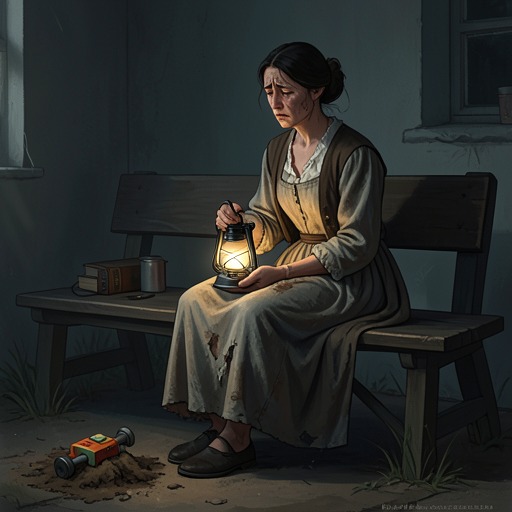
After Mrs. Lacey dies, she is buried following mass in a public procession through the marketplace and up the frozen hill at Fort Marcy. The grave is dug beside Robert’s, in the place where she had insisted on being buried. Robert’s candle burns in the lantern at the grave as Bishop Lamy says the final prayers. The physical closeness she requested gives her relationship with Robert a final form: mother and son, separated by violence, war, and death, are placed together in the ground. The burial fulfills her stated wish to lie beside him, but the story does not confirm that the staircase has redeemed Robert or ended her guilt. Instead, the candle, the graves, and the mourners who return after the ceremony preserve the bond as an act of remembrance rather than proof that her longing has been answered.