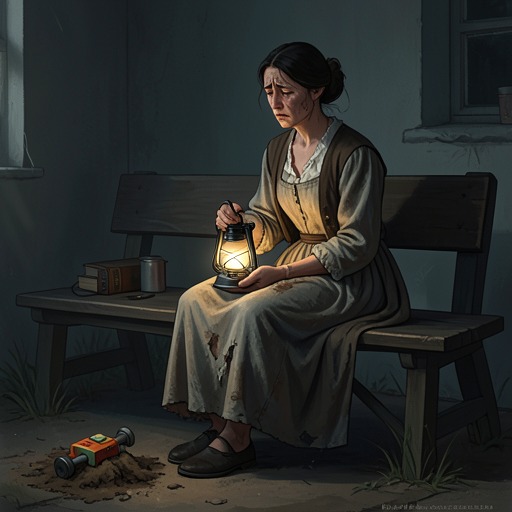
Mrs. Lacey’s terminal illness and coma
The StaircaseMrs. Lacey’s terminal illness and coma expose the difference between caring for a person and exercising authority over her. As her strength ebbs, her pain and fear of an unwanted Catholic baptism become inseparable from the practical acts of care around her: medicine, coffee, and the asafetida bag she asks Lizzy Enders to use if the baptism occurs. Her final return to awareness gives her a chance to thank Lizzy and urge her to send a letter to her father, before illness claims her.
Early Decline and Everyday Care
Mrs. Lacey describes her illness as a gradual wearing-down rather than a single sudden crisis. She feels weaker each day and reports pain in her head, back, and legs. Though Lizzy protests that she is not dying, Mrs. Lacey believes that death is approaching and accepts the suffering as something she must endure for her sins. Her account makes clear both her physical distress and the religious interpretation she places upon it; Lizzy, by contrast, challenges the idea that pain must be deserved.
Care for Mrs. Lacey takes the form of small, recurring gestures. Sister Roberta keeps her medicine in a basket and sets beside it a mug of coffee sweetened with milk and nutmeg. Mother Magdalena forbids the coffee, which Mrs. Lacey understands as punishment for being Methodist, but Sister Roberta quietly allows it. Mrs. Lacey regards the drink as helpful, and the older nun’s discreet kindness makes care a matter of attention to the sick woman’s wishes as well as to her medicine. The episode also establishes a contrast between institutional discipline and personal assistance: the coffee is prohibited, yet Sister Roberta considers that helping someone in need can justify disobedience.
The Baptism and Its Religious Stakes
Mrs. Lacey’s fear concerns what may happen when she can no longer speak for herself. She is Methodist and has no document proving her baptism; she expects the Catholic authorities around her to baptize her and asks Lizzy to place an asafetida bag around her neck if they do. Lizzy later asks José whether the bag can undo a baptism. His answer does not supply a ritual remedy: he has never heard that it could. Instead, he tells Lizzy that God loves people equally and is not a punishing judge keeping account of their actions.
The conflict becomes concrete when Ramona reveals that the Bishop came because Mrs. Lacey might die and had her baptized Catholic. Lizzy learns that her friend has become mentally inaccessible to her, and that the very outcome Mrs. Lacey feared has occurred. The baptism is not simply a difference in denominational practice. For Mrs. Lacey, it concerns her expressed identity and wishes at a time when illness has left her unable to defend them; for Lizzy, it raises the question of whether a ceremony imposed in those circumstances can determine her friend’s fate. José’s assurance that God is loving rather than punitive gives Lizzy a way to think beyond the contest between religious authorities, although it cannot undo what has been done.
Fever, Prognosis, and a Brief Return
On Friday night, Mrs. Lacey’s condition worsens sharply: she develops a high fever and chills, and a doctor is summoned. Seeing the asafetida bag around her neck, he demands to know why it is there. Sister Roberta says it is intended to prevent croup, but the doctor dismisses that concern and predicts that Mrs. Lacey will not live until Sunday. After he leaves, Sister Roberta silently puts the bag back. The act preserves Mrs. Lacey’s requested protection, even though the doctor has treated it as medically unnecessary.
Later, Ramona wakes Lizzy because Mrs. Lacey has asked for her. Lizzy follows her candle barefoot through the convent and finds Mrs. Lacey awake, frailer than before but waiting anxiously. When the nuns leave, Mrs. Lacey takes Lizzy’s hand, grips the asafetida bag with her other hand, and thanks her for being a friend. This awakening does not reverse the illness or promise recovery. It restores, for a short time, the possibility of direct contact: Mrs. Lacey can speak for herself and acknowledge the care Lizzy has given her.
Death and Its Consequences
Mrs. Lacey’s last words to Lizzy are an urgent request that she post the letter to her father. Then her grip loosens. Lizzy cannot weep; she has already spent her tears grieving for her mother and has none restored to her. The narration represents the moment through wind that rises around the house, garden, walls, trees, and street, moving upward in a spiral as if carrying Mrs. Lacey to the Methodist heaven she had hoped for. This image gives the death a spiritual shape without resolving the earlier dispute through a further ceremony or explanation.
The illness thus ends not with a settled answer about baptism, but with Mrs. Lacey’s final personal appeal and Lizzy’s response to it. Later that day, Lizzy asks Mother Magdalena for permission to go into town, explaining that she wants to post the letter; she is told to return within the hour and make no other stop. Mrs. Lacey’s request becomes an immediate action Lizzy can carry out after her friend’s death. In the movement from prohibited coffee and contested baptism to a last message entrusted to Lizzy, the story measures religious care by whether it attends to the person who is suffering and to the wishes she can still express.