Our Lady of Light Academy
The StaircaseOur Lady of Light Academy is a school and convent in Santa Fe whose rooms become both a place of discipline and a practical refuge. After Lizzy Enders arrives with Elinora St. Clair, the institution offers her shelter and a daily religious order she does not share. Its rules can restrict access to help, yet its infirmary, staff, and claims of sanctuary also make it a center of care when vulnerable people need protection.
Identity and Setting
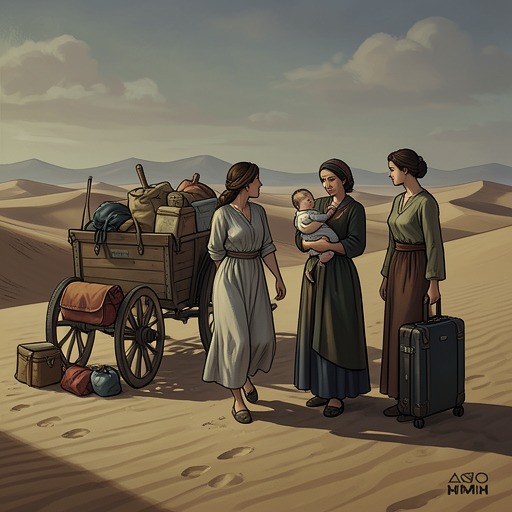
The Academy first enters the story through its arrival scene: the caravan stops before a church, and black-dressed figures emerge through the grilled door of the neighboring building, where Lizzy can glimpse a courtyard and garden. Mother Magdalena welcomes Elinora, and the nuns and girls help receive the travelers. Rooms have been prepared for the whole party to stay the night. The Academy is thus introduced not as an abstract institution but as a community with space ready to absorb unexpected arrivals.
Inside, the rooms are cool and have tiled floors and walls coated in white jaspe, with calico pasted along their lower halves to keep whitewash from rubbing onto dresses. Settees are covered with Navajo blankets; deep windowsills hold pots of red geraniums; candles illuminate plaster saints shown praying, bleeding, and dying, their faces nevertheless turned heavenward. Lizzy shares an upstairs room with Elinora, where mosquito netting covers the beds and rag rugs lie beneath them. The material surroundings join domestic welcome to a pervasive Catholic devotional presence.
Governance and Daily Life
Mother Magdalena governs the Academy through explicit rules. Her first rule forbids girls to leave the grounds without permission and bars them from roaming the streets of Santa Fe. Later, Lizzy receives a narrow exception: she may leave to take Mrs. Lacey to the cemetery, provided she signs out. Mother Magdalena also requires Lizzy to wear the purple school uniform, attend regular classes and morning mass, and take part in a novena to Saint Joseph. The uniform identifies students in public, where people respect those associated with the school; the schedule binds Lizzy to a religious routine even though she is not Catholic.
The institution’s religious community intensifies that outsider status. By the end of the first week, Lizzy learns that she alone among the fifty-one girls does not belong to the True Faith, while many of the others pray for visions of the Virgin Mary. Yet the Academy’s rituals do not affect her only as rules. Evening prayers, incense, Latin, and the congregation’s responses gradually become an oasis amid the confusion of school life: they give Lizzy a quiet interval in which to think, especially about Mama’s death. The same devotional practice that marks her difference also makes space for grief.
Four nuns run the school: Mother Magdalena, Sister Catherine, Sister Hilaria, and Sister Roberta. Sister Roberta’s work crosses the lines between teaching, medical care, and household labor. She teaches French, runs the infirmary, nurses the sick, and sometimes helps Ramona in the kitchen. Her infirmary is a bright, many-windowed room, with plants on the broad sills and a potbellied stove to keep them warm. She keeps her sleeves rolled up, wears boots on the wet brick floor, and smokes a pipe there, joking that its fragrance benefits the plants. On the stove, coffee remains hot; when Lizzy collects medicine for Mrs. Lacey, Sister Roberta adds a sweet mug of coffee with milk and nutmeg. This unofficial kindness makes care tangible within the Academy’s formal routines.
Care, Authority, and Sanctuary
The Academy’s protection has limits. When Lizzy asks Mother Magdalena to give Delvina a place, the Mother refuses because Delvina’s husband is a known brigand, drunkard, thief, and wife-beater. She fears that sheltering Delvina would endanger the girls and orders Lizzy to keep the matter secret, threatening to forbid Mrs. Lacey’s cemetery visits if she does not comply. The convent’s safety is therefore treated as something that must be guarded, even at the cost of leaving an abused, pregnant woman in an abandoned fort. The decision exposes the conflict between institutional security and the demand to protect someone in immediate danger.
That conflict becomes explicit when Lizzy returns exhausted after events at the fort. Gregorio carries her inside and calls for Bishop Lamy; Mother Magdalena and Sister Roberta are summoned, and the Bishop orders a wagon sent for Delvina, her baby, and Mrs. Lacey. He describes his church, school, and convent as a safe house and a place of asylum. His response makes the Academy’s shelter more than a private charitable gesture: it is an assertion that the institution should receive people who have nowhere safe to go. Sister Roberta accompanies the rescue, joining medical care to the convent’s responsibility to act.
Care at the Academy also meets civic and religious requirements. Sister Roberta explains that Santa Fe requires midwives to hold a license granted by a municipal judge and a certificate from their parish priest confirming their ability to administer baptism. Delvina must therefore be brought to the convent for a proper midwife. Later, after Delvina dies, the rule requiring burial within twenty-four hours determines that her funeral must take place that evening because the next day is Sunday. The Bishop decides that the Academy will keep the baby, Elena, since she has no known relatives apart from her drunken, violent father. But after an attack on the school, Mother Magdalena announces that the baby must be placed with a family outside Santa Fe: the convent has offered refuge, yet the danger associated with her father may reach inside its walls.
Devotion and the Chapel Staircase
Religious practice at the Academy is also organized around the new chapel’s need for a staircase to its choir loft. The girls attend a novena to Saint Joseph, and Mother Magdalena makes participation part of Lizzy’s school obligations. Their prayers are not detached from material concerns: the chapel needs a way to reach the loft, and the community asks for divine aid with a specific unfinished structure. The novena gives the school a shared purpose even as Lizzy remains uncertain about Catholic belief and its claims.
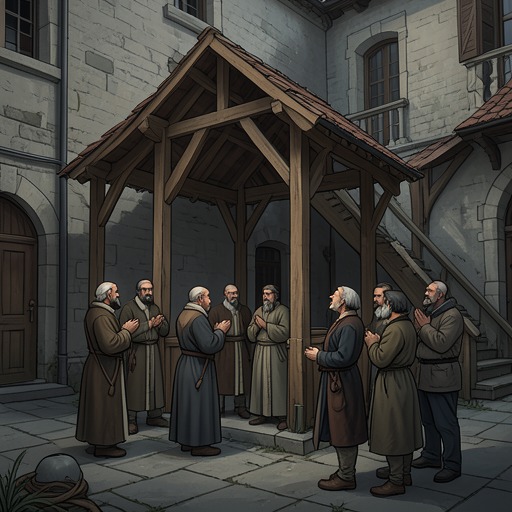
When the staircase is completed without a banister, Sister Roberta interprets its form as a lesson in faith. She tests the descent herself, turning around and creeping backward down the steps on her hands and knees while the onlookers pray; their anxiety gives way to relieved sighs when she reaches the bottom. Her response brings the Academy’s devotional language into contact with practical bodily risk. The staircase is beautiful, but it is also an awkward structure that must be negotiated, not merely admired.
Narrative Significance
Our Lady of Light Academy is never simply a prison or an uncomplicated sanctuary. Its rules restrict Lizzy’s movement and initially help keep Delvina beyond the gates, while its people later mobilize to bring her and her baby to safety. Its religious routines make Lizzy feel like an outsider, but evening prayer offers her a place to encounter grief; its authority can preserve the institution, but the Bishop’s appeal to asylum insists that the institution must also serve the endangered. In this way, the Academy’s meaning is made through decisions about who may enter, who must leave, and what its community is willing to risk in order to care for others.