Robert Lacey
The StaircaseRobert Lacey is remembered through the fierce love his mother, Violate Lacey, bore him and through the violence that shaped their family. A tall, handsome teenager in wartime Richmond, he repeatedly placed himself between his mother and her abusive husband, an act of loyalty that eventually ended in irreversible loss.
Identity and Family Background
Robert was the son of Violate Lacey and her first husband, a much older man who considered her wanton because she enjoyed life and often struck her. The family lived in Richmond, Virginia, where Violate endured the abuse in silence: the conventions of polite society discouraged a woman from running away, and her husband would not let her take Robert. She stayed, she later told Lizzy Enders, because she could not bear to leave her child behind.
By the time the Civil War came, Robert was grown—or, as his mother qualified it, at least fifteen—and tall and handsome. He tried to interfere whenever his father raised a hand to Violate, and his father beat him for it. Violate loved Robert deeply and took pride in him; her later belief that she should have left sooner did not lessen that love, but gave it the weight of regret. Their bond was formed under the pressure of a household in which a child’s effort to protect his mother could not end the danger and instead exposed him to it as well.
Violence, Flight, and War
The protective role Robert had taken in the household reached its fatal limit when his father began beating Violate Lacey severely. Robert intervened, and the two men struggled over a gun his father had drawn to hold him off. Violate could not say whether the weapon went off by accident or whether Robert fired deliberately; what she knew was that Robert killed his father. The uncertainty of intent did not soften the consequence, and the scene became the defining wound in her memory of her son.
Violate sent a trusted servant for John Lacey, a widower she had met at a Richmond social gathering. John helped Robert leave town on the first train north, then arranged for the killing to appear as though Violate’s first husband had been shot in a brawl at one of Richmond’s gambling establishments, places known as Hells that her husband often visited. Violate went west with John, while Robert’s departure kept him beyond the immediate reach of the authorities. In the aftermath, she understood her decision to remain in the marriage as a failure of courage: she had stayed for Robert, yet the violence she hoped to shield him from ended with him fleeing alone.
Robert later joined the army without his mother initially knowing. He was too young to serve and feared that John, who had the connections to arrange his dismissal, would discover his enlistment. By the time Violate and John located him, Robert had been killed at Ball’s Bluff in Virginia in the fall of 1861. The family’s separation had begun with his hurried journey north; the news of his death reached his mother far away in New Mexico, where it made that flight final.
John used his authority as an army officer to have Robert’s body exhumed and transported west, a process that took months. Violate and John were then at Fort Craig on the Rio Grande. While John rode with Colonel Canby’s men against Sibley’s brigade at Valverde in February 1862, the Confederates won and advanced toward Santa Fe. Robert’s body arrived by wagon on the Santa Fe Trail as the family prepared to flee. After the Confederates were defeated at Glorieta Pass in New Mexico and John was assigned to remain, they stayed and buried Robert in the West. Violate was eventually laid beside her beloved son on the hill at Fort Marcy, fulfilling her insistence that they share a grave.
Posthumous Memory and the Staircase
Violate Lacey’s account of Robert Lacey became a form of penance: she chose to tell Lizzy Enders what she would not tell a priest or the Bishop, hoping that her painful history might teach someone else. Robert’s death remained bound in her mind to the violence of his father’s killing, though she had never known whether the gun fired accidentally or Robert had fired it deliberately. Her grief therefore carried an unresolved question of guilt as well as the loss of her son.
That burden shaped Violate’s devotion to the chapel staircase. She gave money to the church because she hoped it might redeem Robert’s soul, and believed that completing the staircase would allow him to rest, be forgiven for killing his father, and enter heaven. She asked Lizzy not to leave before the work was finished. Lizzy had no answer to Violate’s conviction, but recognized that the project gave her comfort. Robert’s absence thus continued to govern his mother’s choices: the unfinished staircase became, for Violate, a material promise of forgiveness that she could still try to secure for him.
Robert’s Grave and Public Memory
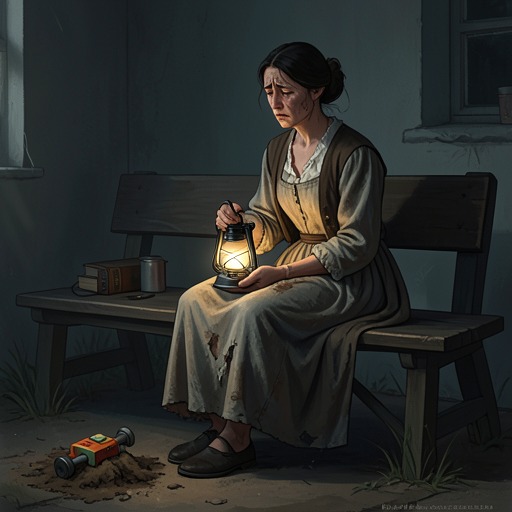
At Violate Lacey’s funeral, the journey to Robert’s grave made private grief visible to the town: after Mass, her coffin was carried by wagon through the noisy marketplace and up the frozen hill at Fort Marcy, followed by people who had known her. Bishop Lamy said the final prayers beside the grave, where Robert’s candle burned in its lantern. Lizzy Enders sensed that, after the mourners left, others would emerge from hiding to smooth the dirt and grieve for Violate. Robert’s grave thus remained not only the place his mother had chosen to rest beside him, but the center of a vigil that the ceremony could not fully disclose.