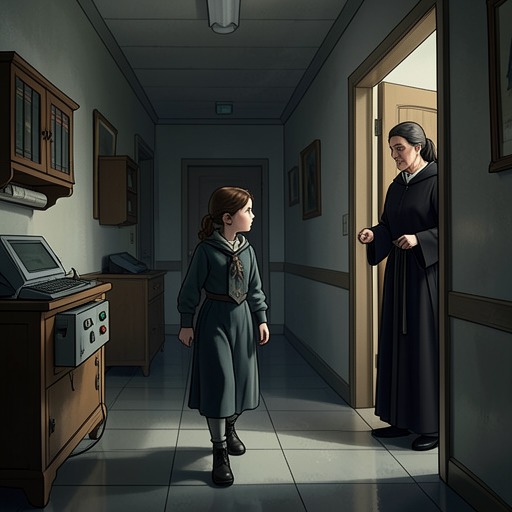
Rule Number One: No Leaving the Grounds Without Permission
The StaircaseMother Magdalena’s Rule Number One: No Leaving the Grounds Without Permission is both a boundary around life at Our Lady of Light Academy and a rule whose enforcement reshapes Lizzy Enders’s daily routine. After Lizzy rides out of the school grounds without permission, Mother Magdalena makes clear that unauthorized wandering is forbidden; she then confines Lizzy’s permitted departures to accompanying Mrs. Lacey to the cemetery. The rule’s force lies not only in its prohibition but in the way its exception turns disobedience into an assigned responsibility.
The Rule and Its Authority
Mother Magdalena announces the rule as a firm institutional principle: “we do not leave the grounds without permission. Our girls do not roam the streets of Santa Fe.” The language makes the school’s boundary explicit and presents leaving as something requiring authorization, not a matter of a student’s own choice. When Lizzy argues that girls go home at night and asks how they manage it, Mother Magdalena does not let the challenge unsettle her authority. Instead, she reprimands Lizzy for impudence and invokes the school’s expectations of humility and ladylike behavior.
The confrontation is also shaped by Lizzy’s recent bereavement and outsider status. Mother Magdalena acknowledges that Lizzy has just lost her mother, but says this does not make disobedience acceptable. She asks whether Lizzy was allowed to leave the school grounds at will in Independence, Missouri. Lizzy admits she was not; Mother Magdalena uses that answer to present obedience as a consistent expectation, not a peculiarity of Santa Fe. In this exchange, the rule is both a practical restriction on movement and a test of whether Lizzy will accept the authority of her new school.
The Breach and Its Punishment
Mother Magdalena treats Lizzy’s ride beyond the gate as a knowing violation. When asked where she thought she was going, Lizzy claims she went to fetch a mother, though she is lying. Mother Magdalena concludes that Lizzy knew she was doing wrong and must be punished. Her first proposed consequence is to take away Lizzy’s horse, a threat that frightens Lizzy; another possibility is assigning chores the girls regard as especially onerous. The potential loss of the horse makes clear that the rule can be enforced through more than a reprimand: it can also restrict Lizzy’s practical freedom of movement.
Mother Magdalena ultimately imposes a more specific consequence. Mrs. Lacey sometimes becomes confused, and Mother Magdalena declares that, while Lizzy remains at the school and Mrs. Lacey lives among them, Mrs. Lacey will be Lizzy’s responsibility. Every day, after lessons, Lizzy must accompany her to Fort Marcy so she can bring flowers to her son’s grave. Lizzy objects that the place is creepy and asks for another punishment, but Mother Magdalena points out that Mrs. Lacey likes her. The assignment therefore links discipline to care: Lizzy loses the freedom to choose when she leaves, yet receives a regular, expressly authorized reason to go out.
Permission, Routine, and Public Life
The rule does not amount to a complete ban on Lizzy leaving the grounds. Mother Magdalena specifies that Lizzy may leave only to take Mrs. Lacey to the graveyard, and only after signing out. She also requires Lizzy to wear the purple school uniform, attend regular classes and go to Mass each morning, as well as join the novena to Saint Joseph for the staircase. These conditions make the exception legible and controlled: Lizzy’s outings are permitted for a defined purpose within a broader routine of school obligations and religious observance. Lizzy, a Methodist who does not understand the Latin of the Mass, questions whether the novena is necessary; Mother Magdalena insists that it matters to the school and should matter to her as part of it.
In practice, the authorized trip becomes a repeated passage through Santa Fe rather than a simple journey between school and cemetery. Lizzy wears the long purple uniform under a heavy shawl and leads Ben as she walks with Mrs. Lacey. People greet Mrs. Lacey, men doff their sombreros, and passersby stop to ask after her or tell her about their troubles. Mrs. Lacey takes an interest in the children, sick mothers, and new families arriving on the Santa Fe Trail. She carries coins to give to people who speak with her and candy to distribute to Mexican and Indian children playing kanute. The outings show that the rule’s permitted exception places Lizzy beside a woman with many connections in town; the text leaves open whether the respect Lizzy receives is due to her uniform, her companion, or both.
The Rule’s Practical Meaning
The rule’s operation is defined by the contrast between unauthorized departure and licensed movement. Before the assignment, Lizzy’s ride beyond the gate prompts a reprimand and the threat of losing her horse. Afterward, she can truthfully say that not leaving without permission is easy, because she has permission to leave every day with Mrs. Lacey. That observation captures the rule’s qualified nature: it establishes Mother Magdalena’s control over when and why Lizzy goes out, while the daily cemetery visit gives Lizzy an ongoing role outside the school.
The assigned routine also changes the meaning of the punishment. Lizzy initially sees the cemetery as an unpleasant destination and would rather accept another penalty. Yet the rule binds her to Mrs. Lacey, whose sociability and generosity make the walks into sustained encounters with Santa Fe’s residents. The school’s boundary remains in force, and Lizzy’s departures remain conditional, but responsibility for Mrs. Lacey becomes the very permission through which Lizzy participates in the town’s life. The rule thus works as discipline and as the structure of a recurring obligation: it limits Lizzy’s choices while giving her a specific, daily way beyond the grounds.