Santa Fe Trail
The StaircaseThe Santa Fe Trail is the route along which Lizzy Enders travels with her family toward Santa Fe, a journey that begins as a planned passage west and becomes inseparable from her mother’s death and her father’s abandonment of her. It is both a physical road and the boundary between the life Lizzy knew and the uncertain life she must make after reaching Santa Fe.
Route and Journey
Lizzy’s family travels by wagon, accompanied by four mules carrying cargo, books, paper, and supplies for the girls’ school. Bishop Jean Baptiste Lamy has asked Lizzy’s father to bring his grandniece, Elinora, to Santa Fe, and the journey also fits her father’s plans to trade on the Gila Trail and then head for Colorado. Rather than take the train as far as it then reached in southeastern Colorado, the family proceeds along the Trail so Elinora can experience the historic journey before railroads take over.
The route itself is a matter of choice. Elinora wants the Mountain Branch, which would take the travelers past Bent’s New Fort, but Lizzy’s father chooses the Cimarron Cutoff, a hundred miles shorter. Lizzy suspects that avoiding Uncle William, rather than distance alone, may have influenced him. The practical calculation of miles thus carries a private family tension within it.
The journey to the point when Mama dies has already lasted fifty days, and the family still has farther to go. At Fort Union, Mama is ill, yet Elinora is still taken to see the fort. The contrast between Elinora’s satisfied wishes and the strain borne by Mama and Lizzy makes the Trail feel less like a shared adventure than a passage in which the travelers do not experience hardship equally.
Camps, Loss, and Memory
The Trail’s camps bring strangers into the family’s path. One evening an Arapaho traveler arrives while the family is eating. He speaks Spanish and English, removes his quiver before accepting food, and sits with the travelers over their stew and bread. He calls Lizzy wise and says she has an old spirit and a good heart. The encounter gives the journey a moment of unexpected peace, even as Elinora retreats into the wagon.
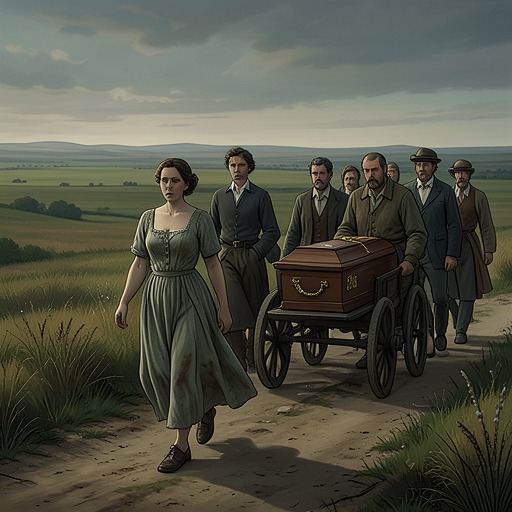
After Mama is buried, the family resumes its travel. Lizzy watches her father secure the wagons and hitch the oxen with one arm, then notices that he scarcely speaks to or looks at her. The next day, at a noon stop, she carves her name and the date, October 1878, into a rock on a mound. When Elinora warns that someone might think she is buried there, Lizzy accepts the possibility. The inscription makes the landscape a record of her presence at a moment when grief has left her feeling cut off from the life that came before.
Arrival and the End of the Road
The family eventually reaches Santa Fe at dusk. Lizzy’s first view unsettles the expectations she and Mama had built during the trip: she sees low, red-sand-colored houses, animals resting along the walkways, and people in blankets, while children run about in scant clothing. Even the Governor’s Palace fails to match Elinora’s enthusiasm. Arrival is therefore not a simple reward at the end of a long journey; it is a collision between imagined destination and observed place, made sharper by Mama’s absence.
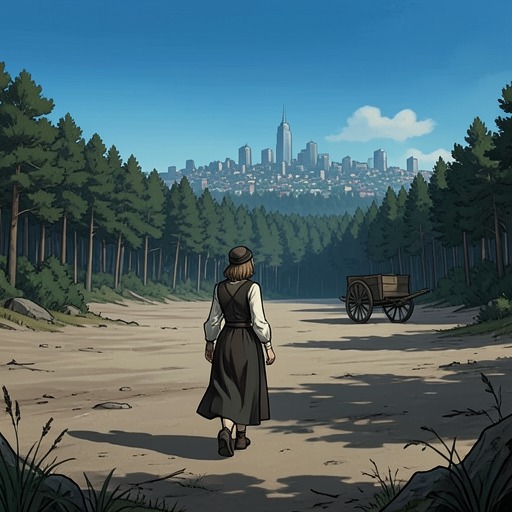
Later, the Trail remains a route Lizzy considers but cannot use. After her father leaves her in Santa Fe, she imagines riding away to find him, then recognizes that he has taken the Trail south and that she does not know that direction. She fears she would become lost in the desert. Her wish to return north is instead expressed in a letter asking Uncle William to arrange her journey home; she notes that wagons are continually leaving Santa Fe for the north. The road that brought her to a new life cannot simply be retraced by a child alone.
Narrative Significance
The Trail gives the novel’s early movement a clear geography, but its meaning changes as Lizzy’s circumstances change. At first it is a route chosen by adults for travel, trade, and Elinora’s delivery to school. For Lizzy, it becomes the scene of her mother’s burial, the place where she marks her name on stone, and finally a path she cannot safely follow to recover her father. Its recurring presence measures the distance between movement and belonging: the family can keep traveling after Mama’s death, but Lizzy cannot make the journey restore what she has lost.