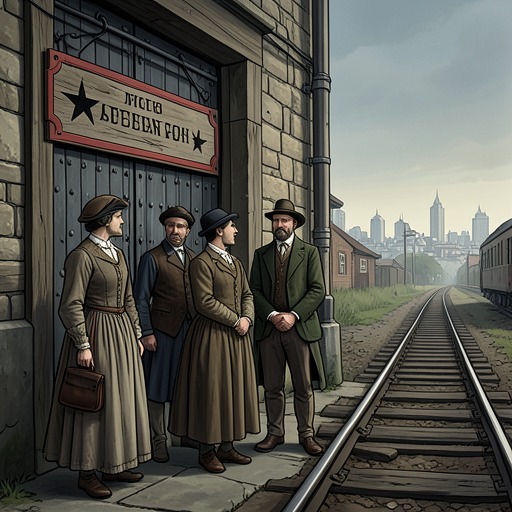
Santa Fe jail lynching
The StaircaseThe Santa Fe jail lynching is a brief but consequential act of mob violence: the sole prisoner in the jail is dragged from his cell and hanged, while Lizzy Enders and Elinora St. Clair are close enough to hear his cry. The scene makes the danger of Santa Fe's streets more than a warning repeated by adults. It becomes an event Lizzy narrowly avoids witnessing directly, and whose victim's identity remains uncertain even after the killing is confirmed.
Background and Approach
The episode begins during a nighttime walk, as Lizzy and Elinora come upon a crowd gathering by the jail at the end of the Governor's Palace. Lizzy cannot tell what is happening, but the sight leaves her with a queer fear. The crowd's purpose is not explained at that moment: neither the prisoner's offense nor the reason people have assembled is disclosed.
An old man traveling behind the girls advises them to take another street. Elinora agrees, although Lizzy is surprised that she listens to him, having apparently forgotten he was there. Her response also suggests that she is glad of his presence. The girls turn away from the jail rather than enter the crowd or investigate it. The advice changes the scene's immediate course: they do not see the violence itself, but their alternative route does not keep them from hearing its unmistakable aftermath.
The Lynching
From the side street, the girls hear a long, anguished cry coming from the direction of the crowd. The narrative gives no view of the hanging and no account of how the prisoner was seized; the sound is the only immediate evidence of what is happening. That withheld visual detail leaves the crowd and its violence partly out of sight while making the human cost impossible to mistake.
The following day, Bishop Jean-Baptiste Lamy explains why Lizzy had been punished for running through the streets at night. A prisoner, he says, was dragged from his cell in the jail and hanged by a mob. His account confirms what the girls' route and the cry had implied: the gathering was not merely disorderly, and the cry belonged to a person being killed. He identifies the victim only as the jail's one prisoner. The story supplies no name, charge, or further information about him.
The Question of Identity
Lizzy's first response to the Bishop's account is to ask whether the prisoner was Billy the Kid. That guess comes from Mrs. Lacey, who calls the jailed man by that name. The Bishop does not corroborate it: he says that he had not heard the victim was Billy the Kid. The exchange separates the established fact of the lynching from the uncertain identity attached to the prisoner.
The Bishop's answer also characterizes Mrs. Lacey's naming as a product of her fanciful imagination. That judgment does not establish who the dead man really was; it only makes clear that the name Lizzy has heard cannot be treated as confirmation. The scene therefore withholds the kind of identification that might turn the victim into a famous outlaw or give the mob's action a readily legible explanation. He remains, in the Bishop's account, the single prisoner the crowd took from the jail.
Consequences and Significance
The lynching enters Lizzy's life first as an unseen event that explains the danger she has just encountered. The Bishop connects it directly to the convent's concern for the girls' safety: Mother Magdalena punished Lizzy because she believed the girls' nighttime running put them at fault, and he argues that violence mayhem in the streets makes the rule against going out without permission consequential. He does not endorse the punishment without qualification. He says he does not believe in corporal punishment and acknowledges that the good are sometimes punished unfairly, while still maintaining that the girls could not safely run through the streets at night.
That distinction gives the episode its moral tension. The convent's discipline is severe, and Lizzy has been punished for disobedience; yet the danger invoked to justify control is not hypothetical. A mob has taken a prisoner from a jail and killed him in the same city, while the girls pass close enough to hear his cry. The Bishop's explanation does not make the punishment fair, nor does the lynching excuse the mob. Instead, the two forms of power and vulnerability meet in Lizzy's account: a child is held responsible for breaking a rule, while an assembled crowd carries out lethal violence against a prisoner whose identity and offense remain unknown.
The episode also shifts the meaning of the girls' detour. Following the old man's advice keeps them from approaching the crowd, but it cannot make them untouched witnesses: the cry follows them from the jail into the night and later becomes part of the Bishop's explanation. By confirming the killing while leaving the victim's name unsettled, the scene emphasizes both the reality of the violence and the limits of what Lizzy can know about it.