Santa Gertrudis Ranch
The StaircaseSanta Gertrudis Ranch is a vast Texas cattle property whose importance in the novel lies as much in what it promises as in what is known about the place itself. Introduced through a drover’s account and Mr. Enders’s letters, it offers work, money, and a possible reunion between father and daughter. Later, the ranch becomes the proposed destination where Lizzy Enders and the orphaned Elena might live beyond the reach of danger in New Mexico. Its meaning thus shifts from an opportunity Mr. Enders pursues to a possible home for a family he has left divided.
A Ranch Made Legible Through Work
Mr. Enders learns of the ranch while traveling on the Gila Trail toward Colorado. A drover returning from a cattle drive north to the Plains tells him that the ranch, owned by King, needs reliable workers. The account changes Mr. Enders’s direction: he abandons the Colorado plan and sets out for Texas instead. The ranch first enters the story not through a view of its landscape, but through the labor and prospects attached to it.
The scale described is immense. In his letter, Mr. Enders reports that King owns six hundred thousand acres and needs a foreman to hire and oversee responsible men taking a market-ready herd of about five thousand steers to Kansas. Texas is sending millions of cattle to eastern markets, and the ranch’s operations belong to that expanding commercial movement. Mr. Enders expects to earn more than five thousand dollars a year. These figures make the ranch legible as a system of land, livestock, labor, and trade, rather than simply as a distant place on the map.
The opportunity also draws force from Mr. Enders’s past. He tells Lizzy that he once ran a plantation before the war and expects his experience to suit him for the ranch’s management. In Lizzy’s private reading of his letter, the prospect of working for someone else again must be difficult for him, since she remembers how much he disliked being a storekeeper for Uncle William. The ranch promises him substantial responsibility, but not ownership: the prospect of a managerial post sits beside her understanding that he will again be employed by another man.
The Promise to Lizzy
For Lizzy, the ranch initially exists through the future her father proposes. Mr. Enders writes that, after her education, she can come live with him there; if he gets the job, he expects to have his own small hacienda. His message gives her a destination and a conditional promise of reunion, but little comfort in the present. She notices that the letter devotes itself to money, profits, and the cattle market, while saying almost nothing about leaving her behind. She is hurt by the absence of feeling, yet still yearns for him.
The ranch therefore carries an unresolved contradiction. It is the place Mr. Enders names as the eventual answer to their separation, but the promise is deferred until Lizzy finishes school, and its realization depends on his obtaining the position. When she writes to him at the ranch, she follows the destination he suggested and hopes he has secured the work. Her letter reports her school progress and the difficulty of being the only Methodist among Catholic girls, yet these present circumstances do not erase the larger question of whether the life her father described will come to pass.
A Possible Refuge for Elena
The ranch’s significance changes when Elinora St. Clair argues that Lizzy should be permitted to take Elena to Texas. She presents the move as a way for the baby to grow up in an atmosphere of health and love, and warns that if Elena remains in New Mexico, Ramon Baca will find her. The ranch is no longer only the setting of a hoped-for father-daughter reunion: it becomes part of a concrete plan for protecting a vulnerable child.
Lizzy supplies the specific basis for the proposal. Her father’s last letter said he was likely to get the job managing Santa Gertrudis Ranch, as he had managed his plantation before the war. Bishop Jean-Baptiste Lamy recognizes the name of the owner, King, and says he has been a guest at the ranch. That connection lends the proposal a practical point of verification, but the Bishop does not immediately grant permission. He says he will write to King and Mr. Enders to establish whether the plan is acceptable. The ranch’s promise is thus tested through correspondence and authority, not assumed merely because it sounds hopeful.
Destination and Significance
Four months later, Lizzy leaves the convent for Texas. The new Santa Fe Railroad has reached the plains within sixty-five miles of Santa Fe, but she is not traveling by that route. Her destination is the ranch, where her father has become an important manager and has his own adobe house with a courtyard. The setting is now more definite than the future hacienda imagined in his earlier letter, though the account still offers only a few details of the property itself.
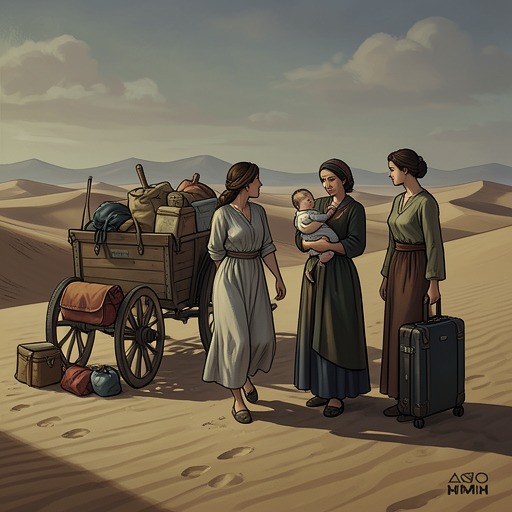
The conditions described there address several of the needs raised by the proposed move. A Methodist circuit rider visits once a month, and a school serves the ranch’s children; Lizzy is permitted to bring Elena. The journey is arranged by Bishop Jean-Baptiste Lamy. Teresa Espinosa, Elena’s wet nurse, travels with her husband, Georgio, and their baby, while six expert riflemen and scouts supplied by Abeyta’s father escort the party in three wagons. These arrangements make the move more than a private hope: it becomes a carefully supported passage to Texas.
Santa Gertrudis Ranch remains largely offstage, known through reports, letters, and the future imagined for those who will go there. Yet those mediated glimpses establish its changing role. It first draws Mr. Enders away from Colorado with the prospect of wealth and authority; it then becomes the distant address to which Lizzy sends a letter while wrestling with her father’s abandonment; finally, it is the destination approved for her and Elena. The ranch’s decisive significance is not only its size or cattle business, but its capacity to turn a promise of reunion into a possible shared home.