The Loretto staircase miracle
The StaircaseThe Loretto staircase miracle is a legend of an enigmatic carpenter whose sudden appearance, extraordinary spiral staircase, and unexplained disappearance invite a supernatural explanation without compelling one. In the novel, the story becomes more than a mystery about how a structure was built: it tests what its witnesses are prepared to believe, and what Lizzy can allow herself to believe after loss and disappointment. The author’s note connects the fictional episode to the famous Santa Fe legend while explicitly leaving the carpenter’s identity open to interpretation.
The architectural problem and its legendary answer
The author’s note places the legend against a practical difficulty: when the Chapel of Loretto was completed in 1878, its choir loft had no staircase. In the historical account summarized there, the Sisters of Loretto consulted builders, carpenters, and architects. A conventional staircase, they were told, would consume too much room; alternatives were to rebuild the choir loft at great expense or use a ladder. The absence of an ordinary solution gives the staircase its initial force. The question is not simply who could build it, but how access could be made possible without sacrificing the chapel’s space.
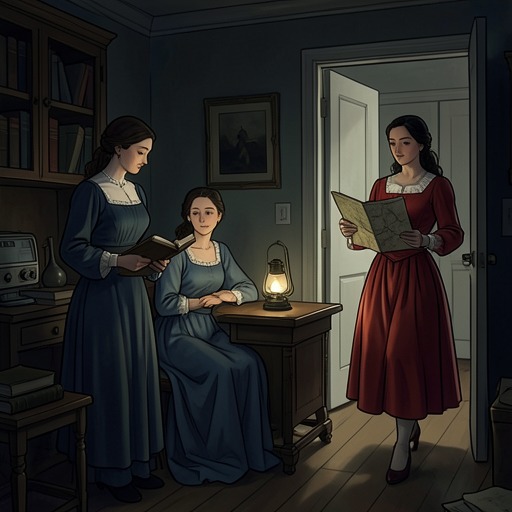
In the novel, the problem is active before the carpenter’s work begins. The nuns have been praying a novena to Saint Joseph, and Bishop Jean Baptiste Lamy describes the staircase as a dilemma for which the sisters look to him for a miracle he cannot provide. Lizzy proposes a more immediate response: a hungry beggar who is a carpenter is staying in the barn, and the chapel needs a staircase. The bishop agrees to have him examine the problem. This practical decision places an ordinary, needy stranger at the center of a question already charged with religious expectation.
The carpenter’s work and disappearance
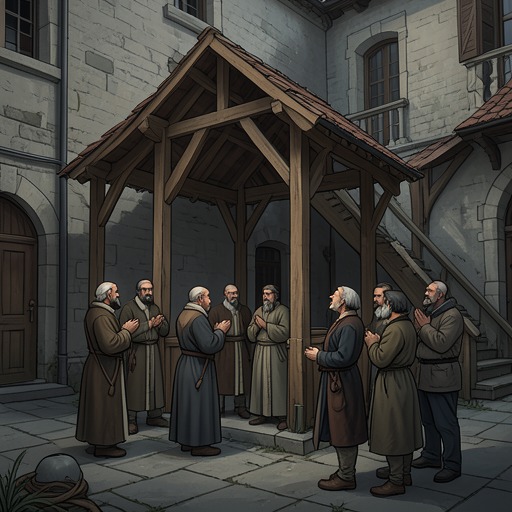
The novel reveals the finished staircase through the startled discovery that the carpenter has gone. Ramona has taken him supper and finds the work completed; the news sends Lizzy running to the church, where the other girls and the nuns have gathered to look up at it. Its appearance is described in precise, material terms: thirty-three carefully trimmed steps rise in a graceful circular arch, their polished wood glowing in candlelight. The staircase makes two complete turns of 360 degrees, and Sister Roberta identifies seven splices on the inside and nine on the outside.
The craftsmanship is impressive, but its apparent lack of support makes it unsettling. The staircase has neither a railing nor visible supports, and Sister Roberta calls the work incredible and impossible to complete so quickly by one man. Mother Magdalena asks whether it will hold. Sister Roberta offers to test it, noting that she is the heaviest person present, but the evidence of the scene establishes the question, not the result of that test. The structure remains at once a beautiful piece of carpentry and an apparent challenge to ordinary expectations.
The carpenter’s absence completes the pattern of the legend. He is not there to explain his method, accept thanks, or claim recognition. In the novel, his departure is discovered along with the completed work, leaving the staircase as the evidence and the missing maker as its mystery. The nuns respond by interpreting the disappearance and the construction together, rather than treating the staircase as an isolated feat.
Belief, skepticism, and the blind cat
Mother Magdalena concludes that the carpenter was Saint Joseph, and the nuns kneel and pray. Lizzy does not join their certainty. Her doubt is rooted in remembered encounters rather than in an abstract rejection of religion: the carpenter spoke with her, listened to her troubles, held her kitten, and advised her about her father. He had also told her that he was sad to leave his own family and had been hurt when the girls rejected him. To Lizzy, the claim that he was a saint sits uneasily beside these intimate, recognizably human details.
That disagreement does not make the carpenter insignificant to Lizzy. The author’s note describes her as wary of supernatural explanations and says that she sees miracles in people, including Bishop Lamy, Sister Roberta, and, eventually, Elinora. It also identifies the possibility that her father will want her as a deeply personal miracle. Against that human understanding, the blind cat offers a small, unresolved opening toward the extraordinary: the author notes that the cat is no longer blind after the carpenter has held her. Lizzy need not accept the nuns’ identification to be left with an occurrence she cannot comfortably dismiss.
The legend therefore supports distinct responses without settling the question for its readers. The nuns interpret the staircase as proof of a saint’s intervention; Lizzy remembers the vulnerable man who built it and refuses their conclusion. Yet her skepticism is not presented as complete certainty that nothing remarkable happened. The carpenter’s kindness, disappearance, astonishing work, and connection to the cat remain in tension, allowing belief and doubt to coexist.
The historical legend and the staircase
The author’s note recounts a version of the local legend in which a beggar-man carpenter arrives with a mule and only three tools: a hammer, a T square, and a saw. Accounts differ about how long he worked: some say two weeks, others several months. The completed staircase is described as making two full circles and having thirty-three steps. The sisters plan a feast in the carpenter’s honor, but he cannot be found. Men at the lumberyard where Bishop Lamy had an account for him say they have never seen him; he never collects his pay and is never seen again. The sisters conclude that the beggar-man was Saint Joseph.
The note also distinguishes the story’s enduring questions from what it reports about the physical staircase. It says that the staircase still stands in the Chapel of Loretto and that a banister was added in 1883. It describes the structure as made with wooden pegs rather than nails, and reports that architectural experts have examined it without accounting for the wood, which they determined was not found anywhere in New Mexico. These details give the legend a material anchor, but they do not, in the author’s presentation, prove the carpenter’s identity. The building can be inspected; the explanation remains contested.
Narrative purpose and open ending
The author identifies the Santa Fe legend as the novel’s springboard, not as a claim that every element of the fictional story is historical. In the note, the specific rejection of the carpenter by the schoolgirls and their hunger strike are identified as inventions for the novel. The staircase legend is thus reshaped into a school story about confinement, rebellion, and the meanings people assign to an event they cannot fully explain. Its religious setting heightens the question, while Lizzy’s outsider’s perspective prevents the nuns’ interpretation from becoming the only available one.
The novel closes this strand without deciding whether Lizzy has met Saint Joseph. The author says that she leaves the convent a better person but not quite believing that she has met the saint, and that the blind cat leaves a small window of belief open. That hesitation is the legend’s narrative resolution: the carpenter’s identity remains uncertain, while the staircase, the cat, and the witnesses’ conflicting convictions preserve the possibility of more than one account.