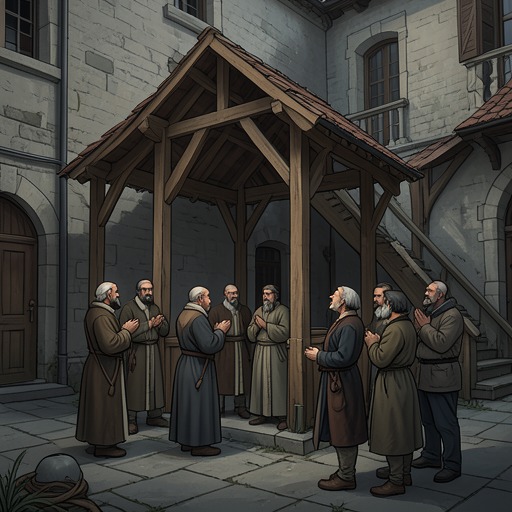
The chapel staircase’s unsupported structure
The StaircaseThe chapel staircase’s unsupported structure is the novel’s strikingly finished route to the choir loft: a polished circular stair with no railing and no visible supports, yet firm enough for Sister Roberta to climb. Its apparent defiance of ordinary construction turns a practical crisis into a dispute about evidence and belief. The stair can be inspected, counted, and tested; what it means remains unsettled.
Appearance and Construction
The staircase is discovered complete in the church, where the girls and nuns gather to look up at it. It rises in a graceful circular arch from the ground to the choir loft, its polished wood glowing in candlelight. The girls count thirty-three steps, each trimmed with care. The finish makes the structure seem not merely usable but exacting: its extraordinary appearance is paired with details of patient workmanship.
The most arresting features are absences. There is no railing, and no visible support seems to hold the stair up. Yet Sister Roberta’s inspection finds a complex arrangement within that spare appearance: the staircase makes two complete turns, with joints spliced at seven places on the inside and nine on the outside. She also observes that the carpenter used wooden pegs rather than nails. The contrast between the stair’s unsupported look and its intricate joinery gives the scene two kinds of evidence at once: it seems impossible at a glance, but it also bears marks of deliberate construction.
The work follows a period of uncertainty over how to reach the choir loft. Bishop Jean Baptiste Lamy has been asked to address the staircase problem and describes it as a dilemma. The nuns have prayed a novena to Saint Joseph, and he has prayed as well, while acknowledging that he cannot perform miracles. When Lizzy Enders tells him that a hungry beggar staying in the barn is a carpenter who needs work, the bishop agrees that the man should examine the stair. The finished structure thus answers a real architectural need, but its sudden completion and unusual form make a straightforward explanation difficult for the characters to accept.
The Test of the Stair
Mother Magdalena asks whether the stair will hold. Sister Roberta, identifying herself as the heaviest person present, volunteers to test it. The others watch as she cautiously places one foot on the bottom step, then another, before climbing all thirty-three steps. Sister Catherine crosses herself; Sister Hilaria silently prays. Their gestures make the test more than a practical inspection: the stair is being approached as a possible danger and a possible wonder.
At the choir loft, Sister Roberta reports that the staircase has not creaked or swayed. The test establishes that the structure is usable under her weight, but it does not explain how its unsupported appearance is achieved. The nuns’ relief is immediate. Mother Magdalena declares that they have a staircase, while Sister Roberta’s attention remains on its construction, especially the wooden pegs. Her examination keeps the scene grounded in physical details even as the others move toward a religious interpretation. The moment ends with a smaller, comic reminder of the stair’s practical reality: from the top, Sister Roberta has to work out how to get back down.
Competing Interpretations
After the inspection, the nuns ask what the carpenter’s work means. Mother Magdalena concludes that Saint Joseph did come after all and that the carpenter was the saint. The group kneels to pray. The unsupported staircase has become, for them, not simply a remarkable piece of craftsmanship but evidence of divine intervention.
Lizzy Enders does not share their certainty. She knows the carpenter as a person who spoke with her, listened to her troubles, held her kitten, and advised her about her father. He had also spoken of the sadness of leaving his own family and of being hurt when the girls did not want him nearby. Lizzy’s knowledge of his human vulnerability conflicts with the nuns’ transformation of him into a saint. Her doubt is not a denial that the stair is extraordinary; it is resistance to treating the work as proof of a supernatural identity. The narration leaves that difference intact rather than resolving it.
The question extends beyond the stair itself. The author’s note identifies the novel as a work based on the Santa Fe legend of a mysterious carpenter who built a staircase for the Chapel of Loretto after its completion in 1878 left the choir loft without a way to reach it. The note also describes the practical alternatives the Sisters of Loretto were reportedly given: a conventional staircase would take too much space, rebuilding the choir loft would be expensive, or a ladder could be used. This context places the novel’s extraordinary stair against a problem of space, cost, and access, without settling the legend’s supernatural claim.
Narrative Significance
The staircase gathers the novel’s tension between observable fact and religious explanation into one object. Its steps can be counted; its turns, splices, and pegs can be examined; its stability can be tested. None of those observations settles who the carpenter was. The nuns interpret the completed stair through prayer and the figure of Saint Joseph, while Lizzy holds to personal knowledge and doubt. The structure supports both readings precisely because it is materially present and yet appears to lack the supports expected of such a construction.
The novel preserves this uncertainty at its close. The author’s note says that Lizzy must remain apart from the general acceptance that the carpenter was Saint Joseph, while retaining a small opening for belief: the blind cat is no longer blind after the carpenter holds her. The note leaves the question of the carpenter’s identity to the reader, just as it remains unsettled whether the builder of the historical staircase was Saint Joseph. The stair’s unsupported form therefore carries more than architectural wonder. It makes visible the gap between what the characters can verify and what they choose to believe.