
The Cosmos as Home
The Stars Have EyesThis flow traces the novel's expanding scale from a tiny apartment to the stars and back again.
increasing Bearing strength in each event
 decreasing
Bearing strength in each eventdecreasingThe Tiny Apartment
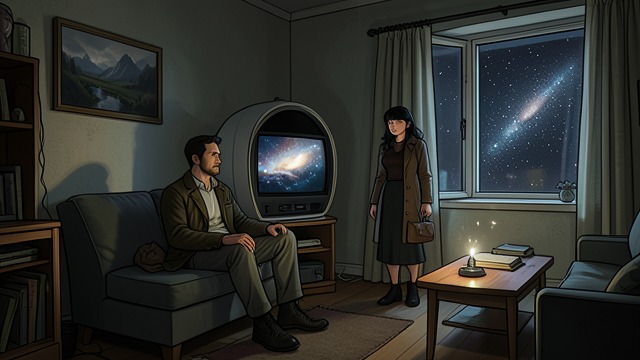
A World Reduced to a Room
Physical Confinement
Joe Mulligan's apartment is scarcely larger than a storage cell and dominated by his pod. Its size reflects a society where physical space is rationed while digital space is abundant.
Emotional Scale
Joe's world is small because his needs are small: food, entertainment, and companionship. The apartment becomes a meaningful home once Maggie shares it.
Expansion Begins
Maggie's arrival makes the room a threshold rather than a prison. Through her perception, even the smallest object becomes connected to cosmic possibility.
Travel Beyond Home

Scale Made Visible
A Larger World
Joe and Maggie travel through orbital stations, freighters, planets, binary stars, and artificial wormholes. The voyage turns the background universe into a direct experience.
Different Reactions
Joe encounters the scale of space through fear, wonder, and gradual acclimation. Maggie experiences it as a long-awaited field of study.
Home Reconsidered
The farther they travel, the more Joe misses Dave-156. The journey proves that home is not simply a location but a network of people, habits, and memories.
Return as Transformation
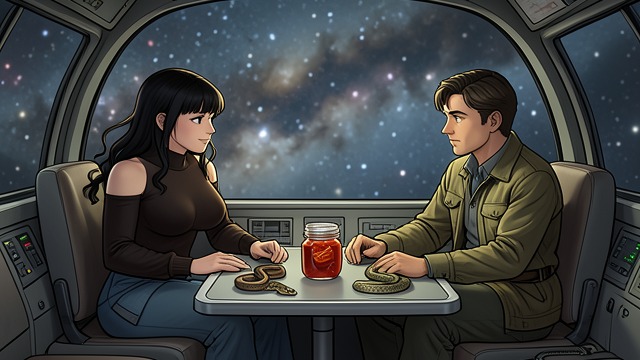
Home Reclaimed
A New Power
Maggie's temporal return and ascension give her command over space and time. She can now cross distances that once required months of travel.
Ordinary Conversation
Despite cosmic advancement, she and Joe spend their reunion discussing jam, imitation food, and a pet snake. The mundane conversation prevents transcendence from erasing intimacy.
The Local and Infinite
The final image is not conquest of the universe but two people talking in a shuttle. Cosmic scale becomes meaningful because it contains a small chosen home.
before Maggie's arrival home
during the Queen Mary cruise
after Maggie's Class-4 ascension
