“How hard could being human possibly be”
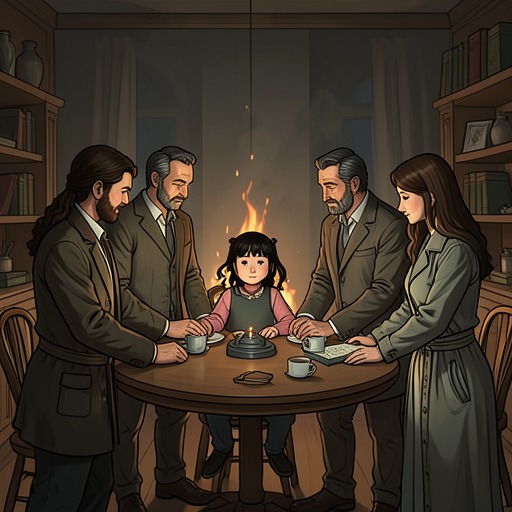
The Stars Have Eyes“How hard could being human possibly be?” is the question that launches Magh'rathlak the Observer’s experiment in limitation. Faced with the maddening immensity of existence, the cosmic entity chooses to compress its reality-warping nature into a single corporeal form and approach the universe from a human scale. The line’s breezy confidence is the hinge between cosmic abstraction and embodied experience: what appears simple to a being from beyond the Veil becomes a chain of complications involving identity, law, military power, family secrets, and the fragile institutions of ordinary society.
Cosmic Perspective and Human Scale
The expression follows an opening meditation on how even the smallest act changes the universe. A person leaving a couch to drink a glass of milk removes one glass of milk from existence, producing an alteration that is tiny but permanent, except in the event of time-travel interference. The point is not that individual action is cosmically large, but that significance depends on perspective. People are advised to focus on the persons and circumstances they can affect rather than despair over events occurring across the galaxy.
Magh'rathlak the Observer exposes the limit of that advice. As an entity from beyond the Veil, it can influence vast stretches of reality merely by existing, yet its power does not grant it a stable sense of proportion. The decision to compress its being into one body is therefore an attempt to narrow its worldview deliberately. The question treats embodiment as a manageable task, but the surrounding setup makes the irony clear: the experiment is undertaken by a creature for whom reality itself is normally the environment, not an obstacle.
The Irony of the Question
The wording is comic because it reduces becoming human to a practical challenge whose difficulty can supposedly be estimated in advance. That confidence is contradicted by the entity’s circumstances. Human existence is not presented merely as possession of a body; it is participation in systems of biology, identification, law, employment, surveillance, family, and institutional authority. The later evidence repeatedly turns the question into a measure of miscalculation.
The human world is itself full of people whose apparent freedom is sharply constrained. Sarah Johanson is a career soldier because the 3rd British Empire gives people with substantial psionic potential the choice between military service and lobotomy. Her implants can remotely fry her brain if she deserts, even though she accepts the work because it is active, lucrative, socially rewarding, and preferable to spending every day attached to a VR pod. Her hated monitor duty, in which she sits in a dark room watching suspects for days or weeks, supplies a particularly mundane contrast to Magh'rathlak’s cosmic scale. The expression’s humor thus rests on a clash between infinite capability and the tedious, coercive routines that define embodied life.
Human Institutions and Exceptional Status
The experiment also places the question against institutions that cannot easily classify what they encounter. When Maggie is arrested, neither her fingerprints nor her DNA matches any planetary database; the DNA shows tampering and mutation consistent with illegal gene modifications. The local officers are so inexperienced and confused that they do not even begin an interrogation during her first thirty minutes in custody. Maggie remains cooperative and plays with her pet while the police attempt to understand the situation.
The resolution reveals how radically the ordinary human framework fails around her. About an hour after the arrest, the police receive orders to release her under military authority and erase the incident from their databases. The command actually comes from the Supernatural Eviction Agency, which wants to prevent the officers from provoking the unusually well-behaved Class-3 cosmic entity. A phrase that sounds like a joke about learning to be human therefore leads into a world where the human state responds to the nonhuman through secrecy, military intervention, and administrative deletion.
Law, Power, and the Cost of Embodiment
The same tension appears in the confrontation managed by Major Gordon Archer. Archer orders Damian Benett to lock down the floor, prevent interruptions, inform local law enforcement that the situation is under control, and clear the area. The language is procedural, but the circumstances involve an injured man and a girl whose nature exceeds ordinary policing. Human institutions preserve order by isolating the scene and asserting jurisdiction, even when their authority is functioning around a cosmic anomaly.
Maggie later turns legal vulnerability into legal protection. At the copyright trial, when defeat appears imminent, she presents a second thumb drive bearing the digital seal of Her Immortal Majesty’s armed forces. The judge discovers that she is a diplomat and realizes that her British citizenship grants protection from civil lawsuits. The copyright dispute is therefore dismissed as a matter that cannot proceed against her diplomatic status, although criminal prosecution would remain possible for a felony. The moment is a sharp reversal: the same character who could not be identified by fingerprints or DNA is suddenly overidentified by a state credential powerful enough to end a courtroom battle. Becoming human means entering law, but the story insists that access to law is radically unequal and can depend on military or diplomatic exception.
Family Secrecy and the Question’s Afterlife
The question’s implications extend beyond cosmic identity and public institutions into private knowledge. When Joe Mulligan presses Margaret Mulligan to explain the truth about his father, she abandons the family’s earlier story. Barry Mulligan did not remain in deep-space mining by choice. He had intended to quit when Joe was born, but a major accident injured many people, cost millions of poundingtons, and led to Barry’s conviction on fifteen counts of gross negligence. He was sentenced to thirty years of hard labor, which explains why he was not sending money home.
This revelation reinforces the expression’s central irony. Human life is difficult not only because the body is limited, but because people are embedded in consequences they did not choose and truths that others conceal. Cosmic compression cannot simplify causality; it merely relocates it into arrests, military orders, courtroom reversals, and family pain. The question begins as a confident challenge to the difficulty of humanity, but the surrounding narrative answers indirectly: the difficulty lies in being subject to histories, institutions, and relationships that remain consequential long after the original action.
Narrative and Thematic Significance
As a recurring conceptual marker, “How hard could being human possibly be?” establishes the book’s comic-existential tension. It pairs a vast universe that changes through every minor act with a protagonist who deliberately narrows an almost limitless existence into one vulnerable form. The line is not a declaration that humanity is easy so much as a dramatic example of the danger of assuming that a different mode of being can be mastered through power alone.
Its force comes from the gap between the speaker’s scale and the world’s resistance. Milk, monitor duty, police databases, brain implants, military lockdowns, diplomatic thumb drives, and a father’s prison sentence all belong to radically different registers, yet each demonstrates that reality is shaped by concrete constraints. The expression therefore functions as both premise and ironic challenge. It asks whether humanity can be treated as an experiment; the events that follow show that embodiment is less a technical transformation than an exposure to consequence.