Azgod'Kalar the Calm
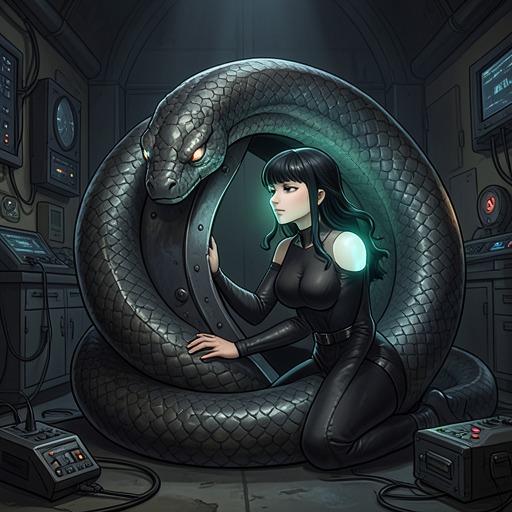
The Stars Have EyesAzgod'Kalar the Calm is Maggie’s small orb python, acquired as a pet after she helped Mr. Charles attract customers to Lyfe Haxx. Though initially treated as an insignificant specimen and even selected for a dangerous fear experiment, the serpent becomes a recurring companion whose presence exposes the distance between Maggie’s cosmic logic and emerging emotional life. Its survival, curiosity, training, and perpetual youth turn it into both a domestic creature and a living record of Maggie’s developing capacity for attachment.
Acquisition and Appearance
Azgod'Kalar was one of eight animals offered at Lyfe Haxx: the store’s selection also included a rabbit, a miniature giant space hamster, a hedgehog, a gecko, a tarantula, a parrot, and a budgie. Maggie calculated that the store’s range gave 96% of humans a potentially appealing companion and judged the hamster cutest by scientific standards. Her personal preference nevertheless settled on the small snake, whose gold-and-brown scales she found more precious than the objectively cuter alternatives.
Maggie obtained the serpent through a business exchange with Mr. Charles. He offered one of his pets as recompense if she helped lift his struggling store off the ground, a phrase Maggie initially nearly interpreted literally. She instead monitored subconscious desires and approached people whose wants could be met by the store’s merchandise. More than seventy potential customers arrived within two hours, at least half making purchases, and the store received the boost its owner wanted. Maggie rejected Mr. Charles’s offer of full-time employment, accepted the snake, and returned triumphantly to Joe’s place.
The animal was small enough to rest in Maggie’s open palm, roughly the length from Joe’s elbow to wrist and about as thick as his thumb. A glass terrarium and a large bag of food pellets were already waiting beside the pod, evidence that Maggie had supplied its basic needs before presenting it to Joe. She named it Azgod'Kalar the Calm, while acknowledging that the snake could not yet understand the significance of the name. When the animal preferred resting on her flesh to returning to its terrarium, Maggie treated that preference as a reason to let it remain with her.
The Fear Experiment and Its Reversal
At first, Azgod'Kalar represented almost nothing to Maggie beyond a convenient test subject. While investigating the fear of losing another being, she rejected the shoggoth-infested pod because its destruction would cause her little more than disappointment over wasted effort. The serpent seemed equally unsuitable in moral and practical terms: it was innocent, insignificant, and of negligible use, and Maggie believed she would not have considered it at all without an arbitrary whim.
Maggie therefore chose the snake for an experiment intended to provoke fear of loss. She carried it to floor 190 of a hyper-scraper, opened a person-sized passage through shatterproof glass by bending its molecules, and walked up the outside of the building to a rooftop. From roughly 270 meters above the highest roadway, she held the thirty-gram serpent over the edge. Azgod'Kalar desperately coiled around her fingers, but Maggie judged its fall necessary and dropped it.
The descent was expected to end in death within seven seconds. Maggie tracked the snake with perfect accuracy, watched the wind toss it through the air, and remained outwardly unmoved while rationalizing its death as a useful contribution to her personal growth. The reversal came when she exceeded the speed of sound, reached the roadway with an impossibly soft landing, and found Azgod'Kalar squirming alive inside her cupped hands. Her stone-faced composure had broken: her eyes were wide, her mouth hung open, she hyperventilated, and her heart pounded as a bead of cold sweat ran down her forehead. The experiment thus revealed that the supposedly negligible creature had acquired emotional value, even before Maggie could fully describe that value to herself.
Companion, Student, and Traveling Presence
After the experiment, Azgod'Kalar became a visible focus of Maggie’s attachment. It climbed her arm to sit on her shoulder and investigated her long black hair, whose twisting locks resembled other serpents. The snake flicked its tongue, tested the hair, and even bit one lock before withdrawing in apparent frustration. Maggie interpreted its curiosity as potentially resembling her own studious nature, allowing the animal’s behavior to become a point of identification rather than merely an observable biological process.
The serpent traveled with Maggie to Dave-157 when she went to see Ryan Foster. It rode inside her left sleeve with its head poking through the shoulder gap, accompanying her first on a flying taxi and then on a supersonic vacuum-tube train. The train’s long chassis reminded Maggie of a gigantic serpent, though she carefully distinguished it from Azgod'Kalar because it was neither alive nor small enough to fit in her hand. During the journey, the surrounding wilderness appeared as a nearly lifeless industrial wasteland, scarred by mobile mining rigs; the absence of animals sharpened the importance of the small creature traveling beside her.
Azgod'Kalar is an orb python, a genetically modified offshoot bred for humanity’s space-faring society. Its kind was made smaller and more docile than larger ball pythons, while retaining some feistiness. The same broad effort, Project BFF, forcibly adapted more than a hundred species to discourage humans from adopting dangerous extraterrestrial life merely because it looked cute. Azgod'Kalar therefore occupies an ambiguous position: it is a living animal, but also a commercial companion species shaped by deliberate human intervention.
Maggie also taught the snake to imitate her gestures. When she raised a thumbs-up, Azgod'Kalar emerged from behind her neck, coiled the end of its tail into a spring-like shape, and raised it in a rough serpentine equivalent of the gesture. Joe recognized the behavior as a trick and was unsettled by what it implied about the animal’s learning capacity. Maggie described the serpent as a studious specimen and offered to demonstrate further tricks, presenting training as both intellectual exchange and shared play.
Relationships and Domestic Meaning
Azgod'Kalar’s relationship with Maggie develops through bodily proximity. It rests on her palm, shoulder, arm, belly, and hair; it coils around her thumb and sleeps close to her skin. When Maggie falls asleep, the snake emerges from beneath the covers, crosses her belly, arm, collarbone, neck, and scalp, then settles into a ball on the highest point of her head. Its movement does not wake her, but it produces an unusual dream in which Maggie surfs through the cosmos on the back of an enormous, top-hatted, monocled, necktie-wearing version of Azgod'Kalar. The serpent thus enters not only Maggie’s physical environment but also her first dream.
Joe Mulligan serves as the second major point of reference in the pet’s life. He examines the tiny creature with bemused wonder, notices the terrarium and food supplies, and wonders whether Maggie can care for it. He later encourages the hope that Azgod'Kalar will grow big and strong under its owner’s care, despite having no sound basis for such confidence. Maggie responds that this is also her hope, and the word comes naturally enough to produce her first smile in a zoo she regards as deceptive.
The serpent’s significance changes decisively in that conversation. Maggie admits, through her behavior rather than a direct confession, that she now looks forward to Azgod'Kalar’s physical and mental development, not solely as an object of study. She understands that the animal will eventually die and that the loss may be painful, yet postpones that future grief in order to enjoy its present company. The creature has become a companion whose value cannot be reduced to usefulness, rarity, or experimental relevance.
Perpetual Youth and Narrative Significance
Azgod'Kalar’s species has had most of its ferocity surgically removed, so the snake will not mature into the dangerous constrictor Joe imagines. Maggie later reveals an even more consequential intervention: she granted Azgod'Kalar perpetual youth. This explains why it remains the size of a hatchling rather than growing as Joe expected, and it transforms the pet from a mortal companion into a deliberately preserved one.
The decision is consistent with Maggie’s powers but not with her earlier indifference. She once argued that the serpent’s brief life could be sacrificed for research because her own existence was vastly longer and more significant. Perpetual youth reverses that hierarchy. Instead of allowing the small animal’s mortality to serve as an experiment or an unavoidable fact, Maggie uses her extraordinary ability to remove the condition that made its loss possible. The intervention does not erase the earlier cruelty; it makes the reversal visible.
Azgod'Kalar therefore functions as a measure of Maggie’s changing ethics. It begins as merchandise selected from a catalog, becomes an experimental victim placed over a rooftop, survives as the object of a genuine emotional shock, and settles into the role of a cherished domestic presence. Its curiosity mirrors Maggie’s own appetite for knowledge, while its dependence tests the limits of her abstract reasoning. Through the snake, the narrative repeatedly contrasts classification with care, engineered companionship with animal subjectivity, and cosmic power with the fragile obligations created by affection. The pet’s perpetual youth is the clearest final sign that Maggie no longer regards its existence as negligible.