Benny Vanson
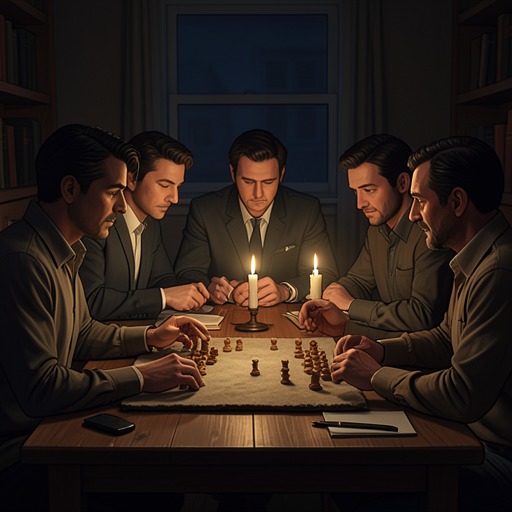
The Stars Have EyesBenny Vanson is one of Joe Mulligan’s closest friends and a recurring embodiment of ordinary sociability in a world increasingly dominated by virtual reality, supernatural danger, and extraordinary people. Bald, casually vulgar, and quick with a joke, he treats friendship as a practical form of stability. His importance lies less in spectacular achievement than in his reliable presence: he attends concerts, plays games, drinks tea, argues about Joe’s romantic life, and helps make impossible circumstances feel temporarily normal.
Identity and Introduction
Benny first appears at a Chronal Impact concert in a virtual arena built over an apparent wasteland beneath flamboyant celestial bodies. Rather than presenting himself through an ordinary human avatar, he arrives as a person-sized bipedal ball of ashen-gray hair, a grotesque and comic form that suits the concert’s crowd of supernatural and extraterrestrial monsters. His greeting with Joe is physical and exuberant even through their digital bodies: the two friends slap palms, repeat the gesture with the backs of their hands, and finish with a fist bump. The elaborate ritual immediately establishes Benny as familiar, tactile, and socially confident.
His exchange with Joe also reveals a shared history of teasing and informal judgment. Benny asks whether Cullen Bigfellow is still coming and remembers that Joe had previously mentioned attending a matchmaking event. When Joe explains that the event was actually a cult ritual, Benny laughs and claims he had predicted something of the sort, while Cullen’s arrival turns the joke into a wager. Benny’s friendship with Joe is therefore not solemn or ceremonious; it is built through banter, recognition, and the assumption that absurdity can be met with laughter.
When Joe introduces Maggie, Benny responds awkwardly but not fearfully to her semi-eldritch appearance. Maggie formally addresses him as Benny Vanson, while Joe asks his friends to call her Mags and describes her as strange in a positive sense. Benny’s uncertain greeting and Cullen’s appreciation of Maggie’s eye-tentacles show that the group can absorb the grotesque into its social vocabulary. Benny does not need Maggie to become ordinary before accepting her into the circle.
Friendship, Virtual Life, and Group Belonging
The Chronal Impact concert becomes a shared social ritual rather than merely a spectacle. Maggie stands apart from the proceedings, attempting to discover a pattern in the deliberately structureless music, while Benny and the others participate in the communal enjoyment. After the two-hour performance, the group gathers at Joe’s place for an after-party. Benny celebrates the concert enthusiastically and joins Joe in wondering why they had ever stopped attending such events. His response frames recreation as something worth recovering, even in a society where virtual entertainment can easily become a substitute for nearly every other form of life.
Benny remains part of Joe’s gaming group in Underwater Yoga Blaster, where the team operates under the name Triple Misfire. In the virtual hanger, Benny adopts a generic fighter-pilot avatar, a practical contrast to Cullen’s elaborate retro-and-space-pirate costume and the commando appearance chosen by Huey. The apparent plainness of his avatar is consistent with Benny’s broader character: he enjoys the performance of virtual identity without needing every appearance to become a declaration of uniqueness.
When Ryan Foster is revealed to have abandoned the team after becoming exhausted by their nonstop training, Benny participates in the uncomfortable discussion about the breach of trust. The friends are disappointed and somewhat guilty rather than furious, and Joe’s relaxed attitude prevents the matter from becoming melodramatic. Benny then accepts Maggie as Ryan’s replacement after Joe announces that she will fill the vacant position. Their silent agreement shows that Benny’s loyalty to Joe includes willingness to adapt when Joe’s unusual personal life enters the group’s activities.
Benny is present for Triple Misfire’s first dramatic victory over Galactic Murder Power. The opposing team’s support vessel is destroyed almost immediately, Maggie’s ship is also lost, and the remaining members of Triple Misfire finish the engagement without difficulty. Galactic Murder Power forfeits after the humiliating defeat, having previously taunted the team over open communications. Benny’s immediate reaction, alongside the others’ praise, transforms the match from a technical contest into a shared triumph. His excitement helps preserve the emotional scale of the victory: the team wins, celebrates, and waits for the next match together.
Worldview and Social Function
Benny’s most revealing statements concern his lack of ambition. He explains that he spends so much time in V-Life because, without Maggie, he would be merely another faceless goon in the crowd, or even less than a cog in a machine. The platform gives him something to do and people with whom to interact; without it, he jokes, he might begin performing strange rituals simply to make life more interesting. His dependence on virtual space is not presented as an isolated eccentricity but as a recognizable response to a post-scarcity society in which work, achievement, and conventional purpose have lost their necessity for many people.
Joe gives Benny’s position a more personal defense when speaking with AJ. Joe explains that he graduated with such poor aptitude-test results that his record labels him unemployable, despite having tried. He accepts that he was not born strong, fast, or intelligent, yet considers a life free from worry and stress a good bargain. Virtual reality, in this account, is not merely an escape from failure; it is an accessible means of social contact and amusement. Benny’s own words support that interpretation. His refusal to measure his life by military service, genius, or public importance gives the friendship group a counterweight to characters whose abilities make them exceptional.
This position also explains why Benny’s humor matters. He does not claim that jokes solve the world’s crises. Instead, he believes that brightening someone’s day is sufficient for him. That modest goal becomes a form of agency rather than simple resignation: Benny chooses a small social contribution and refuses to treat it as worthless merely because it is not heroic. His function in the narrative is consequently both comic and philosophical. He makes visible the value of ordinary companionship in a setting that repeatedly rewards power, knowledge, and supernatural status.
Loyalty, Envy, and the Boundaries of Friendship
Benny’s loyalty does not prevent him from wanting access to Joe’s private life. After AJ and Maggie’s revelation moment reduces tension in Joe’s apartment, Joe invites his best mates over for drinks and the familiar ritual of shouting obscenities at the television. Benny and Cullen arrive with unusual intensity because they want Joe to explain his relationship with Maggie. Benny admits that he and Cullen are envious: they are happy for Joe and Mags, but Joe unexpectedly gained a romantic relationship before they did, and that advantage hurts.
The exchange is affectionate precisely because Benny’s envy is confessed openly and limited by goodwill. He does not wish Joe harm or question the relationship’s legitimacy. He wants details, while also promising not to share them online. His curiosity therefore operates as a form of intimacy. Benny treats Joe’s emotional life as something the friends should be allowed to discuss, but he recognizes that trust requires confidentiality.
Maggie’s fear that another person might eventually replace her in Joe’s affections gives Benny’s role a sharper significance. She describes Joe as gullible, optimistic, and naive because he allowed her into his life and thoughts so easily, and she worries that the same openness could make him vulnerable to someone else. Benny is among the people who have known Joe throughout his ordinary life, and his continuing presence after Maggie’s arrival demonstrates that Joe’s bond with her does not erase his older relationships. The friendship group remains one of the supports that keeps Joe functioning when Maggie is absent.
Later Support and Narrative Significance
Benny’s importance becomes clearest when Joe’s relationship with Maggie enters its most painful phase. After Maggie’s absence, Joe continues to care for her vessel and struggles to maintain a performance of normality. His family and friends help him keep himself together, even as the substitute version of Maggie’s voice becomes less comforting. Benny belongs to the human network that prevents Joe from collapsing entirely into grief and fixation.
He is also part of the ordinary social world Joe attempts to preserve after visiting Barry Mulligan. Joe’s father warns him not to let Maggie become his entire world and urges him to become his own man rather than allowing others to guide him. Benny’s presence in Joe’s wider circle helps make that advice actionable: independence does not require isolation, and taking control of one’s life can coexist with returning to friends for conversation, drinks, games, and laughter.
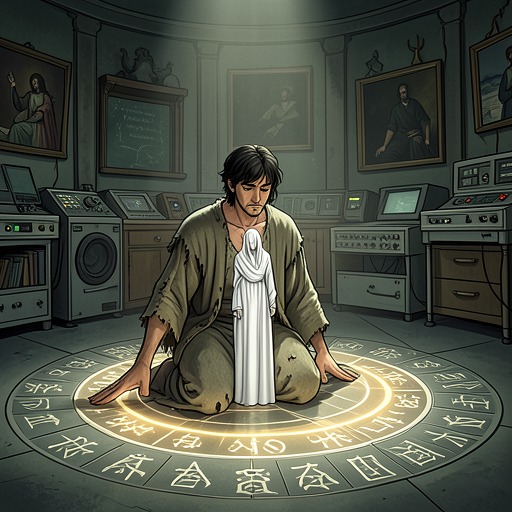
When Joe finally undertakes his desperate plan to summon Maggie back by reviving the Cult of the Gazing Star and reproducing the ritual that originally brought Magh’rathlak the Observer into reality, Benny is among the people who have helped make that plan possible through his long-standing place in Joe’s life. The ceremony involves forty-two robed participants, a planetary alignment, prescribed chants, props, and devices, and Joe recruits desperate or unstable people to fill the ritual’s ranks. Against this vast and dangerous supernatural background, Benny’s significance is almost paradoxical. He is not a ritual expert, military hero, or cosmic entity. He is the friend who keeps showing up, laughs at the right moments, joins the game, celebrates the win, asks difficult personal questions, and helps ensure that Joe remains connected to a human community even when the rest of his life has become extraordinary.
Benny Vanson therefore functions as more than comic relief. His generic avatars, informal speech, envy, loyalty, and acceptance of virtual life express the book’s sustained interest in modest forms of meaning. He cannot restore Maggie, solve Joe’s grief, or control the forces surrounding them, but he can make companionship tangible. In a narrative crowded with beings who possess impossible abilities, Benny’s chosen contribution is simply to keep other people company—and the story treats that as a genuine achievement.